• Solitary Confinement: Moon

    Solitary Confinement: Moon

    Moon is a rare science fiction thriller that doesn’t derive its tension solely from the spectacle of spaceships, robots, or offworld locale. Rather, it’s a psychodrama about paranoia, in the Philip K. Dick tradition of Blade Runner, Minority Report, and A Scanner Darkly (not to mention the countless movies Dick indirectly inspired, such as Dark City, 12 Monkeys, and The Matrix). Moon’s futuristic trappings hide several onion layers of deeper themes: bioethics, torture, labor exploitation, and questioning the nature of the self and one’s perception of reality.

    Director Duncan Jones (aka Zowie Bowie, son of David Bowie), shot Moon on an extraordinarily economical budget of $5 million, achieved largely by restricting production to soundstages and substituting practical miniatures for costly CGI. A beneficial side-effect is a pleasing tactility lacking in most contemporary sci-fi films, where entire characters and environments are now routinely virtual. As a beat-up rover slowly trundles across the uneven lunar surface, kicking up dust, bumping and rattling all the way, it feels real because it is.

    Duncan Jones' Moon
    Our circuit’s dead, there’s something wrong

    As his character’s name Sam Bell implies, Jones conceived the role with Sam Rockwell in mind. Rockwell was great in Confessions of a Dangerous Mind and Matchstick Men, and is great here. He must hold the screen virtually alone for most of the film, and Jones was right to hype him for an Academy Award nomination.

    Sam is a blue-collar miner and the sole occupant of a partially automated base dedicated to strip-mining the dark side of the moon for a compound needed back on earth for clean power. It may sound like technobabble but in fact the science is sound: Helium-3 is a real element believed to be plentiful on the moon and theoretically may someday provide a sustainable source of energy. But in the true sci-fi dystopian tradition, Sam’s employer Lunar Industries turns out to be as insidious as the Weylan-Utani corporation that exploits the Nostromo mining platform crew in Ridley Scott’s Alien.

    Lunar Industries boasts of profitably saving the Earth’s environment by providing clean power on the cheap, made possible by engaging in practices that are arguably immoral but commonly accepted. The exploitation of cloned life is a direct parallel to today’s outsourcing of labor to developing countries with more lax human rights. If one wonders how a future society might be so inured to cloning that they would condone Sam’s servitude, media broadcasts overheard at the end of the film spill the beans: no, they don’t.

    That is, if we’re optimistic and assume what he hear is real – it’s possible they’re the fantasy of a dying man imagining his moral victory. But perhaps it’s like how many in the western world live now; we enjoy affordable consumer electronics and clothing manufactured by workers that literally live inside their factories, and don’t ask why our purchases don’t cost more. Jones told Suicide Girls [update: link no longer available] that Moon is the first part in a projected trilogy, so perhaps we will see prequels or sequels that flesh out a world where human cloning is a fact of life.

    Sam’s madness and physical deterioration is partially explained within the science fiction context as a result of the inherent instability of cloned life. Apparently, like early experiments with animals like Dolly the sheep in 1996, clones are more prone to disease, organ failure, and premature death. Dolly survived about half the normal lifespan for a sheep. Like the “replicants” in Blade Runner, these clones come with built-in expiration dates. But then, don’t we all? While Blade Runner‘s Dekker comes to terms with his true nature through escape, Sam instead chooses to confront.

    Sam Rockwell in Duncan Jones' Moon
    I am obligated to make a lame “Sam I Am” joke somewhere in this review, so here it is.

    Discovering he is merely a commercial product with inbuilt obsolescence is just one of Sam’s problems. His quarters and workspace look like they might have once been as clean and white as 2001: A Space Odyssey‘s Discovery One vessel, or at least the inside of an Apple Store, but have long since become stained and soiled with the filth and grit of the many Sams that came before him. Also like the Discovery One astronauts, Sam periodically receives prerecorded video messages beamed from earth. These asynchronous conversations are not unlike email, and a poor substitute for real human interaction.

    You don’t have to look far for a metaphor: the common practice of solitary confinement is increasingly recognized as a form of torture. The harrowing New Yorker article “Hellhole” by Atul Gawande recounts how a psychologically stable person can go mad in a matter of weeks or even days without human contact. We first meet Sam three years into his tour of duty.

    Sam’s interactions with the base’s computer GERTY (voiced by Kevin Spacey) are likewise reduced to the rudiments of online communication; its “face” is comprised of happy/sad/neutral emoticons. GERTY is a rarity in science fiction: a compassionate example of artificial intelligence. Countless movies (including 2001: A Space Odyssey, The Matrix, Wargames, The Terminator, I Robot, et al.) have trained us to expect artificial intelligences to be inherently evil or, at least, dangerously unstable. But GERTY is more like David (Haley Joel Osment) in A.I.: Artificial Intelligence, Robby the Robot in Forbidden Planet, or Wall-E: an artificial creation that rigidly follows its programming, but whose parameters allow it to exhibit genuine compassion and caring for its charge.

    Kevin Spacey in Duncan Jones' Moon
    GERTY ROTFLMAO

    I loved the movie overall, but was disappointed by the lack of ambiguity in its storytelling. The trailer reveals more than I would have liked to know if I had watched the movie cold, and the movie itself reveals its secrets very early by quickly dropping the word “clone.” Would it have been more interesting had there been hints of a possibility that Sam might be delusional, hallucinating a clone, and was in fact alone the whole time? Maybe I’ve been conditioned by too many Twilight Zone episodes, Fight Club, and M. Night Shyamalan movies, but I anticipated a twist ending that never came.

    I’ve touched on several of Moon‘s more obvious inspirations, but I’m also reminded of Steven Soderbergh’s Solaris remake, in which a clone-like creature murders his original. Cloning is just beginning to enter the zeitgeist, having recently figured into the braindead actioner The Island but also the more contemplative Never Let Me Go, based on the highly regarded novel by Kazuo Ishiguro. Clones may very well prove to be the next zombies or vampires.

  • The Best of Inception Online

    The Best of Inception Online

    To follow up on our recent review of Inception, here’s a collection of the best online coverage I’ve seen elsewhere:

    Devin Faraci’s Never Wake Up: The Meaning and Secret of Inception is the best thing you will read about Inception, an opinion shared by The Awl. “Inception is about making movies, and cinema is the shared dream that truly interests the director.”

    “You have three minutes to make a PowerPoint presentation that will take me three hours to click through.” Christopher Nolan’s Implementation, from The New Yorker, by Gideon Lewis-Kraus. Via Kottke.org.

    The Cobol Job, the official prequel, in comic book form.

    Al Gore, Leonardo DiCaprio’s pal and fellow ecowarrior, gave Inception a rare endorsement on his blog.

    An appropriately Escher-esque infographic by Last Exit To Nowhere. [update: no longer online]

    Which is the best Inception infographic?

    Cinema Blend provides a very handy F.A.Q. [update: no longer online]

    Prepare to have your mind blown all over again by this key musical cue clue discovered by YouTube user camiam321, drawing on hints dropped by composer Hans Zimmer in the L.A. Times:

  • Christopher Nolan’s Fugue State: Inception

    Christopher Nolan’s Fugue State: Inception

    In his 1999 essay Celluloid Vs. Digital, Roger Ebert cites studies equating the experience of watching a movie to entering a fugue state: “film creates reverie, video creates hypnosis.” In other words, experiencing a film in the traditional manner, projected at 24 frames per second in a darkened theater, affects the brain in a way akin to dreaming. Inception is far from the first movie set in dreams, but it may be alone in attempting to encode the experience into the architecture of a film itself. Whether you compare it to onion skins or a puzzlebox, the form follows the content.

    The bar has been set very low by the likes of Avatar, but Inception is finally proof that movies with budgets in the hundreds of millions need not be moronic and disposable. Yes, Inception is a sci-fi action movie full of well-tailored outlaws, guns, fight sequences, and exploding mountain fortresses, but it’s also an intelligent, complex experience for adults. If it took a weak remake and two movies about a vigilante in a rubber bat costume for Nolan to get here, then so be it.

    Joseph Gordon-Levitt in Inception
    “It’s not, strictly speaking, legal.”

    Inception is the natural progression from Following, Memento, and The Prestige, Christopher Nolan’s quartet of wholly original visions. Insomnia, a safe remake of the far more incendiary Norwegian original, now seems like a detour, a paying of dues to enter the mainstream. His pair of Batman franchise entries injected a modicum of psychological realism into the pulp source material, but the grimly ponderous weight of it all was perhaps more than it could bear. For my money, nobody other than Tim Burton has managed to find the right mixture of camp and solemnity that makes up Batman.

    While Inception may have some surface resemblance to numerous heist, caper, long con, action, and science fiction films, it is nevertheless a very welcome New Thing. Its deepest thematic links are probably to cerebral sci-fi meditations Solaris and Until the End of the World. The nightmare planet in Andrei Tarkovsky’s Solaris haunted visitors with imperfect reincarnations of their most emotionally significant others. When a grieving astronaut is reunited with his ersatz wife, long dead of suicide, is it a blessing or a curse?

    Leonardo DiCaprio and Elliot Page in Inception
    “A single idea from the human mind can build cities. An idea can transform the world and rewrite all the rules.”

    Wim Wenders’ Until the End of the World posits a future in which dream-reading technology would be enormously addictive, psychologically damaging, and permanently alter society. If a technology is ever invented for a group of people to not only enter an individual’s dreams but also to construct the dreamworld itself, how plausible it is that society would not be radically transformed? In Inception, Dom Cobb (Leonardo DiCaprio) is a master at corporate espionage. His expertise is with a process normally utilized for the “extraction” of trade secrets, but inverted to inception: to implant an idea, a task which proves to hold massive significance to Cobb. Like a drug, we’re told, these machines gradually seep away users’ ability to dream on his or her own. We glimpse a sort of opium den in which burned-out dream junkies go to re-experience the normality of not only dreaming, but more importantly, waking up from dreams. Wenders’ The End of Violence would similarly look at another dystopian future in which global surveillance is taken to its logical extreme.

    Inception‘s action sequences beg comparison to everything from James Bond, Jason Bourne, and Mission: Impossible. Its creative fight sequences, taking place in virtual arenas in which the laws of time and gravity are fluid, recall The Matrix. But the true narrative and structural template is much more along the lines of long-con tale much loved by David Mamet (particularly Homicide and Redbelt) and heist films Rififi, Thief, and Heat, in which a crack team of criminal experts work with a psychologically damaged leader on a high-stakes One Last Job.

    The bloodless massacre of hordes of armed thugs seems designed to resemble video games. The obliquely portrayed violence is partly explained by a PG-13 rating that hypocritically permits dozens of onscreen shootings, but disallows blood, and thus any sense of the repercussions and ramifications of violence. But in the world of the film, the thugs are explained to be manifestations of the subconscious. A slight-of-hand morality magic trick that makes it OK for our heroes to mow them down with machine guns and grenades (again, this flashes back to The Matrix, in which the good guys rationalize away their mass killing of virtual avatars).

    Marion Cotillard in Inception
    “You mustn’t be afraid to dream a little bigger, darling.”

    Inception had already developed a reputation as a mind-bender even before release, but I found it to be surprisingly straightforward if you pay a little bit of attention. If you choose to take the film at face value, pretty much everything you need to know is spelled out for you, often in frankly literal exposition (usually in exchanges with Page’s inquisitive character). The key ambiguity is a simple but profound question raised in its final moments. Interpreted one way, the film neatly wraps itself up in an airtight box (which is extraordinary in and of itself, when most big-budget movies often fail to make logical sense). Interpreted another way, it calls into question everything you’ve seen.

    This moment hinges on Cobb’s totem, a personal item that each dream-traveller must rely upon to detect whether or not they are awake. Both Cobb and Arthur (Joseph Gordon-Levitt) warn Ariadne (Page) to never allow anyone else to touch hers. But Cobb also freely admits that his totem first belonged to his wife Mol (Marion Cotillard). Complicating matters, unless I missed something, we never see her with it outside of the dream world. The top had symbolic meaning to Mol, for she locked it up in a metaphorical safe in her dreams. Cobb then uses it to plant the notion in her head that the dream world is not real, in order to encourage her to break her addiction and wake up with him. If the top was real, would she not be able to test herself with it when she woke up?

    One further clue that suggests much of what we saw may be Cobb’s dream: if he and Mol lived the equivalent of 50 years in Limbo, several levels deep into their subconscious, why do they seem to only wake up through one level of dreaming? Is Cobb still trapped a few levels down?

    Elliot Page in Inception
    “Dreams feel real while we’re in them. It’s only when we wake up that we realize something was actually strange.”

    And one wonders about the implausible dream technology itself. It’s offhandedly said to have been developed by the military for training purposes, but very little time is spent on the mechanics of the technology. Some sort of IV is involved in the process of linking people together, but how exactly does an Architect create and realize the world? We see Ariadne fiddle with papier-mache models, and verbally describe the world to the participants, but we’re also told that the architect need not necessarily enter the dream personally, so it’s not her mental map that makes things possible. If the agents are able to conjure things on the fly (Eames produces a grenade launcher out of thin air, and Ariadne folds a city in half), why do they not take more advantage of their effectively unlimited abilities during the heist? Cobb makes a big deal out of a prospective architect being able to devise labyrinths, something like a video game level designer. But Ariadne’s work is literally short-circuited and we never see a dramatic payoff to the theme of mazes.

    Ray Bradbury once said that he was not concerned with the mechanics of interstellar travel; if a story he wished to tell required a rocket ship to ferry characters to another world, that was good enough for him. So is it pedestrian of me to wonder about these practicalities, or do these questions actually matter a great deal? Is the lack of specificity about how this miraculous technology actually works a clue? I believe it is linked to the troubling ambiguity of Cobb’s desire to “go home.” Does he simply want to clear his name so he can re-enter his home country, or does he want to plunge deeper into his fantasy? Is he actually guilty of a crime like Roman Polanski, or merely obsessed with indirect culpability like Kelvin in Solaris or Teddy in Shutter Island? Either way, he may have the opportunity to construct a false reality in which he can absolve himself.

    I believe Inception is one for the ages, and not just because it has been endorsed by Al Gore. Like 2001: A Space Odyssey and Blade Runner, it’s the rare science fiction film likely to remain well-regarded for years.

    Random Observations:

    • How many heist movies have you seen in which the master thief attempts the mythical One Last Job before retiring?
    • Despite Leonardo DiCaprio sporting Nolan’s own haircut, Inception might suffer in comparison to his somewhat similar character in his most recent film, Shutter Island. Two thrillers in a row about a man wracked with guilt over his dead spouse.
    • Wikipedia puts the budget at $160 million, plus a $100 million publicity campaign. As usual, these numbers make my head spin. But at least this time the result is a strong movie.
    • Like Paul Thomas Anderson, Nolan has developed his own personal actors’ troupe. Inception features return appearances by Michael Caine, Ken Watanabe, Cillian Murphy.
  • The Mutant Menagerie: X2: X-Men United

    The Mutant Menagerie: X2: X-Men United

    In retrospect, the first X-Men movie did an incredible job of managing the introduction of a wide array of characters to mass audiences likely unfamiliar with the decades’ worth of continuity established in its comic book source material.

    But the sequel X2: X-Men United crowds the stage with too many new faces in addition to the returning original cast, in addition to having a truly annoying complicated title. In short order, audiences not only have to recollect the original characters but also learn how Stryker (Brian Cox), Iceman (Shawn Ashmore), Pyro (Aaron Stanford), and Lady Deathstrike (Kelly Hu) fit in to the mutant menagerie. X2 also expands the ranks of the Blue Man Mutant Group, with Nightcrawler (Alan Cumming) joining Mystique (Rebecca Romijn-Stamos) in head-to-toe body paint, later to be accompanied by Beast (Kelsey Grammar) in Brett Ratner’s risible X-Men 3: The Last Stand.

    Alan Cumming in X2: X-Men United
    Nightcrawler auditions for a spot in the Blue Men Mutant Group

    Holocaust survivor Magneto (Ian McKellen) is still just as genocidal as his former Nazi oppressors, an irony he fails to perceive despite it being pointed out to him repeatedly. His aims and obsessions make for a very good villain, but also for a virtual repeat of the previous movie’s plot. In the original, Magneto built a device to forcibly mutate homo sapiens into homo superior, the arising species known as “mutants” to which both The X-Men and his Brotherhood of Evil Mutants belong. The weapon turned out to be faulty and instead simply killed every human within range. To a man like Magneto, said glitch was not a bug but a feature.

    Nothing if not persistent, he employs basically the same scheme in X2. New baddie Stryker has reverse-engineered Professor X’s mutant-detection device Cerebro into a weapon capable of killing all mutants en masse. Magneto plots to repurpose it to kill all humans instead.

    Kelly Hu in X2: X-Men United
    Kelly Hu as Lady Deathstrike, something of a deep cut from Marvel Comics lore.

    Also recycled from the previous movie is the fact that Magneto is again not the movie’s true villain, despite long holding the rank of the X-Men’s official chief nemesis. The real antagonist last time around was intolerant politician Senator Robert Kelly (Bruce Davison). Now the foe is another powerless human, Colonel Stryker, a warmonger with a private army. Like Kelly, he’s a fervent speciesist, so enflamed with passionate hatred of mutants that he transforms his own mutant son Jason (Michael Reid McKay) into a component in his genocidal weapon.

    One notable tweak to the original recipe is a heavier dose of violence and killing perpetrated by the fan-favorite Wolverine (Hugh Jackman). As a character, Wolverine is capable of both berserker rage and human empathy, but his movie incarnation seems to be able to turn it on and off at will. Coupled with a PG-13 rating dictating that his slaughter remain bloodless, this negates one of the tragic flaws of the character I recall from reading the comics as a kid.

    Hugh Jackman and Anna Paquin in X2: X-Men United
    Wolverine babysits The New Mutants

    The Wolverine I remember constantly struggled to keep his animalistic side in check in order to live among his friends, lovers, and allies. The movie Wolverine is a little bit of a softy, actually, spending much of film babysitting mopey teen trio Iceman, Pyro, and Rogue, the latter still harboring an unrequited crush on a dude way too old, hairy, and Canadian for her.

    X2‘s biggest problem is that it has no sense of humor, allowing the grimness of the scenario to drain most of the fun out of the experience. The original had only a single credited screenwriter, David Hayter, but the sequel teams him with Michael Dougherty and Dan Harris — hinting that the crowded stage of actors was paralleled by a few too many cooks in the kitchen backstage.

    One good scene, at least, provides a reminder of what the first film got right: when the teen Iceman reveals his superpowers to his parents for the first time, his mother asks “Have you ever tried to… (awkward pause) not be a mutant?” It’s an excellent scene that uses humor to employ the sci-fi conceit of the mutant experience as a metaphor for a minority’s troubled coming of age.

  • Cool Like Dickens: Lost in The Matrix

    Cool Like Dickens: Lost in The Matrix

    Now that the Lost fiasco finale has come and gone, and my blood pressure has dipped back down into safe levels, I am going to attempt to speak calmly about how the show let me down. Yes, I am aware that it is just a TV program, and there are a great many other things in the world worth being upset over (I’m looking at you, British Petroleum). But following a weekly TV show from the very beginning, for six years, earns you a little more than the often derogatory sobriquet “fan”. We aficionados are not owed anything by anybody, but nevertheless, our investment of time and enthusiasm created an imbalance that was not satisfied in the end.

    Henry Ian Cusick in Lost
    Neo Desmond enters Deus Ex Machina The Source

    As my frustration at being cheated subsides, another problematic pop cultural touchstone came to mind. Certain parallels between Lost and the Matrix trilogy now seem obvious, and it’s not just that both hinge on a mysterious, glowing, ill-defined “Source.”

    1. Start out strong with a very science fiction-y, mostly plot-driven narrative. The characters are marginally interesting, but the focus is on scenario and story. Viewers’ imaginations are teased, speculation abounds, and sequels are demanded.
    2. Follow up with a sequel that reveals a loose framework of philosophy supporting the science fiction conceit. Whether it genuinely inspired the original work or was bolted on after the fact is open to debate. Simultaneously amp up the soap-opera cheesiness concerning flat characters that fans aren’t really invested in. (For what it’s worth, I contend that The Matrix Reloaded – the second in the trilogy – is not only underrated, but in fact the best of the series, despite the nearly universal opinion that both sequels were failures)
    3. Contrive a violent, action-packed ending that A) strains to fit around the philosophical core (kinda sorta maybe) and B) focuses on character melodrama (tragic deaths, romantic pining, etc.). Myriad story issues are neglected and treated as merely peripheral to the creators’ primary concerns.

    In short, the creative duos behind Lost and The Matrix mistakenly assumed fans were more interested in the philosophical angle and thin characters than in the narrative. And maybe, just maybe, some of us wondered why we couldn’t have it both ways: a cracking good story with a strong subtext of mysticism and philosophy.

    As every high school creative writing teacher must explain to students that keep turning in thinly veiled retellings of Bible stories: just because an allegory fits (kinda sorta maybe), it doesn’t necessarily mean there’s any additional meaning to be construed. For The Wachowskis, it was Jean Baudrillard’s Simulacra and Simulation. For Carlton Cuse and Damon Lindelof, it was John Locke, David Hume, Jean-Jacques Rousseau, etc. (to be fair, they also leaned heavily on writers outside the realm of philosophy, including everyone from George Lucas to Stephen Hawking).

    Keanu Reeves in The Matrix
    Desmond Neo enters The Source Deus Ex Machina

    If, in the end, Cuse and Lindelof neglected their storytelling responsibilities, they had already neatly set up two excuses for themselves to fall back upon:

    1. That Lost‘s appeal was really the characters, and fans ought to be pleased that they all lived happily ever after, after a fashion.
    2. That Lost is really an allegory for a melange of works of philosophy, and that if you don’t get it, you’re a right-brainer too hung up on Star Trek-esque hard sci-fi to have your mind expanded, dude.

    I don’t think I would be so upset if Cuse and Linedlof weren’t so outrageously full of themselves and self-congratulatory in interviews (The Wachowskis are probably right to refrain from publicity). At least Lindelof seemed conscious of how their work might be received. He told Wired Magazine:

    Locke is now the voice of a very large subset of the audience who believes that when Lost is all said and done, we will have wasted six years of our lives, that we were making it up as we went along, and that there’s really no purpose. And Jack is now saying, “the only thing I have left to cling to is that there’s got to be something really cool that’s going to happen, because I have really, really fucking suffered.”

    Damon Lindelof

    Maybe Jack and Locke were both right; the show now appears to have been a headlong hurdle into a faux-mystical conundrum, leaving behind countless abandoned plot threads as so much narrative shrapnel. There is no shortage of blog posts clogging the internet with lists of unresolved mysteries (including my own). Cuse dug himself in deeper, in conversation with The New York Times:

    our goal is when we’re breaking stories, how are we going to really make each one of these commercial breaks really exciting. Those questions led to a lot of really intense scenes and cool reversals and surprises, and I guess it must have been how Dickens would cliffhanger the end of his serials in the newspaper when he was writing them to try to get people to show up the next day.

    Carlton Cuse

    Cool like Dickens, eh? Wait, it gets better. In the recap special “The Final Journey” that preceded the final episode “The End,” they actually had the nerve to call their series “Shakespearean,” which I think automatically disqualifies them from being taken seriously.

    As for The Matrix, I think it’s telling that there’s literally a character in the third film named “Deus Ex Machina.”


    Must read: Philosophy in Lost

    Must read: The Matrix Explained [update: no longer available]

  • Lost: The End

    Lost: The End

    I’ve always been a Lost apologist, at least liking the show even during its weak points. Six years of goodwill very nearly went out the window along with my television, thanks to its extremely frustrating final run of episodes. Close to the end, I attempted to resolve myself to the likely event that the finale would not answer every little niggling mystery. I hoped to shield myself from disappointment, and let the creators finish the story how they wished. Yet “The End” still failed to tell a simple story. A story is not a string of dei ex machina, and every character arc need not end with a sudden, brutal, arbitrary death.

    Carlton Cuse told Wired Magazine:

    The great mysteries of life fundamentally can’t be addressed. We just have to tell a good story and let the chips fall where they may. We don’t know whether the resolution between the two timelines is going to make people say, “Oh, that’s cool” or “Oh, fuck those guys, they belly-flopped at the end.”

    Carlton Cuse

    The latter, pretty much. What follows is just a taste of my catalogue of complaints, with no concern for spoilers.

    Spinning (Donkey) Wheels

    For a show built atop a perpetually compounding series of mysteries and conundrums, it failed to legitimately advance or resolve much of anything in the run-up to the polarizing finale. With so little time left, the penultimate episodes wasted time spinning wheels in classic Lost fashion. People getting locked in cages, escaping, getting locked up again. Groups splitting up, hiking to opposite ends of the island(s), splitting up into different groups and hiking back. Boarding watercraft and disembarking again. Meanwhile, the sheer number of abandoned mysteries filled its own wiki. As usual, CollegeHumor said it best:

    Boom!

    From the very beginning, one of Lost‘s favorite conceits was the sudden death of characters. To be generous, death is rarely “meaningful” in real life, but these plot twists also laid bare the practicalities of serial television (actors quit, get fired, or age unconvincingly). After the tenth or twentieth fatality, I became sick of characters getting suddenly and arbitrarily killed off for cheap shock.

    Past victims included Eko, Libby, and Danielle, all violently exiting the show before their storylines reached any kind of resolution. In the final episodes, it happened to Ilyana, Widmore, Zoe, and (it seemed at first) Frank and Richard. We saw just enough of Zoe that I assumed she must be significant as something more than just cannon fodder, but apparently not. Sayid’s season-long arc (was he mystically reincarnated as a soulless killing machine, or was he merely convinced that he was essentially evil?) is short-circuited by his abrupt choice of self-sacrifice. How did he defeat his mystical brainwashing? Killing off a character isn’t any kind of a resolution to a storyline.

    A positive example from the show’s past would be Charlie, a character whose death figured into the mythology in a big way. It had ramifications, as opposed to: BOOM! Look, somebody just suddenly blew themselves up with dynamite, isn’t that HILARIOUS? Aren’t you SHOCKED? No? Well, let’s kill another character the same way!

    I was never so sentimental for Lost that I felt the need for every character to live happily ever after. But didn’t these creations deserve a little better?

    Across the Sea

    Little of the mythology Jacob finally revealed in the episode “Across the Sea” made any sense, and often directly contradicted my memories of what went before. He tells Kate he scratched her off the list because she became a mother, but the job could still be hers if she wanted it. Does that mean his list is arbitrary? It doesn’t matter which of these last few surviving candidates will do it? And, for whatever reason Jacob disqualifies moms, is it related to why all women on the island die? Were all the other mothers also candidates, for whom disqualification means death? If so, why didn’t he kill Kate? Because she assumed custody of Claire’s baby rather than having her own biological child, I suppose. But if the audience is asked to make too many strained suppositions like this, based on little evidence in the text of the show, we’ll begin to wonder if the writers have any idea themselves.

    In the earlier episode “Ab Aeterno”, Jacob told the Man in Black that he brings people to the island to prove a point to him about humanity. But now he tells Jack & co. that he simply wants to find a replacement. Which is it? Both?

    Jacob’s list of several hundred names eventually narrowed to a mere handful of survivors. Did he know he had to rule them all out until he got to the last name? And that the Man in Black would happen to be very near escape at that point in time? If so, why didn’t he just scratch all but one name off the list? And now that Jack has volunteered, does that mean that the other few have to die?

    Narrative Cheating

    It’s cheap to resolve a plot thread by introducing a totally new element, like the adoptive mother of Jacob & The Man in Black (an unnamed character played by Allison Janney). Imagine a murder mystery, in which the murderer turns out to be… oh this guy right here, whom you’ve never seen before now. The answer to the mystery of Jacob and The Man in Black needed to already be there, in the form of shuffled puzzle pieces the audience hasn’t seen the solution to yet. Not in a single-episode guest star.

    Allison Janney in Lost

    Which brings me to the glowing cave. If it’s really the key motivating force for Jacob and The Man in Black, it’s the ultimate MacGuffin of the entire series. To not even so much as mention it until near the very end of a six-year long series is cheating to say the least.

    Let me go back even further: I’m irritated altogether by the injection of Jacob and the Man in Black into the story. I know that the Man in Black technically appeared in the very first episode (as the sound effect we would later associate with the Smoke Monster), and we’ve been hearing the name Jacob for a few years now. But it does not feel organic at all that the core mystery of the show came down to a mystical struggle between two characters that have barely featured on the show at all. It should be about the characters already on the stage from the very beginning, not two cyphers introduced so late in the game.

    And the final, capping atrocity that would get any kid kicked out of high school creative writing class is, of course, the revelation that the final season’s mysterious “sideways timeline” was actually a kind of Limbo or Purgatory. That this is wildly unsatisfactory (the only thing worse could have been an ending in which it is revealed to be someone’s dream, a la St. Elsewhere or Newhart) is overshadowed by the true crime: it’s explained via exposition by a minor character we hadn’t seen for months (Jack’s father Christian). Exposition! “Show don’t tell” is a cliched rule, and rules ought to be broken, but this case of telling not showing is evidence of contempt for the audience.

    Compare and contrast with the truly mind-blowing conclusion to 2001: A Space Odyssey. Its wordlessness is a sublime virtue, and its mysteries linger to provoke discussion and fascination decades later.

    Ben: A Complicated Guy, or Lazy Writing?

    I’m puzzled by Ben’s apparent boomerang switcheroo from defeated and sort-of redeemed, to pure evil, and then back again. We’re left to suppose he realized something in the penultimate episode that the audience just didn’t know yet. We naturally expect to share his realization in the final episode, but there doesn’t seem to be anything there to find. After the Man in Black is defeated, he’s not only forgiven for his crimes (remember, he is a mass murderer), but given a leadership role on the island. And, he gets to stay behind in Limbo and shag Rousseau (Mira Furlan, who, incidentally, cleans up good, am I right?).

    It bugs me that I had to repeatedly ask this question at each plot turn: was it lazy writing, or part of the mystery?

    The Desmond Zap

    I’m very confused about how much the sideways characters remember about their alternate timelines on the island after Desmond zaps them. Locke and Ben only seem to get a vague sense of deja vu, but Hurley seems to have complete recall (for instance, he seems to know exactly who Ana Lucia is). By the finale, characters need only touch each other for complete memories to come flooding back. So why didn’t Jack & Juliet spark each other’s memories during all the years were married, and not to put to fine a point on it, had sex and conceived a son? Again, part of the mystery, or sloppy writing?

    Lost: The End

    Citing Sources

    Some of the above is derived from a morning-after rant I shared with guest blogger Snarkbait.


    Must read: Jason Kottke’s Lost finale roundup

  • Life by Remote Control: Surrogates

    Life by Remote Control: Surrogates

    Surrogates is an elegantly literal twist on the classic sci-fi theme of living through avatars. Cyberpunk writers William Gibson and Neal Stephenson pioneered virtual reality as a setting for the dramatic exaggeration of issues first sparked by the very beginnings of internet chat rooms. Their predictions have already come true, in part, in the form of social networking and immersive games like Second Life and World of Warcraft.

    Surrogates takes this conceit one step further, but fails to address moss of the questions it raises. To look deeper than I think the film supports, you might start to think about the personas we craft for ourselves in different contexts, how we dress and behave in the privacy of our homes versus how we do at work or play.

    Rosamund Pike in Surrogates
    Rosamund Pike in Surrogates

    Directed by Jonathan Mostow (of the excellent nail-biter Breakdown, but also the dud Terminator 3: Rise of the Machines), the film is based on the comic book The Surrogates by Robert Venditti and Brett Weldele. The premise requires a long, involved prologue necessary just to set the stage. This very near future is defined by the technology for remote-controlled androids, which are not unlike cars: affordable enough for the majority of the population to own one, available in tiered models that reflect your income and taste, and a way of life ingrained into society just as much as cars have shaped cities and the highways that network them together.

    Taken to its logical extreme, a world populated by remote controlled robots affects everything from the workplace to warfare. Beauty parlors have morphed into something like hi-tech auto repair shops, where people trick their surrogates out with new rubber faces and super-strong limbs. Patriot Act-like mass surveillance is conducted through the robots’ very eyes, without their owners’ permission, in an impossible-to-miss metaphor for Bush-era warrantless wiretaps. War is now a deathless abstract resembling a computer game: faceless drones teem distant battlegrounds in a sick parody of today’s airborne predator drones and precision-guided missiles. Notice also the spotless art direction: everything is clean because robots don’t secrete or litter.

    When so much of the fictional ramifications are thought out, it’s disappointing when so many other obvious implications are left unclear. We’re told the crime rate has fallen dramatically since most people started living through robot surrogates, but why, necessarily? Perhaps because there’s no such thing as raping or murdering a robot. But why do FBI agents have such luxurious homes, if their jobs are less necessary in this utopia?

    Radha Mitchell and Bruce Willis in Surrogates
    Radha Mitchell and Bruce Willis in Surrogates

    One interesting wrinkle barely touched upon is that some characters, including Greer (Bruce Willis) and his wife Maggie (Rosamund Pike), have selected surrogates modeled on their own natural physical appearances. Idealized, younger, stronger, and more virile, perhaps, but recognizably their likenesses. There are only a few examples of users that opt to mix race and/or genders, let alone go to further extremes. The most outwardly unusual looking surrogates we see merely have impossible complexions. Perhaps the Greers are not fully committed to living this way. Why not explore this point more? A failure of the imagination.

    But by far the biggest absurdity is the claim that 98% of the population lives through surrogates. The film would have been better off by sidestepping the question of whether or not much of the population could afford state-of-the-art consumer electronics. If only a portion of the population in 2010 has access to things like health care and broadband, it’s certainly absurd to pretend for even a silly sci-fi movie that we all might some day be able to afford personal robots. But then again, there are hundreds of millions of cars in use worldwide today, so perhaps it is not that outrageous to hypothesize that someday we all might be remotely piloting some kind of robot around all day every day.

    Surrogates

    While many other people, choose to live life through their surrogates, FBI agents are given turbocharged loaner models in some kind of perk akin to company cars. Greer behaves differently as himself or when working through his surrogate. He spouts tough, sarcastic, noir-ish detective dialogue when working, but turns meek and emotional when living as a “meatball.”

    Ving Rhames and James Cromwell appear in disappointingly fleeting roles. Rosamund Pike is obviously very beautiful, but her wide circular glassy eyes frankly look slightly odd from certain angles, making her an excellent casting choice.

    There are fewer android-related special effects than you might imagine, especially when compared to Westworld, The Stepford Wives, Alien, and A.I. Artificial Intelligence, all of which revel in revealing robotic guts beneath rubber skin (images one might even fetishize as a literal “cyberporn”). Rather, the film’s best special effect is when a surrogate deactivates and comes to a complete halt. I can’t guess how it was done, but it’s clearly more complicated than simply freezing the frame. It’s very eerie to see a person, however artificial-seeming, simply and silently freeze as the light of life goes out of their eyes.

    A ostentatious dangling plot thread about Greer’s dead son goes nowhere. Even the revelation of what caused his death is a misfire, and has no impact upon the story. Why would a painful loss in the family compel the Greers to live virtual lives? Everyone else is only doing it because they want to appear attractive.

    The final moments are lame and non-dramatic, relying on unseen newscasters to explicitly outline the themes of the movie, for the slower members of the audience, perhaps.

  • The Vacation of the Future, Today: Westworld

    The Vacation of the Future, Today: Westworld

    The late Michael Crichton is primarily known as a bestselling novelist, but somewhat less so as a screenwriter, feature film director, and television producer (he was one of the co-creators of the blockbuster series E.R.). Characteristic novels Jurassic Park and The Andromeda Strain are built upon fascinating speculative science with thrilling story potential, spoiled by wafer-thin characters and simplistic plots.

    His 1973 thriller Westworld suffers from the same syndrome. Despite its high-minded origins in speculative science, the movie is simple in structure and theme. It’s not unusual for science fiction films to be overtly based on Western tropes (the best example that comes to mind is Outland), but Westworld is a hybrid with equal parts of each. The second half is basically an extended chase sequence, punctuated by a few classic horror movie tropes.

    Yul Brynner in Westworld
    There’s a face off in the corner.

    Westworld posits a future in which robotics and artificial intelligence have advanced enough to enable a new market for entertainment and leisure. The futuristic vacation resort Delos is a forerunner to Jurassic Park: an experience adventure for the affluent, powered by untested advanced technology. Imagine Disney World-like animatronics taken to the next level: semiautonomous robots roam an immersive environment to serve as interactive servants, sex toys, and target practice.

    Crichton skips over the entire issue of how these machines achieve consciousness, making the common movie fallacy that robots = artificial intelligence. If they are basically animatronic machines, how did they evolve an instinct for self-preservation? If these droids are not feeling actual rebellion and murderous vindictiveness, is it a virus or malfunction? On a more practical level, there appears to be a plot hole in how all robots but The Gunslinger (Yul Brynner) appear to completely vanish after murdering the Delos’ staff and visitors.

    Richard Benjamin and James Brolin in Westworld
    James Brolin & Richard Benjamin take the vacation of the future, today.

    Brynner may wear the same costume as in The Magnificent Seven, but The Gunslinger’s true analog is closer to Jaws and Moby Dick. He pops up again and again, seemingly unkillable, possessed of an unexpressed, inexplicable motivation to hunt one single man. He fixates on tourist John Blane (James Brolin) and remorselessly pursues him to the death, not unlike the implacable demons that haunt Cormac McCarthy’s No Country for Old Men, All the Pretty Horses, and Blood Meridian. Brynner isn’t given much in the way of dialog or character, but you can see he worked very hard on his physical performance. His bearing, posture, gait, and gaze are all unsettling. Far from a cartoonish robot figure, The Gunslinger is really inhuman, weird, and creepy.

    Westworld, like Jurassic Park, seems to be a vague cautionary tale against toying with advanced science. The famously science-minded Crichton (an M.D.) is not simply demonizing science itself, but rather its arrogant misuse. If the first mistake is to build machines more complex than the human mind can understand, the second is to bet our lives upon them.

    Delos is a fantasy world where people can kill or fuck anything they want. In other words, a recipe for disaster. Later science fiction stories like Tron, The Matrix, and Caprica would typically stage similar morality plays in virtual reality. But I don’t get the sense that Westworld is criticizing the indulgence of humanity’s worst tendencies. Is it instead focusing on the mistreatment of semi-sentient beings as slaves?

    When the park is in working condition, the robots are prostituted and murdered over and over for humans’ entertainment. After they become conscious, we see one “female” robot reject a human’s sexual advances, while another is cruelly chained up in a dungeon. Neither seems to be expressing much in the way of grief or resentment. Instead, we are perhaps meant to see them as innocents that are simply seeking a little dignity.

    Stray observations:

    • The sequel movie Futureworld (1976) and TV series Beyond Westworld (1980) are not available on DVD or online at this time of writing.
    • Young James Brolin looks so much at times like Christian Bale does today that it’s almost creepy.
    • Even Delos’ animals are robotic, perhaps alluding to the moral tests regarding the treatment of animals (robotic or real) in Philip K. Dick’s Do Androids Dream of Electric Sheep. Even more on the nose, Blane finds a robot snake in the desert, foreshadowing the ones we see for sale in Blade Runner.
  • Design is how it works: Gary Hustwit’s Objectified

    Design is how it works: Gary Hustwit’s Objectified

    Objectified finds its thesis in a quotation from one of history’s prime industrialists, Henry Ford: “Every object, whether intentional or not, speaks to whoever put it there.” In other words, everything we select, purchase, and interact with, was first designed and manufactured by a skilled artisan. That person’s job is to obsess about you, your body, needs and habits, and how their product might become a part of your life.

    Director Gary Hustwit’s previous documentary feature Helvetica was a celebration of typographers and graphic designers, and inspired laypeople to recognize the long history and great labor that went into the typefaces they use every day on their computer screens. Similarly, Objectified profiles the often unknown industrial designers behind the stuff we buy.

    Jonathan Ives in Objectified
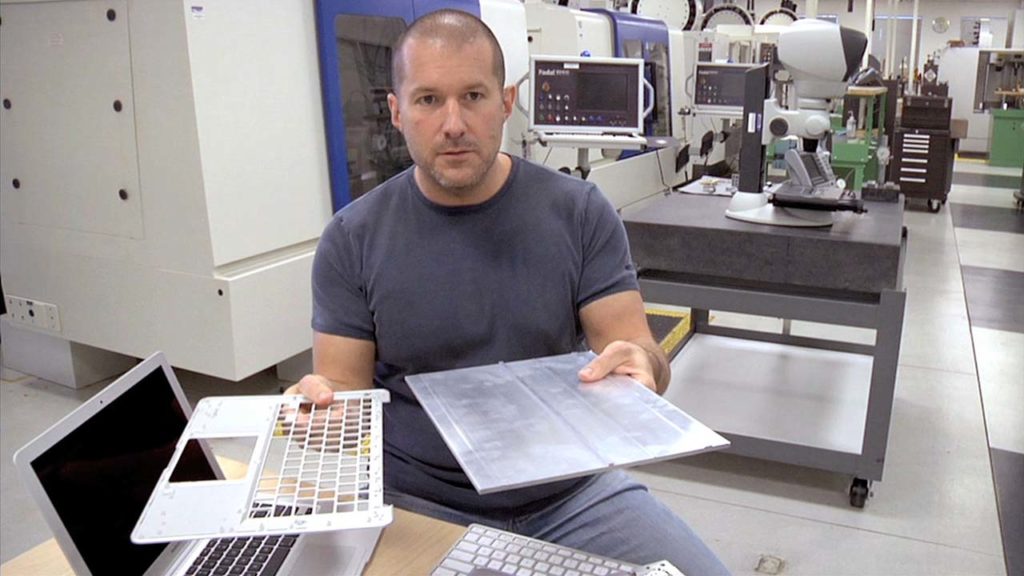
    Jonathan Ives’ inner sanctum. After conducting this interview, Apple had the filmmakers shot.

    Apple’s resident guru Jonathan Ive is perhaps the most famous design auteur featured. Ive is probably the second most famous person at Apple, justly acclaimed for his singular design aesthetic that first caught the public imagination with the bondi blue iMac and then the stark, white, deceptively “simple” iPod. Ive’s boss Steve Jobs famously said that design is “not just what it looks like and feels like. Design is how it works,” a principle born out in Ive’s work. Knowing inside and out the particulars of different materials and manufacturing is just part of designing a product’s externals. Ive brandishes precision-tooled parts from a disassembled MacBook Pro to illustrate that Apple spends an enormous amount of time and resources not just designing their products, but also the custom machines and processes necessary to mass produce them.

    Naoto Fukasawa in Objectified
    Naoto Fukasawa rethinks the CD player.

    Objectified spends some considerable time on the topic of sustainability, a responsibility that regrettably only recently entered the industrial designer’s job description. Valerie Casey of IDEO relates the incredible anecdote of the difficult process of developing a new toothbrush. When the product is finally ready and in stores, she embarks on a much-needed vacation to Fiji. If you didn’t already guess where this story was going, she finds a discarded IDEO toothbrush washed up on a beach halfway around the world. In less than a week, her product had become pollution.

    Objectified necessarily makes a brief detour into interaction design (this brief digression would be worthy of a film unto itself, but in the meantime, the curious can refer to Steven Johnson‘s 1997 book Interface Culture: How New Technology Transforms the Way We Create and Communicate). When we interact with most analog products, their form follows their function. As a thought experiment, would an alien from outer space (or a Tarzan raised in the wild) be able to infer an object’s function simply by looking at it? That is likely the case with a spoon or chair, but not so much with an iPhone.

    For many products of the digital age, the outward form factor gives no clues as to the function. Thus, interaction design was born with the Xerox PARC graphical user interface. Many of our daily tasks are now abstracted onto a two-dimensional screen. The Apple iPhone and iPad have popularized the touchscreen, which likely signals the beginning of another sea change when peripherals like keyboards and mice will be revealed to have been a temporary evolutionary bump, now marked for extinction.

    Objectified
    Awww yeah, designers know what time it is.

    The last images we see are of the devices used to make the movie itself: a computer, hard drive, and camera. Tellingly, the Objectified Blu-ray edition has no menu structure at all. You put it in, it plays, and the supplementary features follow immediately after the closing credits. It’s a completely guided, linear experience that speaks to the film’s elevation of the creator over the consumer.

  • Scratching in the Dirt: Peter Gabriel’s Scratch My Back

    Scratching in the Dirt: Peter Gabriel’s Scratch My Back

    As a Peter Gabriel fan for over two decades, it’s difficult to admit that I find myself struggling to appreciate his first new album in many years.

    There have always been three core things to love about Gabriel’s work: his literate songwriting, meticulous soundscapes, and emotionally expressive voice. Behind the creepily organic album art, Scratch My Back is an experiment in subtraction. It finds Gabriel covering other artists’ songs, accompanied only by solo piano or orchestra (the oddly defensive marketing pitch “No drums, no guitars” says it all).

    That leaves only the voice. Soulful and gravelly even as a teenage cofounder of Genesis in 1967, Gabriel’s voice should be more than enough to justify anything, so my pat reduction here is not totally fair. Gabriel and John Metcalfe clearly labored over these orchestral arrangements, but I miss the complex sonics of the rock and world music instrumentation that has characterized most of his music for over 40 years.

    Gabriel did very nearly the opposite a decade ago, when his high-concept millennium project Ovo made a point of casting Paul Buchanan and The Cocteau Twins’ Elizabeth Fraser to sing his songs. The most recent collection of his own songs was 2002’s Up, followed in 2009 by the collaborative project Big Blue Ball.

    Casual fans of his music might not be aware that Gabriel is an active humanitarian, particularly as cofounder of Witness and The Elders, so the temporal gap between his musical ventures is not entirely explained by chronic procrastination (although he would probably be the first to admit he’s easily distracted). Gabriel has stated that he hopes to work on more song-swap projects in the future, but first plans to work on some of his own songs. How long until he prepares a new album over which he can claim sole authorship?

    Peter Gabriel Scratch My Back

    Gabriel told The New York Times:

    “I was trying to make a grown-up record […] This is treating people as if they can handle difficult music and words. Not that I’ve courted the lowest common denominator before, but there’s a playfulness and childishness in some of my older work that isn’t present on this record.”

    Peter Gabriel

    He is presumably referring to the media satire of “Games Without Frontiers” and “The Barry Williams Show”, the randy sex romps “Sledgehammer” and “Kiss That Frog”, and the vaudeville silliness of “Excuse Me” and “Big Time”. Gabriel is one of the few musicians that I first listened to as a teenager, but whose music has aged with me. So I would have expected myself to appreciate an album of him covering many songs that I know and love well (particularly David Bowie, Lou Reed, Elbow, and Talking Heads), but I find that I don’t know what to make of Scratch my Back even after repeated listens.

    Many songwriters lose their dark edge as they age (case in point: Pink Floyd’s once tortured and prickly Roger Waters is now a big smiley softie), and by all accounts Gabriel should have been following that track too. After leaving Genesis in 1975 to deal with family issues, his first four solo albums were increasingly dark and sinister. But 1986’s So marked a noticeable turnaround in tone and an apparent psychic healing.

    Now reportedly still pals with his old Genesis cohorts, aging gracefully into a gnomish goatee, remarrying, fathering two new sons, and reconciling with his two daughters from a previous marriage, he seemed to be transforming into a cuddly grandfather figure. A trickle of releases over the past decade showed him favoring directly-worded songs for children, including the Oscar-nominated “That’ll Do” (from the movie Babe), the unsubtle “Animal Nation” (from The Wild Thornberrys Movie), and “Down to Earth” (from Wall-E).

    Suddenly, he appears to have reversed back into depressive territory. Nearly every song chosen for Scratch My Back has been transformed into a mournful dirge. Especially when listened to in one sitting, I find many of the interpretations to be too depressing, and I actually like depressing music. My favorite examples along these lines are Michael Andrews and Gary Jules’ cry-your-guts-out cover of Tears for Fears’ “Mad World” (from the movie Donnie Darko), and Elbow’s agonizingly heartrending version of U2’s “Running to Stand Still” (from the War Child benefit album Heroes).

    Peter Gabriel Scratch My Back

    Gabriel’s version of The Magnetic Fields’ “Book of Love” has apparently become something of a sensation on YouTube, licensed in television shows, and played at celebrity weddings. Perhaps I’m coldhearted, but it does absolutely nothing for me. Songwriter Stephin Merritt says his version was sarcastic, while Gabriel’s is deadly serious:

    At first I thought, How hilarious, he’s got a completely different take on the song. But after a few listens I find it quite sweet. My version of the song focuses on the humor, and his focuses on the pathos. Of course, if I could sing like him I wouldn’t have to be a humorist.

    Stephen Merritt

    Did Gabriel just plain miss Merritt’s point, or did he intentionally transform it into something sentimental, singing the same words but altering the instrumentation and delivery? All that said, something to cherish in Gabriel’s cover is the presence of his daughter Melanie on backing vocals.

    Elbow’s “Mirrorball” is one of the most ravishing love songs I’ve heard. Elbow remixed Gabriel’s “More Than This” in 2002, providing a more organic rock structure to Gabriel’s perhaps over-processed studio original. But Gabriel does not return the favor here, turning their gorgeous love song into a depressive bummer.

    The once case where Gabriel’s bummer-o-vision may have actually been appropriate is with Paul Simon’s “Boy in the Bubble”, which actually does have very dark lyrics.

    The original recording of David Bowie’s “Heroes” boasts an unforgettable lead guitar line from Robert Fripp, which by his own rules Gabriel must subtract. He sings Bowie’s Berlin-inspired lyrics in cracked, anguished tones, not an emotion I associate with the song.

    The one song I liked immediately was “Listening Wind”. The original is one of the odder tracks on Talking Heads’ Remain in Light, and Gabriel rather amazingly draws out a catchy melody embedded in the experimental song.

    The Special Edition includes a second cd with four bonus tracks: a cover of The Kinks’ “Waterloo Sunset” and alternate versions of “The Book of Love”, “My Body is a Cage”, and “Heroes”. It might have been interesting to also include some of Gabriel’s past covers, including The Beatles’ “Strawberry Fields”, Leonard Cohen’s “Suzanne”, and Joseph Arthur’s “In the Sun”. I would have also very much liked to hear instrumental mixes of some of Metcalfe’s orchestral arrangements.