Any friend of this blog will know that I almost universally hate biopics. As I’ve complained in my reviews of Control, The Diving Bell and the Butterfly, and even Walk Hard, I believe that the feature film is fundamentally ill suited for biography.
One seemingly minor lesson from college that wound up sticking with me is Edgar Allen Poe’s definition of the short story as a prose piece that can be experienced in a single sitting (The Philosophy of Composition, 1846). No one expects a serious portrait of a person’s entire life in a few pages, so why should we applaud a movie? The feature film’s two-hour running time is more akin to a short story than to a book-length novel or biography, and yet the biopic is a dominant genre in movies.
I would argue the primary reason biopics routinely get financing and awards is that they give ambitious actors the opportunity to exercise their imitation skills. It pleases audiences who perceive “true stories” as being of greater merit than fiction (mere make-believe!), and pandering to the Academy, who love nothing better than a technically impressive mimicry of an addict or handicapped person. I actually welcomed Walk Hard, for although a terrible movie itself, it finally mocked the formulaic drug-addicted musician biopics Ray, Walk the Line, La Vie En Rose, and El Cantante.
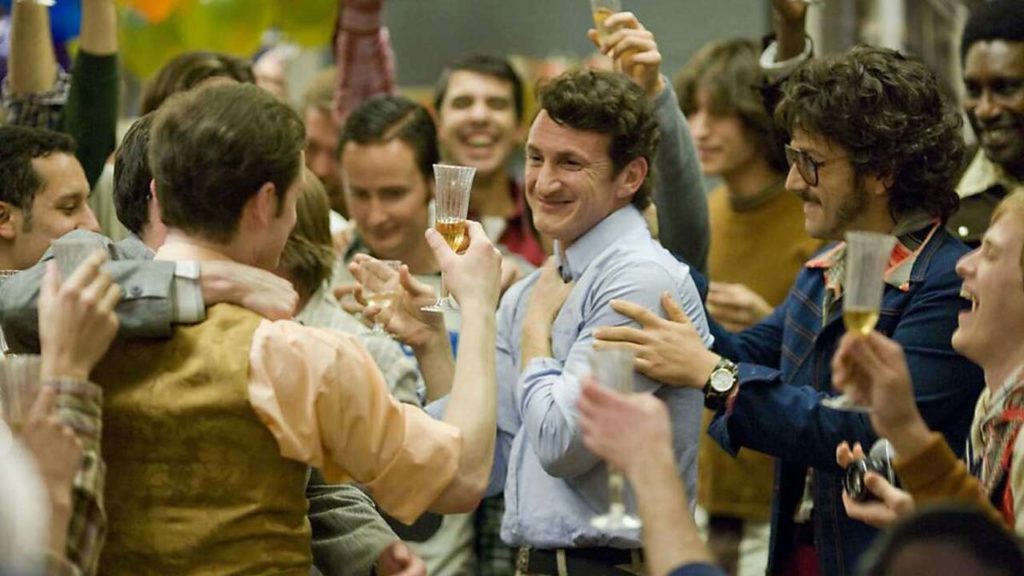
Director Gus Van Sant and writer Dustin Lance Black’s Milk, on the other hand, strikes me as less insincere than its peers. For one thing, it examines only a ten-year span of a man’s life, avoiding the genre’s usual Cliff’s Notes-like approach to summarizing a famous figure’s life into a series of highlights. And yes, Sean Penn did win an Oscar for a lively, spirited performance worlds apart from his natural demeanor. But I believe he, like everyone else involved, approached the project with nothing but the highest integrity, and truly hoped the timely project could affect public opinion.
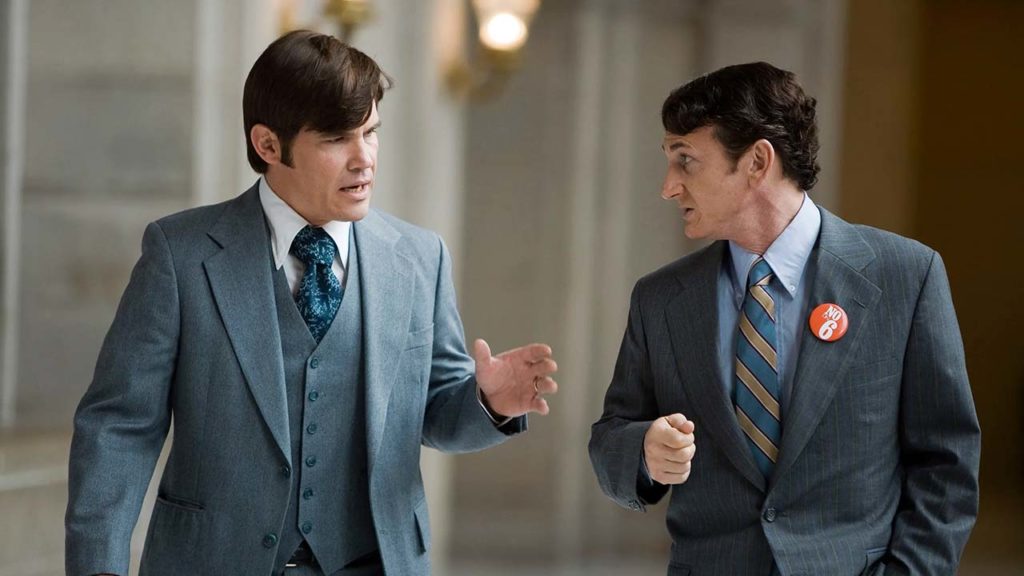
Milk was in theaters during shortly after the national debate over California’s Proposition 8, which denied the right to marry to a significant portion of the population (thanks to commenter Sapphocrat below for the correction). It’s impossible to miss the parallels to Harvey Milk’s struggle in 1978 against Proposition 6, which would have enabled the firing of homosexual teachers and (this is the truly amazing part) anyone that supported them. One of the movie’s biggest achievements is that it emphasized the sheer urgency of the gay rights movement. Equality was not just something that’s time had come. Gays were not only fighting for rights they hoped some day to have; they were fighting to keep the what rights they did have from being taken away.
I must admit that all I knew about Harvey Milk was the tangential bit of trivia that his assassin Dan White (Josh Brolin) was the first to employ the infamous “Twinkie Defense” in court, claiming that a diet of junk food altered his body chemistry and created a temporary state of insanity. Harvey was originally a New York insurance man, closeted from coworkers and family, but not so much so that he couldn’t brazenly pick up a stranger on the subway (with gaydar so fine-tuned that he could immediately tell that what I would assume to a normal-looking dude in 70s fashions was a fellow Friend of Dorothy). Scott Smith (James Franco) urges him to move to California where he can live more honestly. Harvey initially is happy to just live his new life, but becomes politicized as he faces prejudicial opposition to his small business.
Although it may seem to contradict part of my tirade against biopics at the beginning on this post, it might have been illuminating to see a little more of Harvey as a younger man, before he blossomed into a politically aware, out man. We only learn through passing dialogue that he hid not only his sexuality but even Scott’s very existence from his family. If the aim was to compress the essence of Harvey Milk into a short-form narrative, it strikes me that the major dramatic arc would be his transformation from a closeted man into someone that would later ask an entire community to come out at once.
The International may seem a little conventional coming from Tom Tykwer, director of the kinetic classic Run Lola Run, the mystical The Princess & The Warrior, and the lunatic, perverse Perfume. The International is by far his most conventional in subject matter, and lacking his energy and spirit. It especially suffers in comparison to its closest contemporary rivals in the globe-trotting action/suspense field, Jason Bourne and James Bond.
Eric Singer’s original screenplay unravels the sort of paranoid conspiracy theory that only exists in fiction, but in fact is based on an actual scandal involving the Bank of Credit and Commerce International (BCCI), which collapsed in 1991. But the fictionalized story makes use of ridiculous contrivances that reduce a massive international investigation down to a two-handed operation involving disgraced Interpol agent Louis Salinger (Clive Owen) and Manhattan District Attorney (and MILF) Eleanor Whitman (Naomi Watts).
For the love of God, will somebody please tell me where Tykwer hid the camera?!
Speaking of, The International is a true waste of Watts’ talent (watch Mulholland Drive and Funny Games for a primer). A potentially shocking moment comes when her character is hit by a car. Not to sound bloodthirsty, but it might have been very interesting for her character to make an untimely exit from the movie, a la Julianne Moore in Children of Men) and Janet Leigh in Psycho. But she escapes with just an arm brace, with as little impact on the plot as on her body.
Circumnavigating The Guggenheim
The International‘s best purpose is perhaps as porn for those with an architectural fetish. Much has been made of the production’s recreation of New York’s Guggenheim Museum interior on a European soundstage. But the extended firefight sequence is disappointing and clumsy. Michael Mann is often credited for being the master of such sequences, and for good reason. He utilizes his total command of space in Heat‘s street shootout and Collateral‘s nightclub battle. You never forget where all the characters are in relation to each other and the surrounding architecture. Likewise Paul Greengrass’ work in The Bourne Supremacy and Ultimatum. But The International‘s grand shootout is a senseless jumble, and even the total number of assailants seems to wildly fluctuate. First there are two… no, four… no, eight! And the last two are right above you… no, wait, they’re loitering on the ground floor. A mess.
Robyn Hitchcock & The Venus 3 (including Peter Buck of R.E.M. and Bill Rieflin of Ministry, R.E.M., and The Humans) opened with an enjoyable 30-minute set. I was unfamiliar with Hitchcock, but by total coincidence had just days before seen his appearance in Jonathan Demme’s Rachel Getting Married. His quirky non sequiturs between songs (“I had a root canal this morning, which is why I’m wearing a hat” – which he wasn’t) contrasted with his focused, tight songs. The Decemberists’ Colin Meloy briefly joined in on tambourine and backing vocals.
I’m a latecomer to The Decemberists, only catching on with their third album The Crane Wife (2006), which features a guest appearance by Laura Veirs, one of my favorite singer/songwriters, on the wonderful track “Yankee Bayonet.” My interest was further piqued by a review (that I now can’t track down) that compared them to early Genesis, of which I am also a longtime fan. It’s a bold comparison, for few would classify The Decemberists’ music as progressive rock. But it is fitting insofar as their compositions are often epic narratives, encompassing styles ranging from pastoral folk to hard rock, all performed with high musicianship that eschews flashy individual soloing. Further bolstering their prog rock cred, the first half of The Decemberists’ set was the entirety of their 2009 concept album, The Hazards of Love.
Colin Meloy joins Robyn Hitchcock & The Venus 3 as they warm up the crowd
In retrospect, a concept album was inevitable for a such a band that had already shown a penchant for lengthy story-based songs like “The Mariner’s Revenge Song” (on Picaresque, 2005) and “The Crane Wife Parts 1-3.” Compared to Genesis’ grand but slightly inconsistent epics “Supper’s Ready” and The Lamb Lies Down on Broadway, The Hazards of Love is actually one of the most cohesive concept albums I’ve heard. It rivals The Who’s Quadrophenia for clarity of vision and cohesiveness of its recurring musical themes.
An instrumental organ intro (sorry to keep bringing them up, but possibly an idea borrowed from Genesis’ “Watcher of the Skies”) launches the epic fairy tale. The role of a girl that falls in love with a forest creature is sung on record and live by the airy, sweet voice of Lavender Diamond’s Becky Stark. Shara Worden, a multi-instrumentalist powerhouse, blowed everybody’s hair back as the evil forest queen.
Although a few tracks can stand on their own (especially “The Rake’s Song”), the entire suite deserves to be heard in one piece. It was a very bold move to release a 58-minute song suite at a time when the long-player album is dying, and music is consumed track-by-track and randomly shuffled by iPod algorithms. Personally, I had found the album a little slow to absorb, but now that I’ve witnessed the whole thing live… wow. It’s brilliant, and made to be experienced live, in one piece.
Becky Stark & Shara Worden join The Decemberists to cover Heart’s “Crazy On You”
The second set mostly featured songs I didn’t know, so it’s time for me to visit Amazon MP3 to buy up their back catalogue. Peter Buck came back out to join them for a cover of “Begin the Begin” from my favorite R.E.M. album Lifes Rich Pageant (I was unable to shake Michael Stipe’s hook “The insurgency began and you missed it” from my head the entire walk home from the show). Stark and Worden rejoined the band for a full-blooded cover of all things, Heart’s “Crazy On You.” Their rendition was totally faithful, and yet somehow managed to sound both like a Decemberist original as well as something Fleetwood Mac might have done. They ended on a high note for me, with one of my personal favorite Decemberist songs, “Sons & Daughters.”
Street Sweeper Social Club, the new band formed by Rage Against the Machine guitarist Tom Morello, opened. Their badass cover of M.I.A.’s “Paper Planes” was a highlight.
Nine Inch Nails
It felt wrong somehow to see a band as moody and dark as Nine Inch Nails play while the sun was still up. But clouds soon moved in, obscuring a sunset that would have been impressive over the water, making everything suitably gloomy and very, very cold as NIN chased summer away. This stripped-down four-piece version of the band played a great cover of David Bowie’s “I’m Afraid of Americans,” the best song Nine Inch Nails could have but never wrote, and ended with the overwhelmingly sad “Hurt.”
Surprisingly omitted was “Closer,” what I would assume to be a requisite entry in any NIN set list (but the end theme did feature in a short instrumental jam). Speaking of, said jam was one of only two instrumental portions of the set (the other being The Fragile’s ambient interlude “The Frail”). A little disappointing, given that Trent Reznor has been becoming more and more musically experimental and adventurous of late, with whole chunks of The Fragile and the entirety of the massive two-disc Ghosts being instrumental. Personally, when it comes to Nine Inch Nails, the music (not so much the gloomy lyrics) is where the action is for me.
Nine Inch Nails
Jane’s Addiction
All thanks to Reznor for playing peacekeeper in reuniting the notoriously fractious and unstable Jane’s Addiction, at least for the length of the NIN/JA tour. Basically a funk/prog/metal power-trio fronted by the antics of Perry Farrell, a… unique individual whose ego (he once re-released a raft of Jane’s Addiction songs under just his own name on a solo greatest hits album) has often created conflict with bassist Eric Avery. The full moon peeking out from the clouds probably only added to Farrell’s lunacy.
They opened with their magnum opus “Three Days,” an epic featuring more discrete guitar solos by Dave Navarro than I could count. Honestly, where do you go from there? They kept finding high points to hit, however, including “Ocean Size” and the closer (what else?) “Jane Says.” It only took a few songs for the ageless Navarro’s vest to disappear (he must have one heck of a personal trainer, not to mention a chest hair waxer), and Perry’s shirt followed shortly thereafter.
Nine Inch Nails
The Future
Reznor has made vague noises about Nine Inch Nails coming to some kind of end following this tour. It remains to be seen whether he means retiring the name in favor of solo work, starting a new band, or simply ceasing to tour for a while. He’s reportedly been clean & sober for some time now, and engaged to be married, so more power to him. If he retreats now, he’d be going out on a high note. I hope the original lineup of Jane’s Addiction manages to keep it together to continue working in some form or another. With only two studio albums to their credit (I’m not counting the awful Strays, written & recorded without Avery’s inimitable bass), the world needs some new songs from them.
Jane’s Addiction
Getting There and Back
I had a little unexpected adventure on the long trip from Manhattan all the way out to Jones Beach. Met a few fans on the Long Island Railroad as we debated the various ways of getting there, all of which suck. Thanks to Kim & friend for the impromptu car ride to the venue! But I didn’t have the same luck on the way back, an ordeal that included waiting a full hour for a LIRR train to arrive. Picture dozens of hungry fans, shivering atop an elevated platform in the middle of nowhere.
The Venue
Blech. Surrounded on three sides by water, Jones Beach sounds nice in theory, but in person it’s cold. Never mind if you’re going to a show there during the summer; dress warmly. Also, for a music lover used to all kinds of venues in Manhattan and Brooklyn, it’s in the middle of nowhere, with no food or water for literally miles.
The exorbitant concession prices are, let’s be honest here, graft. Just to keep from dehydrating and getting a migraine from all the second-hand pot smoke, I reluctantly paid $6.50 for a bottled water, which I certainly hope the venue recycled. Also, the sound system is kinda crappy. Jane’s were noticeably louder than NIN, but Farrell’s mike sounded pretty muffled, especially on the first and last songs.
The Audience
The audience was a weird mixture of goths, metalheads, and graying thirtysomethings like me. Although NIN has remained extremely relevant for some time now, the original Jane’s lineup has been out of action for more than a decade, and both bands date back to the late 80s / early 1990s, when I was in high school. The black-fingernailed loners didn’t surprise me, but I didn’t really expect so many headbangers. I even saw a middle-aged, bearded dude in a skirt, a look I thought fizzled on arrival in the mid-90s.
In retrospect, I shouldn’t really have been surprised, but I come at Nine Inch Nails and Jane’s Addiction from a different angle. Listening to NIN is an extension of my appreciation for electronic and progressive rock, and Jane’s viscerally filthy, slightly sleazy rock owes more than a little to Led Zeppelin (who were also arguably a bit prog).
The title of Courtney Hunt’s suspenseful Frozen River refers to both a literal body of water separating countries, and to the tenuous border between merely scraping by and true poverty.
Melissa Leo was rightly praised last year for her performance as Ray, a woman struggling to support two boys in upstate New York. Her family appears to have been living beyond their means, even before her gambling-addict husband lit out with their savings. If she doesn’t make the next payments on their huge flatscreen television (a ridiculous sight in their shabby living space) or a coveted replacement double-wide home, they’ll lose the TV and the new home’s down payment. The TV is exactly the sort of extravagance that can put a checkbook in the red, and the double-wide upgrade becomes a necessity when their existing place looks unfit to survive the bitter winter.
Circumstances push her into an antagonistic partnership with Native American Lila Littlewolf (Misty Upham), whose situation is, if anything, worse. Lila’s business is smuggling illegal immigrants over the titular frozen river on Mohawk land. The fact that there is a question as to whether the practice is legal on a reservation is almost a point of pride. No one seems to know the actual law, but the perceived grey area in a way validates the Mohawks’ autonomy. Making a living this way is seen as prideful, never mind the exploited immigrants that pay about $40,000-50,000 each to make the trip, either in cash or the obligation to work it off as indentured slaves.
As I recently wrote about the extraordinary Kelly Reichardt’s Wendy and Lucy, a single event such as a car breaking down or a spouse leaving may be the tipping point leading to homelessness. Both films feature a woman on her own, struggling to meet pressing debts while feeding loving but needy dependents. But Frozen River suffers in comparison when watched back-to-back with Wendy and Lucy (as I happened to), feeling overwritten and with a neatly schematic ending. Without spoiling too much, a surprising burst of exposition near the end explains the rules of almost too-convenient new situation for Lila and Ray right as it’s happening.
Kelly Reichardt’s Wendy and Lucy is, on its own terms, perfect. As such, it exposes the silly practice of rating films in numbers of stars, even if this particular blog is merely one movie lover’s journal of personal reactions, and not pretending to be objective criticism. So please interpret these five stars as meaning that I was utterly moved by Wendy and Lucy.
Wendy (Michelle Williams) is a young drifter from Indiana heading nowhere in particular. Her home is a battered car, shared only with her beloved dog Lucy. She’s worryingly skinny, with an unexplained bandaged ankle. She keeps a running ledger in her journal, tracking the rapid decline of the life savings strapped to her waist. We don’t know why Wendy is on her own — whether she’s running from something or someone, or if she’s simply searching for a job. She calls her sister and brother-in-law in Indiana, but they evidently have problems of their own and quickly dismiss her. The poor, miserable girl never smiles, but often quietly hums a tune to herself.
One night, Wendy meets a group of young drifters by a bonfire. Icky (musician Will Oldham, a.k.a. Bonnie ‘Prince’ Billy) mentions an Alaskan fishery that pays well and provides housing. This is good enough for Wendy, and provides her with a destination. But she experiences a disastrous day while passing through Portland (or in terms of her ledger, as least, the most cripplingly expensive). In short order, her car breaks down, she’s caught shoplifting, loses Lucy, and is very nearly assaulted.
The security guard of the neighborhood Walgreens (Walter Dalton) becomes a genuine friend, whose greatest aid may simply be just talking with her. They briefly bond over the shared miseries of those that fall between the tracks: you can’t get a job without an address or a phone number, and you can’t get an address or a phone number without a job. People like her are always “just passing through.” He gives her $7, a gift he hides from his family, clearly a sacrifice for him.
Wendy and Lucy is spare and economical at only 75 minutes long, but it is heartbreaking and devastating. In some ways, Wendy is better off than the group of drifters she meets at the beginning of the film; she has a car, meager savings, and some discipline. But the number of steps it would take for her to become like them is few, and may happen in only a single day. One can only hope that Icky is right, and that Wendy will find some livelihood in Alaska.
Like the 1966 Corvette a reckless young James Tiberius Kirk commandeers in an early sequence, the new Star Trek is precision-crafted for speed, sex appeal, and total awesomeness. Kirk launches that beautiful machine off a cliff, but thankfully director J.J. Abrams never does the same with the movie. Star Trek (the first in the franchise to go by the perfectly terse name of the original TV series) joins the rarified ranks of the few other modern blockbusters that thrill and entertain (not to mention cost and earn massive piles of money) yet have lasting merit. Make room on the DVD shelf for a new entry in the canon, alongside Jaws, E.T.: The Extraterrestrial, The Lord of the Rings trilogy, Star Wars: The Empire Strikes Back, and Spider-Man 2.
Trek has a long tradition of utilizing the science fiction conceits of time travel and alternate dimensions to playfully subvert its characters and mythos. The original series introduced the Mirror Universe, giving the cast the chance to reinterpret their goodly characters in hairier, eviler alter egos. Two of the best movies brought the Enterprise back in time, first to save the whales in the 1980s (in the lighthearted Star Trek IV: The Voyage Home), and later to witness Earthlings’ first contact with an alien race in 2063 (in the underrated Star Trek VIII: First Contact). Two of my personal favorite Next Generation episodes “Yesterday’s Enterprise” and “All Good Things” tasked Captain Picard with course-correcting an Enterprise skipping through time, no matter the sacrifice. The fun in these kinds of stories comes not just from their brain-teasing sci-fi concepts, but in enjoying new twists on the established characters fans love. But any real innovations were always only temporary, the status quo always quickly restored in time (so to speak) for the next episode.
All hands on deck
Thus, the Star Trek franchise has managed to maintain a single (albeit massively complicated) timeline across six TV series, ten movies, and countless novels and comic books. There’s even a niche market in the continuity data itself, as evidenced by popular wikis like Memory Alpha and reference tomes such as Star Trek Chronology: The History of the Future. Such catalogs of the incredibly complex future “history” in which Trek is set are useful not only to obsessive fans, but also to the writers charged with creating new stories that don’t contradict what came before, at least too badly.
A certain degree of renewal was already built right in to Star Trek. When any one premise ran out of ideas, an ensemble aged beyond plausibility, or ratings dipped, the producers could always start over with a new ship, a new space station, or in a new year. The most radical departure yet attempted was the ultimately disappointing final series, Enterprise. The prequel, set years before Kirk would take the helm, got off to a great start with a Starfleet crew a world apart from any we had seen before. As many have pointed out over the years, Star Trek creator Gene Roddenberry may have modeled Starfleet on the Navy, but the original 1960s series was basically a Western set in space. The 1980s The Next Generation reconceived Starfleet as kind of trans-species peacekeeping fleet, a kind of U.N. of The Milky Way. So, set between Earthlings’ rough-and-tumble early spacefaring years and the later idealistic intergalactic cooperation, Enterprise featured a bunch of cocky cowboys brazenly taking their values out with them into space, baseball caps firmly screwed on heads, and phasers defiantly set to kill. The series seemed poised to be a somewhat obvious but fruitful metaphor for an arrogant, George W. Bush-era United States forcibly spreading democracy where it wasn’t welcome. But its quality (both in writing and in special effects budget) bottomed out in just a few episodes, and even the smoking-hot, well-endowed Vulcan T’Pol (Jolene Blalock) couldn’t keep the show on the air.
Uhura models the latest in 23rd Century Bluetooth fashions
The entire Star Trek franchise seemed all but dead after Enterprise‘s cancellation, not unlike the no-win scenario Spock devises as a test to torture Starfleet cadets to see how they cope with failure. A cherished part of Star Trek lore is that Kirk doesn’t believe in no-win scenarios, and thus cheated in order to win Spock’s unwinnable test. Paramount evidently learned a lesson from Kirk’s lateral thinking, for the first they they have given the OK to an irreverent new creative team to permanently reboot Trek from top to bottom. Nearly all of Trek’s meticulously maintained continuity (excepting, ironically, the failed Enterprise, set chronologically before any of the events of this movie) has now forever been redefined as belonging to an alternate timeline. At least, that is, until the next reboot. As the heavily-advertised appearance of Leonard Nimoy as the original “Spock Prime” attests, nothing necessarily precludes the reappearance of any beloved original actors or other kinds of crossovers between timelines (anything in possible in science fiction). But Star Trek does mark a very clear end to Star Trek as we knew it.
After 40 years of unreliable quality control and diminishing box office, such drastic measures were arguably essential to preserve Trek as a viable franchise. But I do sympathize with the grumbling of longtime fans upset at scrapping everything and starting over. And this is not even to mention the many writers, directors, and actors that created the no-longer canonical stories. All of which hasn’t disappeared from our reality, and will be enjoyed forever on DVD, but this film does render pretty much everything that came before it as second-class Trek. I can’t help but wonder how all future spinoffs are now going to be handled on a practical level. For instance, if there are to be future comics or novels featuring the characters from The Next Generation, are the physical products going to have to be labelled as taking place in the now-depricated original fictional universe? How does “Trek Classic” and “Neu Trek” sound?
Spock has had enough Kirk and can’t take it anymore
But back to the topic at hand: the totally awesome new movie is packed with glossy art direction, genuinely exciting special effects, fight scenes, chase sequences, and attractive young actors young and attractive enough to strut about on the big screen in their space scanties. Despite all this gloss, it somehow manages to not be totally stupid, which is more than blogger can say about your typical summer movie (*cough* Transformers *cough*). However, I can’t help but point out a few, forgive me, illogical plot elements, especially in the mad rush towards the end:
Why does Kirk bother firing upon Nero’s ship as it’s being torn apart by a black hole? Our No-Prize answer: maybe Kirk feared Nero would time travel yet again to create mischief in yet another timeline (hey, there’s always the inevitable next reboot in a few years).
Starfleet is busy elsewhere in the galaxy, so we see the cadets mobilized into a strike force to confront Nero. So why is the Academy still full of students when Nero’s ship reaches Earth? Our No-Prize answer: maybe they were Freshmen not qualified to do more than merely swab the decks.
It’s wildly implausible for young Spock to maroon Kirk on the same planet that Nero did Spock Prime. Our No-Prize answer: nope, I got nothing. I mean, really, come on! (but still, the movie is awesome, just go with it)
The hardest plot point to swallow is why Spock Prime does not accompany Kirk back to the Enterprise. Would he really risk the fate of Earth because he thinks it’s more important that Kirk and his young self forge their destined friendship? Our No-Prize answer: yes.
But enough complaining. Did I mention the movie is TEH AWESOME? There’s not one bad performance to drag things down (a notable problem with Watchmen). Despite being tasked with recreating characters beloved by fans for over 40 years, no one attempts an outright imitation or caricature. The most faithful is Zachary Quinto as Spock. Beyond his eerie physical resemblance to Nimoy (maybe not how he actually looked in 1966, but how he might have), he has a fresh take that plays up the character’s internal struggle between emotion and logic. Chris Pine artfully embodies Kirk’s blend of righteous nobility and brash rule-busting attitude without aping William Shatner’s famously hammy style (for which we all, admit it, love him). Karl Urban nails Bones as a seasick pessimist, and Zoe Saldana and John Cho bring welcome sass and physical action hero prowess to Uhura and Sulu, two characters often left on the sidelines. Only Anton Yelchin and Simon Pegg come close to overdoing it. Pegg mugs and shouts, playing Scotty as much more of a mad Scotsman than James Doohan ever did, and Yelchin overexaggerates Chekov’s accent for pure comedy. But that’s not to say both performances aren’t hugely entertaining, just like everything else on display.
Pegg gives Scotty’s accent all she’s got, Captain!
Star Trek goes much much further with Spock’s half-human nature than any of the Trek I’ve seen. Spock was such a key ingredient that almost every version of Trek that followed was obligated to include a similar character: most obviously the android Data (Brent Spiner) in The Next Generation. We are reminded the Vulcan species is not naturally emotionless, as many casual fans assume, but rather a deeply passionate people that holds its warlike nature in check by elevating logic to the level of religion. A purely devout Vulcan would be about as dramatically interesting as a robot (but it must be said that even Spock’s father Sarek (Ben Cross), a high-ranking Vulcan elder, privately admits to being moved by the irrational emotion of love). The aged Spock Prime is practically jovial, seemingly having come to terms with his duality. It’s actually rather heartwarming for a longtime fan to see him at a place of peace with himself.
None of the many Trek sequels, prequels, or spinoffs to date have ever reached the mythic status of the original series and its core dynamic duo Kirk and Spock. Star Trek makes a bold bid to reclaim what made the original such a phenomenon: it goes back to the original scenario and characters, and thoroughly remasters, reinvigorates, reinvents, and gives them a swift kick in the ass. It restores the names Kirk and Spock to the realm of legends and icons.
At last, finally another entry to our hallowed pantheon of zero-star unholy cinema atrocities. Frank Miller’s The Spirit is far more than just merely bad. Like the most infamous movie disaster of all, Ed Wood’s Plan Nine From Outer Space), it veers wildly from stunning weirdness to unintentional hilarity, interspersed with frequent stretches of insufferable boredom.
But what truly lands The Spirit among the rarified company of true cinematic crimes against humanity is that it is the insane and unhinged product of a uniquely obsessed auteur mind. The only difference is, Miller was handed a great deal more money and resources than Wood ever managed to wrangle.
Not that he didn’t have to work for it. Miller is one of the best-known (and most ripped-off) rock stars to graduate from the sweatshop that is the comic book industry. He has written and/or illustrated some of the best-selling and most influential series of comics’ modern age, including Wolverine, Daredevil, Ronin, Elektra: Assassin, Sin City, and 300. Much of this work has long been ruthlessly pillaged for raw material for Hollywood’s leveraging of comic book intellectual properties.
The unmatched one-two punch of his 1980s Batman graphic novels Year One (with David Mazzucchelli) and The Dark Knight, together with Alan Moore and Brian Bolland’s The Killing Joke, became the basis for Tim Burton’s Batman (1989). That first major comics-to-movie blockbuster not only borrowed Miller’s particular interpretation of the character (itself a highly distilled version of its surprisingly dark history), but also his overall visual style (going so far as to visually quote individual panels).
“I’m gonna kill you all kinds of dead.”
Over a decade later, Mark Steven Johnson’s Daredevil (2003) unfortunately fumbled Miller’s most famous original character, the Greek ninja assassin Elektra. But Miller was soon to cease being merely someone from whom Hollywood stole paid homage. In 2005, Miller jumped media barriers to co-direct a feature film adaptation of his original graphic novel Sin City with Robert Rodriguez. The two crafted an exactingly faithful recreation of the book, essentially treating the original comics as storyboards. Miller’s profile only rose as Zack Snyder pulled a similar stunt with Miller’s 1998 graphic novel 300, producing an even bigger (and slightly controversial) smash hit.
Credit to Miller for absorbing countless lessons from the seasoned indie maverick Rodriguez, enough to helm an entire feature on his own. The Spirit‘s visuals are often extraordinarily beautiful, exploiting the thin barrier between animation and live action blurred ever since the largely green-screened Star Wars: The Phantom Menace (George Lucas, 1999) and Sky Captain and the World of Tomorrow (Kerry Conran, 2004). Like Sin City, nearly every shot is highly processed to effect a stylized evocation of noir literature and movies.
But together with Miller’s signature brand of stark, chiaroscuro images and purple, pulpy noir dialogue, it doesn’t look or sound anything like the real ostensible real source material, Will Eisner’s original Spirit comics. The legendary Eisner is considered the inventor of the graphic novel. The DVD edition of The Spirit includes a must-see bonus feature: “Miller on Miller,” in which he talks of Eisner as a teacher, and took many of his aphorisms as lessons, including the essential sensuality of inking (which Miller took rather literally). Eisner (and others such as Neal Adams) may have inspired Miller in the first place, but Miller’s version of The Spirit in Chucks and cape-like trenchcoat more closely resembles his own creations, especially Dwight from Sin City (Clive Owen in the film) or Daredevil as he appears in the 1990 graphic novel Elektra Lives Again.
I read Miller’s comics as a kid, and certainly never expected the guy would one day be a bankable force in Hollywood. Looking backwards, it’s plain he hasn’t changed much. His obsessions and preoccupations are now only amplified and enhanced: his modern comics (and now movies) are mostly comprised of homoerotic bone-crunching acrobatic fights (if the entirety of 300 isn’t proof enough, might I refer you to Daredevil’s battle with the naked, big-dicked Bullseye in Elektra Lives Again), voluptuous femmes fatale (no skinny waifs for him), and pulp fiction and film noir-inspired odes to his beloved New York City. Also on the DVD, Miller expounds on all his favorite talking points, from his detailed knowledge of comics history, his love for New York City, and his hatred of censorship (he’s famously prone to castigate the comics industry for weakly censoring itself instead of fighting back against – or even ignoring – Congressional pressure in the 1950s).
“I’ve known some pretty strange women in my time but this one, she’s got the final word on strange.”
I’m not familiar with Eisner’s original Spirit comics, which appeared as inserts in 1940s Sunday newspapers. But from what I understand, Miller took a great deal of liberties beyond jettisoning Eisner’s colorful visual style in favor of his own Sin City look. Miller adds a metaphysical aspect missing in the original, making The Spirit and his nemesis The Octopus both indestructible and quick-healing (perhaps inspired by the character Wolverine, to which Miller had a hand in popularizing in the early 1980s). The presence of Samuel L. Jackson can’t help but recollect M. Night Shyamalan’s Unbreakable, an infinitely more subtle examination of the superhero archetype.
The action is set in an unnamed fantasy urban landscape like that of Alex Proyas’ Dark City (1998) and David Fincher’s Se7en (1995): filthy, surrounded by water, soaked by constant precipitation and fog, and in perpetual night until the sun finally rises at the end. Miller’s script conspicuously avoids mentioning the year, but the automobiles and fashions are clearly of the 1940s while the characters employ the cell phones and internet of the 2000s. This is Miller’s home.
The Spirit sports an unusually eclectic cast, with Gabriel Macht in the eponymous role alongside much better-known stars Jackson and Scarlett Johansson in supporting roles. The performances range from the distracted (Sarah Paulson as a good girl besotted with The Spirit) to the borderline lunatic. One can hardly blame the actors, for surely they were at the mercy of the screenplay and Miller’s rookie coaching. Stana Katic is entertaining as Morgenstern, a gosh-golly gee-whiz rookie cop that goose-steps from scene to scene like a sexy robot. ScarJo rocks hornrimmed glasses like no bad girl before her, but it’s just plain uncomfortable to see her in Nazi fetishwear and jackboots.
The Octopus is a mad scientist conducting all sorts of medical atrocities in the name of mutating himself to godlike powers. He deems one of his misfired experiments as “just plain damn weird,” a phrase apropos of the movie itself. It’s oddly slapstick, and often outright silly. Unexpectedly, it’s much less violent, or rather, gory, than 300 or Sin City. It’s also slightly more playful in narrative terms; the Spirit’s noirish voiceover often brazenly breaks the fourth wall by speaking directly to the camera.
And finally, some trivia gleaned from the credits:
This comic geek thought I recognized a contribution by frequent Miller collaborator Geof Darrow (Hard Boiled and Big Guy & Rusty the Boy Robot), and I was proved correct in the end credits.
The end credits themselves, designed by Miller, are stunning.
Miller is also credited for the storyboards, which must be something to see.
Miller cameos as a decapitiated cop, the head of whom The Octopus wields as a weapon. He also appears in Sin City, Daredevil and RoboCop 2, for which he wrote the screenplay.
Quarantine, remade by director John Erick Dowdle (co-written with brother Drew) from the Spanish movie REC (2007), follows in the now-firmly established horror fauxmentary tradition. Previous entries Blair Witch Project, Diary of the Dead, and Cloverfield are all ostensibly comprised of found footage recovered from cameras found at the scenes of horrific disasters. Quarantine‘s only wrinkle is that, unlike its predecessors, this pretense is not explained as such on screen. Quarantine‘s conceit is that we’re watching raw footage, edited in-camera, abandoned by the late characters themselves. There are no implied, unseen survivors that picked up the pieces.
Cloverfield never provided a convincing psychological motivation to explain why its cinematographer would keep his camcorder running throughout his desperate flight from toxic alien creatures swarming across Manhattan. A much more intelligent examination of an obsession to capture everything on video came from the less expected source of none other than the zombie godfather himself, George A. Romero. His underrated Diary of the Dead features a group of young film students with pretensions to becoming great documentarian filmmakers, and what better subject to document than their own first-hand experiences during a zombie outbreak? Although Cloverfield had significantly greater budgetary resources at its disposal to create eerily realistic images of Manhattan crumbling beneath the feet of a Godzilla-like monster, Quarantine follows in the more modest footsteps of Diary of the Dead in striving for greater psychological realism.
In story terms, the justifications for Quarantine‘s characters to keep filming continually evolve as their circumstances worsen. Like Romero’s Dawn of the Dead, Quarantine features members of the press as main characters. The first full 12 minutes are devoted to reporter Angela Vidal (Jennifer Carpenter) and cameraman Scott Percival (Steve Harris) shooting a television news segment on a local fire department. By the time an emergency finally arrives and the duo hitches a ride along to the scene, we’ve become fully endeared to the bubbly, spunky reporter and the charmingly filthy firefighters. As the routine investigation turns into a confrontation with a feral-seeming elderly woman, Angela senses the opportunity to score some sensational footage. It’s clear she fancies herself a more serious reporter.
In true horror movie fashion, Angela (Jennifer Carpenter) sheds layers of clothing throughout her ordeal
Later, as the elderly woman is revealed to be patient zero for a new highly contagious disease, the Los Angeles Center for Communicable Disease quickly quarantines the building, cutting off all their communications and falsely reporting to the public that it has been evacuated. The trapped tenants are a random assortment of Los Angelans: an opera tutor and his hot young live-in protege, a veterinarian, a cleaning woman, a mom and her baby (whom we meet again near the end of the film, in horrifying transformed fashion), toy dogs, an immigrant couple, and… what’s missing? That’s right! If this is L.A., where are all the unemployed actors?
Building manager Yuri (Rade Serbedzija) keeps conveniently remembering exits (including a back door and a basement entry to a sewer), but all are blocked. By this point, Angela has morphed into a righteous crusader wanting more footage as proof of the city’s outrage against justice and human rights. But when the virus spreads to most of the people trapped in the building, the power goes off, and panic truly sets in, Angela’s motivations switch to pure survival. The camera now only proves useful as a source of light, and anything captured on video happens by chance as they frantically navigate through the corridors. Then, in true horror movie fashion, things get even worse. In a scene rivaling the nail-biting basement sequence in Silence of the Lambs, Angela and Scott find themselves barricaded in a pitch-black attic with their camera’s lamp broken. The remainder of the movie is seen through the greenish haze of their night-vision filter.
While Quarantine may seem to tip its hat to horror tradition as protagonist Angela sheds layers of clothing over the course of her ordeal, the movie is actually quite subversive in showing her lose her spirit. Atypically for a horror movie protagonist, she is no plucky survivor that defeats the menace. She pretty much just breaks down.
ground floor, coming up
Quarantine may be yet another in a long line of zombie flicks, but I would argue its true genre identity is as an urban nightmare. Cloverfield relived 9/11 in the form of another Godzilla and its highly toxic babies, and Guillermo Del Toro’s Mimic envisioned swarms of giant cockroaches breeding in abandoned subway stations. Quarantine touches on another deep anxiety of urban dwellers: a viral contagion born of city filth. The entire outbreak plays out in the confines of an aging tenement building (with what seems to be a clothing sweatshop hidden in the back), a place many city slickers might recognize as home.
What made Quarantine the most frightening for me in particular was not the gore or the booga-booga scare factor, but rather the disturbing plausibility of its fictional disease. In reality, all we hear about are the dangers of diseases like HIV jumping from bushmeat to humans, and the avian or swine flu incubating in impoverished nations where people live in close quarters with animals. What about those of us living in developed, supposedly civilized cites, full of dogs, roaches, rats, and yes, a certain number of crazy nutjobs?
A hyper-evolved form of the rabies virus is the most plausible pseudo-scientific explanation I’ve yet heard for zombies, especially compared to the vaguely described Venusian radiation in Romero’s Night of the Living Dead. Like the “superflu” in Stephen King’s The Stand and the distilled “rage” virus in Danny Boyle’s 28 Days Later, this strain of rabies was genetically engineered by a lone terrorist holed up in the attic of the tenement. An ominous clue is dropped halfway through the film about an unaccounted-for tenant living in the attic. When we finally meet him, he appears to have been infected for quite some time. Blind and emaciated, he scrambles around in the total darkness of his former home and laboratory (scattered with disgusting medical photos and newspaper clippings about Doomsday Cults).
The creepy figure is played by the unusually tall and slender Doug Jones, most recently seen as the Silver Surfer in Fantastic Four and Abe Sapien in Hellboy. I worked on the official website for Guillermo Del Toro’s marvelous Pan’s Labyrinth, for which Jones was interviewed about his experiences playing The Faun and The Pale Man; for someone that so typically plays monsters, he’s a super-nice, funny, and charming dude. I skimmed through the bonus features on the Quarantine DVD, and it’s a crying shame that he apparently wasn’t interviewed.
In place of a musical score, Quarantine features a complex sound design built around an eerily creaking, groaning old building. It also forgoes other standard movie pleasures, being a gruesome, depressing, and punishing experience. In that respect, it’s similar to how the nauseatingly (literally) bleak Blindness. In contrast, the sublime Children of Men is the rare movie nightmare set at the brink of the end of humanity that nevertheless carries a spark of uplift and hope.
A grotesquely costumed, knife-wielding creep on the Timecrimes (Los Cronocrímenes) theatrical poster promises an exploitative slasher pic along the lines of Texas Chainsaw Massacre. To some degree, considering the degradations made upon a breathtakingly beautiful girl alone in the woods, it is.
But Nacho Vigalondo’s Spanish science fiction puzzler is a friendlier sibling to Shane Carruth’s Primer (2004), a much more brain-spraining chronological conundrum. Both are rare science fictions that rely on a complexity of ideas rather than special effect eye candy. Vigalondo’s different take on the sci-fi tropes of time travel (more on that later) makes Timecrimes a little easier to follow than Primer.
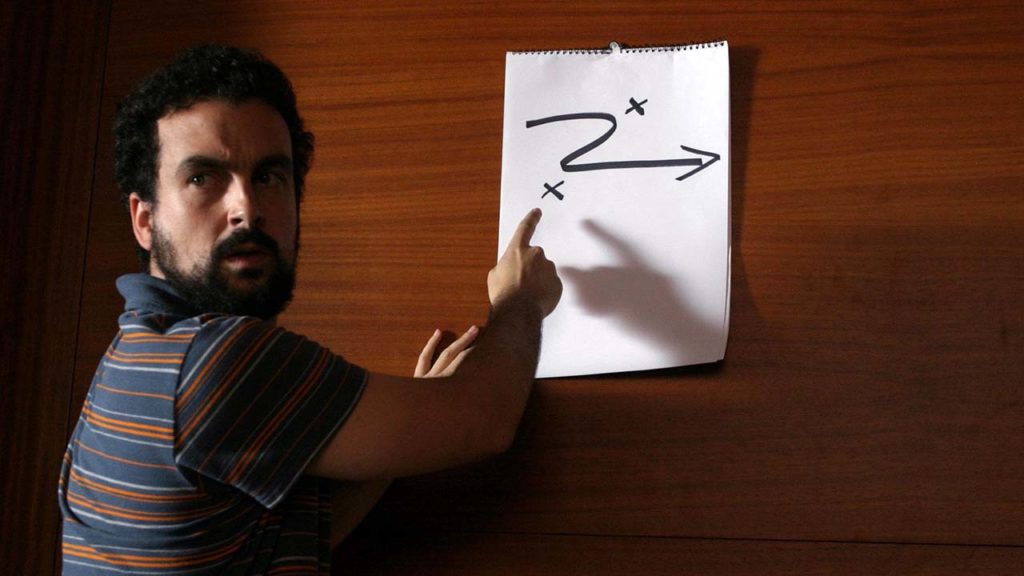
The film opens with Héctor (Karra Elejalde) driving home from grocery shopping with the hatchback of his car ajar, leaving a string of groceries behind him (yes, it’s a metaphor). He and his wife Clara (Candela Fernández) are outfitting a country home as a retreat for the stressed-out insomniac. We never learn what exactly ails him, or what kind of job affords them such a lifestyle. Little do we realize that violence and chaos is already roiling in the bucolic woods around them. Their neighbor turns out to be a research institute developing a rudimentary time machine. The device is not due to be tested for weeks, but unnamed staffer El Joven (Vigalondo himself), is hanging around the facility to tinker with it without permission.
Timecrimes’ pink boogieman
Héctor encounters an unconscious nude woman (Bárbara Goenaga) in the woods, and finds himself pursued by what he assumes to be her assailant. Taking refuge at the institute, El Joven volunteers to hide him in an apparatus that resembles a hot tub prepared for a milk bath. From Héctor’s point of view, the doors open mere moments later, but he finds himself several hours in the past.
Even though Héctor is the first person to ever travel through time, El Joven seems pretty unamazed that the machine works. He’s also assured of the rules: Héctor must be sure to stay out of the way as his future self comes to the time machine, after which there will once again only be one Héctor in the world. Meeting himself and/or altering events (say, preventing his future self from ever passing back to the past), would cause a cataclysmic paradox.
El Joven never specifies what exactly the results would be, but anyone familiar with Doctor Who, Star Trek, and the aforementioned Primer would know that a temporal paradox could rupture the space time continuum, reverse the polarity of the neutron flow, be really socially awkward, or… whatever.
More illustrative is the paradox at the heart of the Terminator films: the evil artificial intelligence SkyNet sends a cyborg back in time to kill Sarah Connor, before she becomes the mother of SkyNet’s mortal enemy John Connor. Future-John also sends his best friend Kyle Reese back in time, ostensibly to protect his mother. As David Foster Wallace pointed out in his vicious critique of Terminator 2: Judgement Day, the paradox is that both time travelers cause the unwanted future to occur: Reese sleeps with Sarah and becomes John’s father, and the wreckage of the cyborg becomes the technological basis for building SkyNet.
Director Nacho Vigalondo apparently wrote his pitch meeting into his script.
Héctor originally acts impulsively and attempts to contact his past self by phone, and then in person. He makes a series of calamitous errors, and eventually comes to realize that he must shift his strategy to ensure he not disrupt what has already happened to him, but will be everybody else’s future. El Joven only sticks Héctor into the time machine in the first place because a copy of him that already went through told El Joven he had to do it. Héctor kidnaps and abuses La Chica to recreate the perverse scenario the past version of himself encountered. He commits a perverse crime against her, but he rationalizes to himself that it is not for his pleasure (regardless of his sci-fi predicament, his behavior is psychotic).
But the increasingly crazed Héctor tries one last time to change events. He travels back in time again, creating a second temporal loop-de-loop, a third duplicate of himself, and more proliferating walkie-talkies than I was able to keep track of. Héctor only seems to realize near the end of his ordeal that everything is clicking into a predetermined sequence of events, regardless of his direct or indirect interference. Eventually, a calmness comes over him, and he simply sits down and waits for events to finish playing themselves out, knowing there is nothing he can do. So Timecrimes‘ notion of time travel is not actually like that in Star Trek or Terminator, but more like the television show Lost, whose rules stipulate that there is only one unalterable timeline. There is no such thing as a paradox.
La Chica unknowingly helps Héctor out of two different car crashes
Héctor’s time loops are straightened out by the end, with only one version of himself left in the world. But his misadventures in time have left a trail of destruction behind him similar to his spilled groceries in the beginning of the film. La Chica lies dead in his garden, he’s crashed two cars, and the police are coming. La Chica’s necklace is in his pocket, and he’s sure to be found guilty for her death. Perhaps worse of all, a working time machine sits idle at the top of the hill, waiting for more mistakes to be made.
The DVD also includes Vigalondo’s excellent short film “7:35 de la Mañana (7:35 AM)”, in which he exhibits his prowess with the slow reveal of narrative information.