Director Fernando Meirelles has examined desperate pressure cookers (City of God) and institutional corruption (The Constant Gardener) before. Blindness proves perfect to meld both themes, with a science fiction twist imagining the downfall of civilization itself.
Blindness is part of a special subset of the horror/sci-fi/disaster genre: the dystopian end-of-civilization nightmare. Whereas the typical entry works by introducing a disrupting element into the status quo (typically a monster), a few instead subtract one fundamental fact of life that we take for granted. The basic recipe is simple: flip one switch, and watch civilization fall in short order. In Children of Men, humanity becomes infertile. In The Happening, the biosphere starts pumping out poison. In the comic book series Y: The Last Man, all males on the planet suddenly die off. In innumerable zombie flicks death is no longer absolute. It may not be a coincidence that at least two members of the Blindness cast already have relevant experience on their resumes: Julianne Moore in Children of Men and Alice Braga in I Am Legend.
“The only thing more terrifying than blindness is being the only one who can see.”
All of these stories bleed over into the genre realms of science fiction and horror. Blindness, however, is based on the magical realist (if it’s accurate for me to call it that) novel by Jose Saramago. The novel is set in a generic city, featuring unnamed characters (the movie, filmed in Sao Paulo, Brazil, effectively preserves both conceits – I didn’t notice until the credits rolled that the characters did not have names). Without getting bogged down in pseudo-scientific details, Zaramago posits a highly contagious “White Blindness” that rapidly sweeps the globe, affecting everyone but one random woman. The movie’s explanation is a far more literal highly communicable disease, diagnosed for the audience by the unnamed opthamologist “Doctor” (Mark Ruffalo). By sheer coincidence, The Doctor’s Wife (Moore) appears to be immune.
The obvious challenge for the filmmakers is how to render a prose story about blindness into the most visual storytelling medium of all. Cinematographer César Charlone (who also shot City of God and The Constant Gardener) meets the challenge by creating stunning visuals which paradoxically obscure. The picture frequently flares into a burned-out whiteness, often a relief from the ugly filth in which the characters find themselves living as the safety net of society collapses.
The story brutally details a basically pessimistic view of human nature. Right from the start, humanity’s inherent greed and avarice make a catastrophic situation worse. The very first victim of the disease is immediately exploited by a car thief (ironic, as automobiles are shortly to become the most futile of valuables to steal). As the blindness disease spreads, the authorities (represented by The Minister of Health, in what amounts to a cameo by Sandra Oh) attempt to contain the infected in isolation wards, a weak euphemism for concentration camps. As The Man With the Black Eye Patch (Danny Glover) states in a nicely written but implausibly eloquent monologue, “the disease was immune to bureaucracy.”
“I know that part inside you with no name, and that’s who we are, right?”
The infected are made up of characters from many cultural and economic backgrounds, much like Alejandro González Iñárritu’s Babel (2006). Left alone to self-organize, two opposing societies coalesce around two very different natural leaders. The Doctor and his Wife create a fragile but functioning democracy, but the King of Ward Three (Gael Garcia Bernal) forges a depraved Sodom built on exploiting their few resources for short-term base pleasures. Inevitably, the two fledgling states go to war, as much out of ideology as for want of resources.
As the ward denizens’ circumstances get worse and worse, the movie itself becomes a punishing experience to watch (an imitative fallacy). In terms of depictions of violence, it is no less explicit than, say, Children of Men, but wholly lacks that superior film’s dark wit and essential thread of hope. Whereas Children of Men had no real villain (Luke, Chiwetel Ejiofor, was actually more of a Che Guevarra-type revolutionary), there is little or no subtlety of character in Blindness‘ wholly evil bad guys. Would the central allegory be more interesting to ponder if the villains were not so unambiguously monstrous? Even I Am Legend dropped hints that its vampire/zombie-like monsters possessed crude intelligence, a will to live, and empathy for their own kind.
The fragile community in the wards disintegrates into a hell of gang rape and open war. Then, amazingly, it gets worse. But as the walls of the prison burn, the prisoners discover the doors have actually been left open. If anything, the world outside has become worse off than the pressure cooker in which they were imprisoned. After a harrowing trip through the devastated city, they experience one fleeting moment of joy as they bathe in the rain. Afterwards, they set up an eden in the Doctor and his Wife’s former home, like a less-satiric version of the fortified suburban shopping mall in George A. Romero’s Dawn of the Dead. The Doctor’s Wife’s newly extended family embraces her as their “leader with vision.”
Wes Anderson and co-writer Owen Wilson’s feature debut Bottle Rocket is based on their 1992 short film of the same name. Like Kevin Smith’s Clerks and Quentin Tarantino’s Reservoir Dogs, Bottle Rocket may not have turned the world upside down, but is now viewed as a key filmmaker’s ur text. His signature style is already fully present: meticulously constructed of primary colors, written in torrents of words, and shot perpendicularly against exacting mise-en-scène.
The Royal Tenebaums is the only of Anderson’s films to feature parents as featured characters throughout, but Rushmore, The Darjeeling Limited, and Bottle Rocket all concern misfit siblings with largely absent parents. Like the Tenenbaums and the Whitmans (of Darjeeling), the Adams brothers are privileged yet seem to possess nothing of their own.
James Caan and Owen Wilson in Bottle Rocket. “This seems like a nice soirée.”
Dignan (Owen Wilson) throws in his lot with local gangster Mr. Henry (James Caan), who proves to be both a bad boss and poor father figure. Dignan forms an amateur gang of sorts with brother Anthony (Luke Wilson) — an aimless young man suffering from self-diagnosed “exhaustion,” and their pushover friend Bob Mapplethorpe (Robert Musgrave) — of use mostly because he has access to a car. Every detail of Dignan’s grand scheme for his life is plotted out in the handwritten manifesto “75-Year Plan – Notes Re: Careers.” As he tells Anthony, “I think we both respond well to structure.”
Robert Musgrave, Owen Wilson, and Luke Wilson in Bottle Rocket. “On the run from Johnny Law… ain’t no trip to Cleveland.”
They feel the urge to steal (from a chain book store, hilariously, and even from their own parents’ home), not so much for money itself but to enable their fantasy of living independently on the road. Their dream is that being on the lam would provide the excitement they imagine their lives lack. But Dignan’s precise vision of the future is disrupted at every turn. The most cataclysmic event of all is when the romantic Anthony becomes smitten with motel maid Inez (Lumi Cavazos), and he gives up most of their illgotten spoils to help her. Dignan’s own future hasn’t factored in love; eventually he realizes he must set off on his own to find his destiny.
Lumi Cavazos in Bottle Rocket.
The 2007 Criterion Collection edition reprints a 1999 appreciation by producer James L. Brooks, in which he describes how the neophyte filmmakers had little notion of how movies are actually written and made, especially any aspect thereof involving creative compromise. Their first draft was reportedly so wordy that a simple table reading proved epic:
the longest entertainment known to man, beating Wagner’s Ring Cycle before we reached the halfway point of the reading. By the time we approached the last scene, all the water pitchers had been emptied, yet voices still rasped from overuse, and there were people in the room showing the physical signs of starvation.
James L. Brooks
The script was deemed unfilmable, beginning a long process of urging Anderson and Wilson to cut material they held dear, and they held everything dear. The movie still seemed doomed even after successfully shooting a workable script. When early cuts tested poorly before audiences, Brooks tried to console Anderson and Wilson by telling them that early feedback for E.T.: The Extra-Terrestrial was also poor, but it was saved by the music and a memorable logo. Indeed, Brooks credits the score by Mark Mothersbaugh of Devo for helping make the film work.
James Caan only worked on the film for three days, and still seems bemused by the whole thing. But the result has proven a cult classic, and launched the careers of not only Anderson but also the Wilson brothers. The Criterion Collection edition also includes Martin Scorcese’s 2000 appreciation from Esquire, in which he credits Anderson with a rare, true affection for his characters.
Dignan’s belief in his imperviousness is the flm’s “transcendent moment”: “they’ll never catch me, man, ’cause I’m fucking innocent.”
Pride and Glory was one of the last New Line Cinema productions made while still a semi-autonomous company, before being eviscerated by parent company Warner Bros. in 2008. For the morbidly curious, Vanity Fair recently related the sad tale in its latest Hollywood issue. Disclaimer: I worked for New Line Cinema through its end times, but had absolutely nothing to do with actually making or marketing its movies, and nobody there cared what rank-and-file employees thought about the artistic merit of their product anyway.
For still undisclosed reasons, Pride and Glory was completed in 2006, but sat on the shelf for almost two years. Director Gavin O’Connor (Tumbleweeds) publicly blamed New Line (and co-head Bob Shaye in particular) for burying his movie. Stars Edward Norton and Colin Farrell also spoke out about it in the press, clearly disappointed but yet more understanding (perhaps these seasoned actors were more jaded, and unsurprised by studio machinations). New Line countered that the sliding release date was intended to avoid the lead actors’ competing projects from different studios. It was eventually scheduled for March 2008, but not actually released until late 2008.
Ed Norton and Colin Farrell as a bent copper in Pride and Glory.
This attention helped it become a minor cause célèbre among online movie aficionados that couldn’t resist the bait: a scandalous tale of a suppressed masterpiece. But the sad truth is that Pride and Glory is an awful, depressing, pointless mess of a movie. Actually, that’s not fair; it’s not poorly made from a technical standpoint. It now seems likely there was no actual conspiracy to bury a misunderstood masterpiece. Perhaps New Line simply couldn’t slot the film into its slate, figure out how to market it, or was forced to shunt some projects aside during the stress of the imminent destruction of the entire company. Or maybe even, most unlikely of all, New Line had the sense to realize Pride and Glory just wasn’t a very good movie.
Also contributing to the aura of controversy was the bungled filming of a police funeral scene at the actual ceremony for New York City officer Eric Hernandez, accidentally killed by friendly fire in 2006. The production reportedly promised the family they would be respectful and stay out of their way, but reneged and clumsily intruded on the sensitive affair. Having seen the completed scene, I don’t see any reason why it couldn’t have been effectively staged with a complement of extras in full dress uniform.
Pride and Glory was written by brothers Gavin and Gregory O’Connor. As the sons of a police officer, they had unusual access to the New York Police Department. If their film is supposed to be a tribute to honest cops, its corruption plot must feel like a slap in the face. The movie’s fictional corrupt cops are wholly, utterly evil, with no gradations of character or motivation. Jimmy Egan (Farrell) and a clutch of fellow cops have been skimming money off drug busts for years, and have graduated to murder and selling drugs themselves. Egan’s brother-in-law Ray Tierney (Norton) finds himself in a position where he could turn Egan in.
Complicating matters, Tierney’s pop Francis Sr. (John Voight) and brother Francis Jr. (Noah Emmerich, brother to New Line executive Toby Emmerich, and typecast as a cop after his role in Little Children) are also in the force. Francis Jr. also knows about the corruption, but doesn’t have the courage to man up. If Ray does the right thing, it will not only tear up his family but the New York Police Department itself. But events conspire such that the good guys don’t have to act; three crooked cops self-destruct of their own accord, and the story reveals itself to the press. Jimmy and Ray are freed to settle their personal grievances as two stereotypical movie Irish cops ought: fisticuffs in a pub.
John Voight in Pride and Glory. Cheese it, it’s the fuzz!
I suspect O’Connor had ambitions of making another L.A. Confidential, but his result doesn’t measure up to the standards of such a superior film noir. Note the superficial resemblances: police corruption, drugs, family pride. The plot only seems complex, but is actually stupid-simple. Exposition scenes lay out the entire narrative quite early, draining any sense of mystery or suspense. The dialogue is peppered with a torrent of names that are challenging for the audience to connect with faces, a technique that provides only a superficial complexity to a simple plot.
The tone is absurdly grim and totally humorless, and devoid of any human emotion beyond Ray’s grim sense of duty. The classic film noir element most notably lacking in this boy’s club production is any hint of women or sex. What few women there are in the cast barely figure into the plot. The most significant female character is cancer-stricken Abby (Jennifer Ehle), whose sole purpose in the plot seems to be to humanize husband Francis Jr.
Pride and Glory utterly lacks the sense of verisimilitude of the television series The Wire, similarly set in the worlds of inner city drug and police cultures. Now is as good a time as any to state that this blog does not apologize for taking advantage of any opportunity whatsoever to evangelize The Wire.
The setting is a version of New York City that may or may not actually exist. In fact, there’s an unusual disclaimer before the end credits stating its characters and events are totally fictional. Obviously, if there was an actual case of such massive corruption in the NYPD, we’d have heard about it.
After the credits, there’s yet another disclaimer I’ve never seen before, stating that no one connected with the production took any money to promote the use of tobacco products. I don’t smoke, and never has, but is offended by the notion that movies are influential in this way. Granted, movies are a powerful artform, and can affect people’s hearts and minds. The ills of society are real problems that require complex solutions, but censoring movies is not one of them. It’s a cheap and easy way for righteous fools to believe they are combating a problem. Where’s the corresponding worry that little kids will watch this movie and be inspired to grow up to be corrupt cops?
The first X-Files feature film Fight the Future (1998) was so tightly bound to the complex mythology of the original television series that it was mostly incomprehensible to anyone not already a deeply committed fan. I myself had only seen the odd episode over the years, and as such could barely follow what was going on.
The unexpected I Want to Believe, belatedly coming about six years after the conclusion of the series and a full decade after the last feature film, is a standalone adventure almost entirely decoupled from the series’ unifying story arc: all that jazz involving an invasion of body-snatching aliens collaborating with the government, all of which may or may not have something to do with sticky black goo.
Don’t eat the yellow snow, Mulder.
Freed of the weight of years of continuity allows this new film to dig into the true core of the series: the relationship between Fox Mulder (David Duchovny) and Dana Scully (Gillian Anderson). These are two people who not only deserve each other (their idea of pillow talk is to discuss toxicology reports) but are actually each other’s yin and yang. Their believer / skeptic dynamic fueled the addictive science fiction aspects of the show, but also the sexual tension that helped make it a hit. They each need each other in order to not self-destruct.
Scully, a brainy redhead like a grown-up Hermione Granger, is every geek boy’s crush. In the intervening years, she has voluntarily left the FBI to toil without reward as a doctor at the aptly-named hospital Our Lady of Sorrows. As a pragmatic woman who does not operate on faith, a Catholic Church-operated institution is the last place she ought to be. Her counterpart Mulder, since last we’ve seen him, has become the stereotypical bearded recluse. Without the mediating influence of Scully, it’s clear he’s only a few cranky letters to the editor away from becoming the next Unibomber.
Scully is, as usual, the life of the party
Meanwhile, next-generation FBI Special Agent Dakota Whitney (Amanda Peet) investigates the alleged visions of a convicted pedophile Father Joseph Crissman (played against type by wacky comedian Billy Connolly). Needing agents with a certain expertise in the weird, she gets the old X-Files band back together. In an unfortunately dropped subplot, it’s evident she crushes on an endearingly oblivious Mulder. In fact, her entire character is unfortunately dropped too soon — dropped down an elevator shaft, that is. Sorry for the spoiler, there, folks.
The plot is a mélange of hot topics ripped from the headlines, Law & Order style. Ticking the boxes, we have lung cancer, gay marriage, Catholic church pedophilia (the murderer turns out to be the husband of a grown altar boy that the Father buggered years ago), stem cells (Scully attempts to cure a boy’s rare brain disease with research she cunningly finds via Google), grotesque scientific experiments (a plot point refers to an actual Cold-War era Russian experiment that has been making the rounds on the internet recently involving artificially sustaining a dog’s severed head). To top it all off, the movie also features cinema’s most extreme sex change operation since The Silence of the Lambs.
Special Agent Dakota Whitney has an appointment with an elevator shaft.
I Want to Believe was poorly reviewed, and worse, a commercial failure (although, granted, much of the latter was the fault of opening opposite The Dark Knight). The most radical innovation to the X-Files formula is the new version of the famous theme music by electronica outfit UNKLE, so perhaps audiences and critics wanted something new, and not a nostalgia retreat. But it’s an enjoyable film, largely because it’s not without some humor, and against all odds, features a happy ending for the long-suffering couple.
A note on the DVD: I watched the “Extended Version” cut, so I can’t comment on how significantly it may differ from the theatrical version. Among the bonus features is an interesting featurette in which Chris Carter discusses the “green production” for the movie (the use of hybrid cars, recycling of set materials, etc.), and how he abhors the waste that typically goes into television and movie production. An anti-smoking public service ad is included on the DVD, making one wonder if the recurring theme of lung cancer in the plot was grafted on or an organic component to the plot.
David Byrne and Brian Eno, both long favorites of this blog, collaborated extensively between 1978-1980. Many of these classic albums have passed into the musical canon, most especially Talking Heads’ Remain in Light (1980) and My Life in the Bush of Ghosts (1981).
There are lingering rumors of interpersonal friction, certainly within the four Talking Heads, but Byrne and Eno appear to have remained in light, as it were. As Byrne relates the story in the liner notes to their new album Everything That Happens Will Happen Today, the possibility of his completing several of Eno’s stockpiled instrumental demos arose over dinner. The eventual result is a brilliant new album that is unmistakably the product of these two unique musicians, but is certainly no sequel or retread of past glories.
Touring to support the new material, Byrne challenged himself with the self-imposed restriction to draw from only the five albums on which he worked with Eno, with or without Talking Heads: More Songs about Buildings and Food, Fear of Music, Remain in Light, My Life in the Bush of Ghosts, and Everything That Happens Will Happen Today. Even with this self-imposed limitation of albums that are all, frankly, kind of weird, it’s amazing how many toe-tapping pop songs they contain.
The excellently sequenced set list, mostly alternating between the weird and (relatively) normal, kept the massive Radio City Music Hall audience singing along. “Strange Overtones”, my favorite song from the new album, came first. Talking Heads’ “Crosseyed and Painless” proved an early climax, bringing the entire audience to their feet for most of the rest of the show. The only disappointment was that Byrne selected only one single track from the legendary My Life in the Bush of Ghosts: “Help Me Somebody”. It was imaginatively rearranged with live voices replacing the original’s found vocals (or as Byrne noted that we would call them today, samples). Why not try the same with some of the other great tracks on that album?
The long white splotch in the middle is David Byrne and the Rockettes!
The stage design was perfectly austere, and deceptively simple. I especially liked the stark, monochromatic lighting design. The entire band was clad in white, and three modern dancers accompanied several songs with wittily choreographed routines. The show climaxed with a truly barnstorming version of “Burning Down the House”, with the entire band dressed in frilly tutus. It could only be completed by the startling appearance by… wait for it… the Rockettes! OMGWTF!? Needless to say, the crowd went bananas.
In short, I had a grand time. I have fewer qualms about rating movies on a five-star scale than I do concerts. Movies are cheap enough to rent in consume in large gulps. I end up seeing many bad or mediocre movies, but few concerts that suck. The likely explanation is the expense involved, which often limits the concerts I go to to artists that I already very much like. The only reason I didn’t rate this particular show higher is that I could imagine that if I could time-travel back to the 1980s and see the original Talking Heads (preferably during the period Adrian Belew was in their live band), it would easily merit five stars.
I was right to worry. Zack Snyder’s Watchmen movie is indeed a sexed-up and dumbed-down shadow of the richly multi-layered graphic novel by Alan Moore and Dave Gibbons.
I’ve already unleashed my pent-up anxieties about the then-forthcoming movie in 10 Reasons the Watchmen Movie Will Suck). Now that the notably long-gestating and troubled production is finally out in the wild, I’m puzzled why so many comics fans utterly adore it (q.v. Wil Weaton and AintItCoolNews), while mainstream film critics are competing to deliver the most vicious teardown (q.v. The New Yorker and The Hollywood Reporter). The exception to the rule is the always-unpredictable (bless him) Roger Ebert, who gave the “powerful experience” four out of four stars.
As a lifelong comics fan, I ought to naturally fall into the first camp, but I cannot relate to geeks like Kevin Smith, for whom, after spending decades anxiously pining to see Watchmen playacted on the big screen, found the result “fucking astounding” and “joygasmic.” Endlessly fascinated by the original, I personally never even wanted a Watchmen movie in the first place. But as a lover of both comics and movies, I felt obligated to suffer through it.
My aforementioned rant also repeated the old saw that Watchmen is the Citizen Kane of comics, and attempting to adapt it into another medium is folly. What is important about the example of Citizen Kane in particular isn’t so much its characters or incident, but rather how the story is told. As Welles did to movies in 1941, Moore did to comics in 1986: stretching, bending, or breaking every so-called rule of comics, and revolutionizing how the medium could be used to tell stories. Like Welles, Moore didn’t invent the many storytelling devices he used: including scrambled chronology (flashbacks nestled within flashbacks – not just as a storytelling device but a key insight into how one character perceives reality), mixing of media (prose pieces expand the story), and stories-within-stories (the embedded Tales of the Black Freighter comic book that foreshadows a cataclysmic ending). Watchmen is in essence a book, not a movie.
Nite Owl might have some trouble doing up the snaps on his super suit
Robert Rodriguez and Frank Miller’s Sin City inaugurated the recent trend of treating comic books not just as raw story material but as actual storyboards. But whereas Snyder had room to expand the story of Frank Miller’s relatively short graphic novel 300 into his previous film, Watchmen is a massive beast of a book that only realistically had to be brutally cut and/or significantly altered to squeeze into a roughly two-hour motion picture narrative. Maybe, just maybe, that’s exactly what Snyder should have done: radically reinvent the story to fit another medium. Instead, he created a slavishly accurate translation that comics fanboys like Wheaton, Smith, and Ain’t It Cool News apparently thought they somehow deserved.
In the end, Snyder and screenwriters David Hayter and Alex Tse did make numerous cuts, many out of simple necessity. Some of them hurt (especially the murder of Hollis Mason, essential to the story). Whereas I suggest above that the movie fails to reinvent the book as a film, Snyder’s mostly faithful adaptation does in fact make many significant alterations, but they are arguably the wrong ones. My three primary objections are the out-of-character violence, the flawed characterization of key character Adrian Veidt, and the altered ending.
I. Here’s What’s Wrong With: The Violence
First let me pre-empt the immediate objections: I am not a prude that decries any portrayal of violence in fiction (be it movies, video games, whatever). I have never subscribed to the reductive theory that censoring movies is the way to reduce real-world ills; if an individual is so damaged as to be inspired to violence by a movie (or even to take up smoking), there’s something more wrong with that individual than can be repaired by censoring movies for everyone else. So I don’t object to Watchmen‘s notably extreme violence and gore per se, but rather to its injudicious use by all its characters, regardless of whether it is motivated by their individual natures.
All of the so-called superheroes in the Watchmen movie are shown to be brutal killers. It does makes sense in the cases of Ozymandias (a megalomaniac who rationalizes killing in the theory that it will save others), Dr. Manhattan (an unemotional non-human that finds nothing extraordinary in life), The Comedian (a misanthropic, nihilistic mercenary), and, most especially, Rorschach.
One of the most difficult-to-watch sequences of the entire film is a flashback relating Rorschach’s (Jackie Earle Haley) origin story. His voiceover narration states that, early in his career as a costumed vigilante, he was originally “too soft on crime,” meaning to him, that he used to let criminals live. He goes on to recall the specific case in which he cracked. He tracks down the hideout of a creep that has kidnapped and killed a little girl, and fed her to his dogs. This case is beyond the pale for a street-level vigilante more accustomed to busting up organized crime and purse snatchers. Rorschach sees no point in apprehending him on the police’s behalf, and summarily executes him in a rage. This sequence is unbelievably violent, but it speaks volumes about Rorschach, why he is the way he is, and what differentiates him from his peers, the vigilante fraternity.
I’m hard pressed to decide which Silk Spectre costume is more impractical
But all this is undercut when we also see Nite Owl (Patrick Wilson) and Silk Spectre (Malin Akerman) execute an entire gang of would-be muggers. Muggers, not demonic child molesters! What’s their excuse for splintering bones and severing spines? At what point in their careers did they adjust their moral compasses and decide it’s justified for them to kill? To murder is totally out of character for both of them, and undercuts the entire point of the Rorschach sequence. Their actions make them no different than Rorschach. If the point is that they think they are different than Rorschach but are not, the movie doesn’t seem to be aware of this contradiction. Silk Spectre’s fighting style, incidentally, seems inspired by Madonna’s “Vogue” dance and maximized to strike sexy poses (not that I’m complaining).
The movie also alters the already-horrific rape scene in the book in two very strange ways: it makes it considerably more violent, but also explicitly clear that the actual act of rape was interrupted before… there is no word for the crime… completion, I’ll say. In later scenes, it is explicitly spelled out that Sally (Carla Gugino) and The Comedian (Jeffrey Dean Morgan) have consensual sex some years later, conceiving Laurie (who assumes his mother’s mantle of Silk Spectre). My interpretation of the rape scene as it appears in the book has always been that Laurie was conceived during the rape, and that there is no evidence in the text that Sally and The Comedian had any kind of relationship afterwards.
In both the book and the movie, the aged Sally cries and kisses a picture of the original hero group The Minutemen, which included a young Comedian. The scene is ambiguous in the book; I always assumed that Sally’s feelings were very complex – certainly not that she forgave or loved her rapist, but more that she was sad and nostalgic for a world long-lost. Laurie’s biological father (for better or for worse) and most of the population of New York were all murdered. Her happiness and glory days are long gone. Wouldn’t you cry too? But in the movie, it’s made utterly clear that she consensually slept with The Comedian some time after his attempted rape. If we are expected to believe that a fictional woman could do that, the movie ought to spend some time examining her psychology and motivations, which it does not.
The Minutemen
In fact, this scene was so squeamish that the crowd in the theater became unruly (an opening-night screening on Manhattan’s Upper West Side), and at least one person (a man, as it happens), got up and walked out, loudly complaining all the way. I also note without judgement that a few other people also walked out during the absurdly long sex scene between Nite Owl and Silk Spectre. Personally, the most offensive aspect of that scene for me was its ironic soundtrack of Leonard Cohen’s lovely “Hallelujah”.
II. Here’s What’s Wrong With: Adrian Veidt
To pull off a workable movie version of Watchmen, I would argue that the one character it would be most important to get right is Adrian Veidt. Strangely for such a visual director as Snyder, Veidt’s origin story is told not as a flashback (as with all other characters) but as a dull lecture given to a bunch of industrialists. He takes pleasure in explaining that he has patterned his hero persona after no less grandiose historical models than Alexander the Great and Pharaoh Ramesses II, also known as Ozymandias. Everyone should have known that this one would be nothing but trouble. A statue in Veidt’s arctic hideaway (his version of Superman’s Fortress of Solitude) is inscribed with the Percy Bysshe Shelley verse:
My name is Ozymandias, king of kings: Look on my works, ye Mighty, and despair.
Percy Bysshe Shelley
One of the key details that makes the superhero characters in the book so interesting is that only one of them is actually “super.” Dr. Manhattan (Billy Crudup) is a nonhuman being that exists on a quantum level of reality, but every other “hero” character is mortal. Exemplary and/or damaged in certain ways, but all human. We know from the book that Veidt has honed his body to near-perfect physical fitness, but the movie clearly shows him to possess superhuman strength and speed. It’s a pity to make Veidt more than human, because, like all of history’s greatest heroes and villains, he is just a man.
Ozymandias speaks the only instance of the word “Watchmen” in the book.
Most curiously of all, the movie implies Veidt is gay. If you think my gaydar is on the fritz, bear with me here for a moment. First, we see a brief flashback of Veidt hanging out in front of the legendary Manhattan nightclub Studio 54 with gay and/or androgynous pop icons The Village People, David Bowie, and Mick Jagger. Additionally, actor Matthew Goode made the bizarre choice to give his character a speech defect, perhaps meant to be the sort of lisp that codes movie characters as “gay.” It’s so dominant that some lines of dialogue were actually difficult to understand. Goode seems to speak clearly in Match Point and Brideshead Revisited (in the sexually ambiguous role of Charles Ryder), so we can rule out it being natural for him. The original graphic novel does not make any suggestions as to Veidt’s sexuality at all, which makes a kind of sense, as he is a megalomaniac that probably doesn’t want or need anybody, of any gender.
III. Here’s What’s Wrong With: The New Ending
Veidt’s final solution to save the world is utterly insane, but one aspect in particular is brilliantly manipulative. He distracts his former comrades from his machinations with a conspiracy theory perfectly tailored to their own little psychodrama: an invented serial killer targeting former superheroes. While the world slides towards armageddon, they are preoccupied running around the globe fretting about a “mask killer.”
Meanwhile, Veidt plots to save the world from immanent nuclear war, a threat the other heroes are aware of but never consider to be something they can affect. In the graphic novel, he fabricates a nonexistent extraterrestrial threat, and stages a massive alien attack on Manhattan that kills thousands (millions?). Humanity is effectively united in a new but fragile world order, looking outward for foes, rather than at each other.
Veidt’s plot in the movie is significantly different, framing Dr. Manhattan for the destruction of New York. Both endings imagine a kind of 9/11 in 1985, but the movie version is more self-contained and less absurd, perhaps meant to be easier for audiences to digest. The comic version is admittedly utterly batshit insane, which is part of the point: the faux attack is so shockingly unprecedented that it shocks the entire world into submission. It also underscores Veidt’s true diabolical evil genius: he’s the only one of his kind that sees outside of the superhero psychodrama, and he knows that to truly unite the world behind a fiction, it has to be something new, not something humanity has already rejected: the superhero.
Also, as contributing blogger Snarkbait notes, why would the Soviets necessarily react peaceably to the threat of Dr. Manhattan? He was already a threat to them for decades, but had long since stopped becoming a deterrent (as the story begins, they were encroaching on Afghanistan anyway). It shouldn’t have surprised any citizens of this fictional world that Dr. Manhattan might blow something up. But it would shock the entire world if a gigantic alien squid were to decimate a city.
New York suffers again: the movie shows only the attack, while the book shows only the aftermath
Another issue entirely is the pathetic cop-out of depicting only the decimated buildings of Manhattan, and not the accompanying piles of bodies (something the book does not shy away from). Co-screenwriter David Hayter chalks it up to a fact of the movie being a big-budget product of a major studio:
The ending of the book shows just piles of corpses, bloody corpses in the middle of Times Square, people hanging out of windows just slaughtered on a massive scale. To do that in a comic book, and release it in 1985, is different from doing it real life, in a movie, and seeing all of these people brutally massacred in the middle of Times Square post 2001. That’s a legitimate concern, and one that I shared.
If you’re doing the movie for $40 million, fine – bloody bodies everywhere. And that’s fine, and it’s a niche film, and only the hardcore fans would go see it. But if you’re doing it on this big of a scale, I just don’t think that’s… I understood their [Warner Bros.’] reticence to putting those images on screen.
David Hayter
IV. Here’s What’s Right With Watchmen
Quite a rant this is turning into. Who needs this much negativity in their lives (and blogs)? The movie was not a crime against humanity, and certainly could have been a lot worse. As io9.com reports, for all its flaws, Snyder’s flawed alterations look like genius compared to the rude bastardization the studio Warner Bros. wanted: to set it in the present day, cut all flashbacks, cut the sequences on Mars, cut Rorschach’s psychoanalysis, and worst of all, end with the villain Veidt dying, apparently based on the conventional wisdom that audiences are conditioned to expect villains to die.
The movie kept one of my favorite little character moments of the book: when the old crimefighting duo of Nite Owl and Rorschach are reunited, Nite Owl finally snaps and tells him people only put up with him because he’s a lunatic and they’re afraid of him. Rorschach shows a final glimmer of the last bit of humanity left in him, and puts out his hand: “you’re a good friend, Dan.” But he doesn’t let go. Rorschach has long since lost his ability to interact normally.
Nite Owl and Rorschach get the old band back together
Watchmen is, remarkably, a period piece. Snyder keeps the original setting of the book in the 1980s, complete with nostalgic easter eggs: including a vintage Apple Macintosh desktop, Pat Buchanan, Annie Leibovitz, John McLaughlin (of The McLaughlin Group, not the jazz fusion guitarist), Andy Warhol, Henry Kissinger, Ted Koppel, Lee Iacocca, Truman Capote (seen in Warhol’s Factory), Fidel Castro, Mick Jagger, and David Bowie. But one background detail in the book (a repeatedly reelected Nixon) is expanded to an absurd degree.
Jackie Earle Haley was extraordinary, far and away the best asset of the movie. More than any other cast member, Haley seemed to really understand the complex character. Rorschach is undoubtedly an unhinged, right-wing, sexually stunted nutjob, but in a strange kind of way, he becomes the moral center of the very liberal graphic novel. The same utterly uncompromising nature of his character that causes him to appoint himself an executioner of criminals also makes him unable to live with the grand lie that Veidt architects. For all his sins, Rorschach is right about one thing: the world deserves the truth. Haley’s final scene was perfectly performed, and the one moment in the entire movie imbued with real emotion.
Some of the best bits of Watchmen commentary, clips, humor, and esoterica that bubbled up on teh interwebs during the buildup to this geek apocalypse:
Todd Klein’s Watching Watchmen, the best-written review of the film I’ve yet read. Klein is the comics letterer extraordinaire, and friend to both Moore and Gibbons.
Reading the Watchmen: 10+ Entrance Points Into the Esteemed Graphic Novel (no longer online: comicsreporter.com/index.php/reading_the_watchmen_various_entrance_points_into_the_esteemed_graphic_nove) by Tom Spurgeon. A sober look at the phenomenon from the point of view of one who’s fallen in and out and in love with the book, and has no interest in the movie. Via The Comics Journal.
Levitz on Watchmen, in which DC Comics CEO Paul Levitz reveals the heartening statistic that DC hurriedly ran hundreds of thousands of additional copies of the book to meet demand. (also via The Comics Journal)
5 Reasons a Watchmen Movie was Unnecessary (no longer online: blog.spout.com/2009/03/05/5-reasons-a-watchmen-movie-was-unnecessary) by Christopher Campbell. Prejudges the movie “redundant, rehashed, irrelevant, ridiculous and inescapably disappointing superhero cinema.” I’m jealous they received more comments than my own 10 Reasons the Watchmen Movie Will Suck, despite having precisely twice the number of bullet points!
This is Not a Watchmen Review by Sean Axmaker, asking not only why the world needs a Watchmen movie, but why it would need another Watchmen review. Guilty.
Why Alan Moore Hates Comic Book Movies by San Shurst. Total Film’s brief exclusive interview with Moore in which he pithily nails the problem with movies: “everybody who is ultimately in control of the film industry is an accountant.” On Watchmen’s 100 million dollar budget: “Do we need any more shitty films in this world? We have quite enough already. Whereas the 100 million dollars could sort out the civil unrest in Haiti. And the books are always superior, anyway.
Will You Watch the Watchmen? by Jason A. Tselentis. A consideration of the then-forthcoming movie from the point of view of a designer. I posted what I thought was a decent comment but was rejected. Ouch!
DeZ Vylenz’s feature-length documentary about the life and work of writer Alan Moore was made in 2003 but not released until 2008. The delay might be easily explained as that of an independent production’s typical struggle for funding, but it’s hard not to guess the timing of this particular film’s lavish release as a deluxe double-disc DVD may have something to do with Moore’s currently elevated profile. The long-awaited theatrical adaptation of Moore and Dave Gibbons’ seminal graphic novel Watchmen finally hits theaters on March 6 2009, after almost 2 decades of fits and starts in Hollywood limbo.
The Mindscape of Alan Moore is essentially an extended sit-down interview with Moore, intercut with evocative imagery evoking Godfrey Reggio’s Koyaanisqatsi: Life Out of Balance. It moves too quickly to focus on any one aspect of Moore’s long career, and it’s possible to glean more insight into the man just by reading one or two interviews. But it’s apparent that Vylenz’s true interest lies less in Moore’s comics work than in his practice of magic. More on that later.
The charmer from Northhampton
Let’s be frank; Alan Moore is a weird cat. As more than one person has described him, he’s a truly great writer that has chosen to work in “The Gutter” (as it amuses Neil Gaiman to call it): comics. Which is to oversimplify; some of his other work includes several performance art pieces and the stunning prose novel Voice of the Fire. All this has left Moore a cult figure, underestimated even by many fans.
He is probably one of comics’ best-known marquee names, but while his friend Gaiman frequently tours the globe like a rock star, he’s happy to stay at home in Northhampton. Like Stanley Kubrick, he has an unfair reputation as a kind of eccentric recluse, but reportedly the actual truth is that he is a warm and friendly person who simply wishes to enjoy life in his home town and practice his art.
Moore began writing comics in the 1980s Reagan/Thatcher Cold War era, which informed the paranoid and apocalyptic air of V for Vendetta and Watchmen. One particular fictional nightmare of Moore’s that he perversely enjoys to point out is V For Vendetta‘s accurate prediction that CCTV surveillance would blanket England by the late 1990s. But further on the topic of political oppression, Moore affirms that while conspiracy theories are everywhere you look (the act of looking creates them, one might say), in fact there are no conspiracies. If the world is rudderless and chaotic, conspiracy theories are mere comforts.
V approves of this post
Against his intentions, his dark take on the superhero and science fiction genres was radically influential in the wrong way. Fans and creators who didn’t grasp the deeper themes behind Watchmen forever steered comics into grim and gritty stupidity, mimicking the superfluous sex and violence without the subtext and literary merit that Moore snuck in the back door.
On its simplest level, Watchmen could be described as what the world would be like if there actually were such a thing as superheroes. The answer being: totally different and yet exactly the same. But looking deeper, Watchmen is actually about the danger of those that claim the power to change the world. It’s impossible to read Watchmen now, two decades after its creation, and not to compare the book’s true villain (whom it would be a cruel spoiler for me to name here) with George W. Bush’s misadventures in the Middle East. Bush and Watchmen‘s villain both manufactured wars with the presumptive belief that they were destined to save the world.
Moore believes that while a knowledge and appreciation of how cinema works can inform comics, there are things that only comics can do. If comics creators only work with movies in mind, their comics will be like “movies that don’t move.” So, as a result, most of his work was essentially “designed to be unfilmable.” I worry that the forthcoming adaptation of Watchmen will carry on the tradition of missing Moore’s point, and will simply be a dark, nasty, and depressing story of violence, sex, and depravity starring superheroes in sexy tights.
Rorschach’s cameo appearance
Moore declared to friends and family on his 40th birthday that he was a magician. Not “magic” as in the pulling of rabbits out of proverbial hats, but as in the exploration of areas outside the realm of science. Magic is the exploration of what science does not cover, but sometimes science describes the world in ways that might sound like magic. Collaborator Dave Gibbons points out the Heisenberg Uncertainty Principle, in which the more we learn what makes up matter and the material world, the less substantial it all seems. We can’t observe or measure it; there’s nothing there.
Moore defines magic as “The Art,” and if art is the manipulation of words and images to alter consciousness, then art is magic, and a writer is a magician. As Moore says in an interview with Daniel Whiston, his best grimoire (or book of spells) is actually a dictionary. Moore believes writing is a “transformative force than can change society” but by the 21st Century, writing is seen as a mere entertainment. Whereas once, in less rational or scientifically enlightened times, writers were feared.
A witch could curse your crops or your health, but a writer could afflict you with a satire that could cause an entire community to laugh at you, and worse, for posterity to continue to laugh at you generations after you die. Now, the power of magic is not only underestimated, but abused. Advertisers work magic every day by manipulating and anesthetizing people en masse.
Doctor Manhattan as Da Vinci’s Vitruvian Man
Moore posits the existence of what he calls “Ideaspace,” the landscape of the mind and spirit. The various systems of magic, like the Tarot and the Kabbalah, are maps to Ideaspace. He describes how writers and musicians sometimes feel like they are tapping in to something beyond them, as if merely taking dictation.
I myself once felt a faint, pathetic little echo of I think what Moore is talking about. A high school friend and I used to compose and record instrumental music for guitar and keyboard. Our compositions were of varying degrees of seriousness, many just silly fun, but some fairly ambitious. While jamming around one of our silliest tunes, I still swear I heard a melody in the music that neither of us had played yet. My friend couldn’t hear it even when I figured it out on the guitar and played it over the backing tracks we had already recorded. Perhaps I was just hearing musical overtones that were literally present in the sound waves, but I remain convinced that, as silly as that particular tune was, I very briefly connected into some kind of world of music. I don’t feel like it was a piece of music that I wrote, more like something that was already there, waiting, and I just had to hear it and play it back onto tape.
But if Ideaspace is real place full of “information” (nonmaterial ideas and inventions), humans are accumulating information at an exponentially increasing rate, and Moore predicts an apocalypse of sorts. If it continues at this rate, the accumulation of information will accelerate to a point where it will effectively approach infinity around 2015. He doesn’t know what will happen, but poetically describes the event as society reaching a boiling point and “becoming steam.”
Moore’s ideas here are similar to Ray Kurzweil’s notion of the coming Singularity, the point at which computers become so advanced that they can act of their own accord, improve themselves, and in effect become conscious. What Moore has to say here is both fascinating and frightening, but the film falls down by illustrating his big ideas with overly literal special effects sequences showing Northhampton burning.
A bonus DVD includes lengthy interviews with many of Moore’s collaborators, discussing their own work as well as their collaborations with Moore. Moore’s wife Melinda Gebbie, an American expat and illustrator of the pornographic novel Lost Girls, is more… well, normal than I would have expected. She’s extremely intelligent, with progressive politics, making her an obvious partner for Moore, but to be honest, I expected more of a freak. Also, Dave Gibbons does a wicked impression of Moore.
Sorry for the melodramatic title, but be honest, would you have clicked through to this article had I used a more measured headline like “10 Well-Reasoned Arguments to be Mildly Apprehensive the Watchmen Movie May Not Live Up To Expectations”?
Consider yourself a true admirer of Alan Moore and Dave Gibbon’s graphic novel Watchmen (1986)? Read on for 10 reasons to be very, very afraid. Please note that I haven’t yet seen the movie, and the below rant is all coming from the perspective of someone that cares about the book. Also be forewarned that I can’t be bothered to avoid spoilers.
1. The project has been cursed for years.
Numerous directors have come before Zack Snyder, and all have tried and failed. The rogues’ gallery includes no less than Terry Gilliam, Darren Aronofsky, and Paul Greengrass, and those are just the ones we know about. It’s too soon in Snyder’s career to issue a verdict on him, but it’s fair to say that these three directors are all a fair sight more seasoned and acclaimed than he. It’s likely that all three (not to mention their producers and screenwriters) gave up on Watchmen for very good reasons.
Gilliam, in particular, famously had the good sense to agree with Moore that his book may actually be truly unfilmable. And all this is not even to mention Warner Bros.’ dramatic feud with 20th Century Fox over the rights to the project itself, eventually ending in January 2009 with the two rivals begrudgingly agreeing to share the profits (while not mentioning that, I also won’t mention its fruitless fling with Paramount). Read on for still more animosity and bad blood swirling about the long-gestating project…
Have no fear! Right-wing, sexually damaged, sociopathic nutjob Rorschach is on the case
2. It doesn’t have Alan Moore’s blessings.
Worse, it doesn’t have his apathy either. Moore didn’t seem too perturbed by the From Hell (The Holmes Brothers, 2001) and League of Extraordinary Gentlemen (Stephen Norrington, 2003) movies. He didn’t collaborate on them, nor did he care to even see them. Basically, he shrugged, and trusted his books would live on in their own rights.
But the results in every case so far have been disastrous: terrible films that retained little of what made the books matter. In retrospect, it seems Moore showed extraordinary patience with the first two films that mangled his books, and that he now have no mercy for those messing with V for Vendetta and Watchmen makes perfect sense.
Additional legal and ethical skirmishes with DC Comics and Warner Bros. over The Wachowskis’ and James McTeigue’s V for Vendetta (2006) led to Moore taking his name off any comics work to which he does not control the copyright, which is essentially everything he wrote for DC. In the cases of the V for Vendatta and Watchmen films, he has put his money where his mouth is and officially deferred all of his royalties to his collaborators David Lloyd and Dave Gibbons. You have to admire the integrity of anyone willing to leave that much money on the table.
One ray of hope for those that appreciate the book, however, is that Gibbons has been actively collaborating on the Watchmen production. Hopefully his contributions have helped to keep the filmmakers on target.
3. At least one character has been miscast.
One of the curses of having read a book enough times to internalize every detail is to also have very clear mental images of the characters. The Watchmen producers were probably right to avoid casting any especially well-known faces. Based on what I’ve seen so far, several of their choices do feel right to me, especially Patrick Wilson as Daniel Dreiberg (Nite Owl), Jackie Earle Haley as Walter Kovacs (Rorschach), and Matt Frewer as Moloch. The 30-year-old Malin Akerman is certainly a very attractive sight onscreen, but her character Laurie Juspeczyk (Silk Spectre) is supposed to be almost 40 in the novel’s present.
I’m giving her the benefit of the doubt for now, but the real problem is Matthew Goode as Adrian Veidt (Ozymandias). Goode is, simply, totally wrong. Veidt should be ridiculously handsome, like George Clooney, but utterly dispassionate and ice-cold, like Keanu Reeves. He should radiate intelligence and self-confidence, like Kevin Spacey, and be incredibly fit, like Michael Phelps. But Goode here seems shrimpy, ugly, and weaselly. His mushmouth dialogue in promotional clips has him affecting some kind of botched accent or speech defect. If I were the Watchmen casting agent, I’d give Aaron Eckhart’s agent a call.
4. Snyder has reportedly tarted up the action.
Early reports are that Snyder has amped up the sex, violence, and action. Readers of the book will recall that Silk Spectre and Nite Owl come out of retirement by effecting an aerial rescue from a burning tenement building. As io9.com rightly notes, Snyder’s version of the scene sets entirely the wrong tone. The book shows Dan and Laurie as old pros that can basically sleepwalk through such a mission, and yet the movie has them outrunning fireballs in slow motion (Snyder’s directoral calling card).
Other early reports are that a rape scene, already horrific and shocking in the book, has actually been made more titillating and explicit for the film. Jeffrey Dean Morgan (The Comedian) told MTV News that the scene is “really violent” and the movie is “rated ‘R’ for a reason.”
5. Snyder’s adaptation may be too worshipful.
In DeZ Vylenz’ documentary The Mindscape of Alan Moore, Moore notes the superficial resemblance between comics and movie storyboards. He believes that an understanding of the mechanics of cinema can inform comics writing (and vice versa), but if comics writers worship movies too much, their comics will be reduced to “movies that don’t move.”
It also works the other way: Snyder has already proven his skill to literally recreate comics panels into cinema with his lurid adaptation of Frank Miller’s bonkers graphic novel 300 in 2007. Worse, Warner Bros. has produced an atrocious “motion comics” version of the original Watchmen graphic novel (available now on iTunes and soon on DVD), comprised of motion-graphics animated versions of Dave Gibbons’ artwork, read aloud by a single voice actor.
As Scott McCloud spent an entire book demonstrating (Understanding Comics, 1993), the way that comics “work” is much more than that: the interplay of sequential images and (optionally) words. If Snyder’s movie is similar to 300 or the Watchmen Motion Comics, then it might as well just be called Watchmen for Illiterates. We don’t need a moving, talking version of the book; we can always read the book.
6. Paradoxically to the above point, the changes that Snyder does make may be the wrong ones.
Anyone who’s so much as flipped through the book will realize that its complexity is irreducible. I personally can’t imagine what must be sacrificed to squeeze the essential narrative down to a 2 1/2 hour movie, so thankfully Entertainment Weekly has compiled this list. Snyder has recently admitted to cutting what I feel to be one of the most heartbreaking and seminal sequences in the entire story: the senseless murder of Hollis Mason (the Golden Age Nite Owl). Snyder also hints he has changed the book’s cataclysmic climax. I don’t mind losing the specific details if screenwriters David Hayter and Alex Tse have devised something suitable to replace it.
7. One word: “Watchmen”
Several trailers and TV spots released to date include both Rorschach and The Comedian speaking the word “Watchmen.” To anyone that’s read the book, this is an egregious sin (almost as bad as saying “The Watchmen”). As such, the trailers make it seem as if “Watchmen” is the name of some kind of supergroup like the Fantastic Four or The X-Men.
In the book’s backstory, there was a group of heroes called The Minutemen in the 1940s (Moore’s equivalent to comic’s so-called Golden Age). A second generation of heroes gather in the 1970s (including many of the main characters of the book) to discuss forging a new group called The Crimebusters, but they immediately break up. At no point in the book is the word “Watchmen” ever spoken, by anyone. Its only appearance in the book is the occasional graffiti “Who Watches the Watchmen?” in the background of some New York City street scenes.
According to the all-knowing Wikipedia, the Latin phrase “Quis custodiet ipsos custodes?” comes from the Roman poet Juvenal, asked by Plato in the socratic dialog Republic (380BC-ish). In the context of Watchmen, the meaning is obvious: the public is asking of their self-appointed protectors, who’s protecting us from you? But who’s protecting moviegoers from filmmakers that are dumbing down this story?
8. These characters are definitely not “cool.”
Nearly every character in the book is psychologically scarred, some deeply so (with the possible exception of Hollis Mason – the original Nite Owl – who comes across as the only one who turned to vigilanteism out of a genuine need to help people). Rorschach is a right-wing sociopath (Watchmen having been written in the mid 1980s, think of a costumed Bernard Getz or Charles Bronson). The Comedian is a fascist and a rapist. Ozymandias is an egomaniac of the most dangerous sort (think George W. Bush, except infinitely worse). Dr. Manhattan is not even human, and unlike the somewhat analogous Superman, is devoid of emotion, empathy, or compassion.
New York City was recently host to a Comic-Con convention at which more than a few borderline psychos left the sanctity of their mothers’ basements to walk around the city dressed up as the sexually damaged, violent nutjob Rorschach. The imagery and clips released from the movie so far only seem to reinforce the perception of these characters as cool and badass.
9. The merchandise makes me cringe.
What creep would buy and display a statuette of the rapist and fascist The Comedian? Or if you want to rob a bank, you could do worse than don a Rorschach ski mask, about which io9.com has already remarked. Only an Ozymandias action figure makes sense in an ironic kind of way, for the character heavily marketed his superhero persona for personal profit. As for why these tie-in items make me feel queasy, please refer to No. 8 above.
One of the most ironic aspects of the whole Watchmen movie hoopla is now that you can actually own a real Ozymandias action figure.
10. And finally, Hollywood is taking away one of the last remaining comic book masterworks.
Warner Bros. Picture Group president Jeff Robinov proclaimed to Entertainment Weekly his loyalty to the source material: “The movie is impactful, tough, and true to the book that we all loved, and I’m very proud of it.” [update: link no longer online] I’ll try to set aside my immediate gag reflex at the use of “impact” as an adjective, and hope that he’s right.
Hollywood has already brutalized Moore’s From Hell, V for Vendetta, and League of Extraordinary Gentlemen. The books were read by relatively small number of people, but the movies were seen by millions who who may never even know the source material exists, let alone read it. Watchmen, like all of Moore’s comics work, was created for comics. None of the previous adaptations of his work have survived the adaptation process, and were misinterpreted and pureed into milquetoast.
Final Thoughts
Moore and Gibbon’s Watchmen is perhaps the seminal graphic novel to date. I’m not the first to say it, but Watchmen is the Citizen Kane of comic books. It’s a towering, complex, and multi-faceted masterpiece. It has the kind of scope, ambition, and narrative experimentation that makes it one of the few graphic novels that deserves to be called a novel. Time Magazine recognized as much by naming it one of its All-Time 100 Novels in 2005. Just as it’s inconceivable that Citizen Kane be adapted into another medium (theater? poetry? interpretive dance? or for that matter, comics?), so too do I shudder to imagine Watchmen translated into any other form. My biggest fear is that millions of moviegoers will experience Watchmen in this incarnation as a big-budget escapist spectacle, and never be aware of its special source material.
Most of Moore’s graphic novels are exactly that: novels. Watchmen, V for Vendetta, Lost Girls, and From Hell are all finite and self-contained. There are no sequels, prequels, or spinoffs. Watchmen is being heavily marketed as another in a long line of superhero movies, following the massive success of Iron Man, Batman, and Spider-Man franchises. All of these are open-ended, ongoing episodic series that have lasted for decades. How many moviegoers will not understand that Watchmen is based on an actual novel? Will they anticipate a sequel? Let’s pray that Warner Bros. isn’t plotting one, lest Moore really lose his temper.
The Comedian is no Captain America.
Only Art Spiegelman’s Pulitzer Prize-winning Maus is more well-regarded, if perhaps less widely read. Watchmen too might have earned such top-shelf garlands had it not been set firmly within the historically juvenile genre that utterly dominates Western comics to this day: hot men and women that dress up in tights and fight crime. Superheroes. They’re for kids, right?
To anyone familiar with Moore’s oeuvre, it’s clear he does genuinely love superheroes despite his repeated attempts to rip them apart. With Watchmen and the even more pitiless Miracleman (now tragically out of print, maybe forever), Moore tried to inject a degree of psychological and political realism into comics. But generally speaking, audiences (and publishers) mostly latched onto the superficial elements of violence and sex, ushering in a few decades of superhero comics that were grim and gritty but lacked depth and imagination. As the comics chased the aging generation that grew up reading Watchmen and its progeny, it left kids behind.
In 1999, Moore did try to atone for his inadvertent revolution with a line of comics that attempted to re-inject whimsy, clever storytelling, and innocence back into comics (especially in the Tom Strong and Tomorrow Stories series). But even so, today most acclaimed comics lie outside the superhero genre, including Neil Gaiman’sThe Sandman (fantasy, mostly) and Brian K. Vaughn’s Y: The Last Man (science fiction, mostly).
The Comedian is dead. Ground floor coming up. The jokes just keep coming.
Watchmen is one of my favorite books, and I’ve probably read it at least 10 times over the years. So obviously, my love for it feeds into my apprehension that it may be mishandled. But there have been other much-loved books that I haven’t been especially worried about. Stuart Gordon’s film based on William Wharton’s novel A Midnight Clear is an excellent (and rare) example of an exceedingly faithful adaptation that works. Also, as much as I loved Cormac McCarthy’s novel The Road, I’m quite looking forward to director John Hillcoat’s film, as opposed to dreading how he might screw it up. Although it should be noted Hillcoat has the excellent The Proposition (2005) on his resume to commend him, while Snyder only has Dawn of the Dead and 300.
Some prose works have arguably been improved as movies, or at least translated into great works in their own rights. To name a few examples mostly in Watchmen‘s arena of science-fiction: Alfonso Cuaron’s Children of Men is more gripping and visceral than P.D. James’ novel. Ridley Scott’s Blade Runner is something else entirely than Philip K. Dick’s novella Do Androids Dream of Electric Sheep. And at the risk of incurring the wrath of sword-and-sorcery geeks everywhere, I’m prepared to argue that Peter Jackson’s The Lord of the Rings films improve enormously upon J.R.R. Tolkien’s insufferably tedious books. Oh yeah, I said it. Bring it on.
So why am I so apprehensive about Watchmen in particular? Because it has been historically misunderstood and misinterpreted for 20 years and I see no sign that Snyder is seeing any deeper than its surface. If Moore’s Watchmen tried but failed to permanently revitalize the superhero genre by laying bare its internal lunacies, what is Snyder’s movie trying to accomplish, and will it too fail?
Must read: BoingBoing’s Xeni Jardin interviews Snyder and special effects creator John Des Jardins about their efforts to make an exactingly faithful adaptation of the source material.
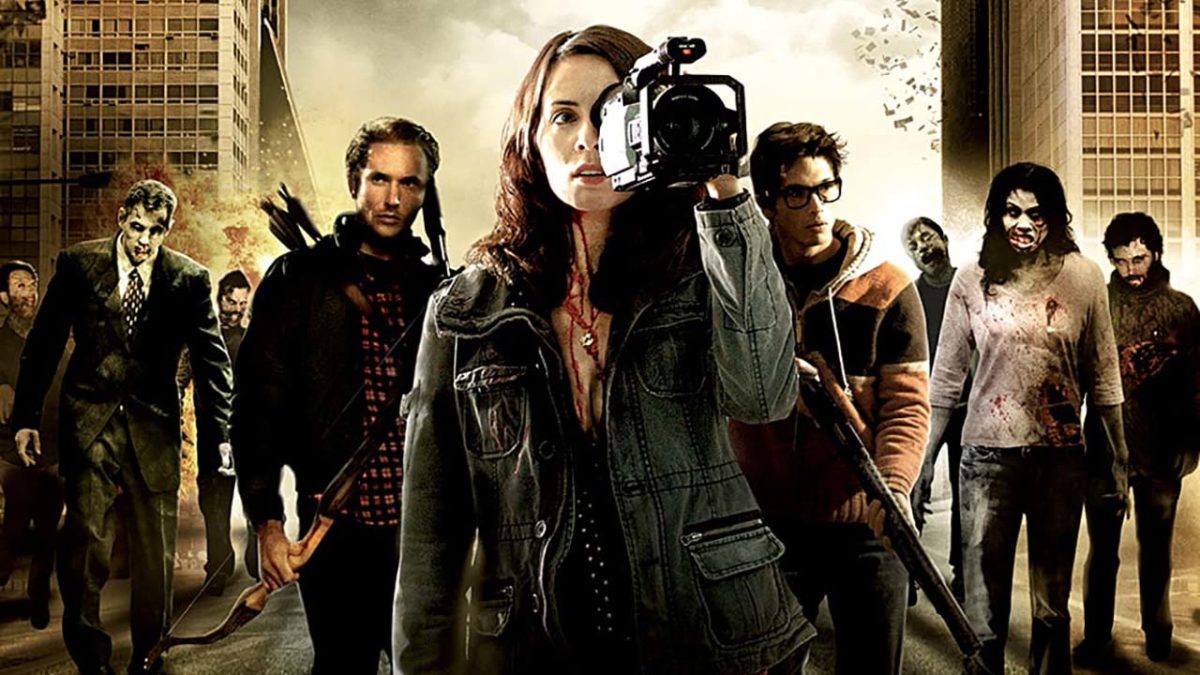
This is not an opinion you’re likely to find anywhere else on the internet, but we are prepared to argue that Diary of the Dead is one of the best of the entire George A. Romero zombie cycle. It sports the best special effects, is the least repetitive or trigger-happy, and is a welcome return to the focused social satire of the first (Night) and second (Dawn) installments.
Curiously, Diary of the Dead is the first to break the continuity of Romero’s ongoing story of society in zombie meltdown. The first four films follow a rough chronology: Night of the Living Dead depicts the initial wave as seen by a small group caught in a country farmhouse. Dawn of the Dead takes place a few weeks later, showing the breakdown of cities (and even the media). Day of the Dead featured an isolated group surviving in isolation as the world was long since overrun by the undead. Land of the Dead shows the ultimate gated community fall to an evolved zombie horde. But Diary of the Dead is a return to the early days of the outbreak, a more fertile ground for storytelling: you never get tired of human characters witnessing such horrors for the first time.
Saving the human race, one nonfiction documentary short subject at a time
The rules are still the same: simply, the dead don’t stay dead. The zombie epidemic is not due to a plague or virus, which was the potent contribution of Danny Boyle’s 28 Days Later to the zombie genre. Arguably, Romero’s concept is more bleak. A virus might be mitigated or even cured, but if anybody, anybody at all, that dies will revive as a unintelligent carnivorous monster that feels no pain and never tires, it cannot be stopped. If humanity is to somehow regroup and survive, it will forever have to burn or decapitate anyone that ever dies.
Diary of the Dead opens on a group of University of Pittsburgh film students making a tongue-in-cheeck mummy movie in the woods of Pennsylvania, under the guidance of alcoholic Professor Maxwell (Scott Wentworth). Many of these kids are privileged, but judging from the events of Romero’s other films, we know that the luxuries of the rich are of little worth against the living dead. But none of these movie aficionados have ever seen any of Romero’s films, otherwise they’d be more prepared.
One of them, Eliot (Joe Dinicol), wears Coke-bottle glasses in an apparent homage to Romero’s famous spectacles. Budding director Jason Creed (Joshua Close) looks down his nose on the commercial horror genre, and has the not-so-secret ambition to become a documentary filmmaker. But Jason gets his chance to do both, as he documents their their flight from a real-life plague of zombies. Jason’s footage, later completed by girlfriend Debra (Michelle Morgan) comprises a film within a film: “The Death of Death.”
Romero’s scathing indictment of our broken health care system, or just some more zombie gore?
In a world in which nearly everyone carries a cellphone camera around in their pocket, “shoot me” can have a different meaning than you usually hear in zombie movies. With a batch of young filmmakers documenting a real-life tale of horror using new portable video technology, Diary of the Dead superficially resembles Cloverfield. One of Cloverfield‘s most telling moments showed a group of New Yorkers instinctively reacting to the horrible sight of a chunk of the Statue of Liberty hurtling into the middle of a street by whipping out their cell phone cameras and taking pictures to transmit to their friends.
But Diary of the Dead‘s true inspiration is actually a bit older; it rips off the basic plot of The Blair Witch Project, in which a batch of student filmmakers set off to shoot a horror film in the woods and accidentally stumble onto the real thing. Cloverfield became increasingly implausible as the fleeing teenagers cling to their cameras throughout their travails. In contrast, Diary of the Dead surprisingly sports more believable psychology than Cloverfield, constantly questioning its characters’ compulsion to document everything. Indeed, it’s one of the biggest themes of the movie.
Diary‘s mix of themes also includes the return of the media as a prominent presence for the first time since Night and Dawn. In what I felt was one the film’s only dramatic missteps, the characters first learn of the zombie breakout via radio (really? radio? in an age of instant text messaging?), and are convinced of the incredible news reports a little too quickly. But perhaps their immediate acceptance of what the voices of authority tell them is one of Romero’s points.
Two characters in Dawn of the Dead were media professionals, working in broadcast news. But in this case, something only possible in the 21st century internet age, the Diary of the Dead kids are able to become part of the medium itself. Jason starts out as a frustrated documentarian making a silly commercial mummy film, but given the chance he chooses to document. As citizen journalists, they edit their footage on laptops and post to YouTube and MySpace. They also download other clips from around the world, providing the film with what are basically a series of short vignettes. They watch as a U.S. SWAT team cleans out zombies from an apartment complex, and as counterparts on the other side of the globe document an overrun Japan. One of the spookiest clips is a brief shot from the point of view of a truck driving under a bridge from which someone has hung themselves. After the truck cab jostles the corpse, it starts to move.
Three radio monologues were voiced by horror genre luminaries Guillermo Del Toro (whose ghost story Devil’s Backbone shares some elements of the zombie genre), Simon Pegg (who paid homage to the genre as comedy with Shawn of the Dead), and Stephen King (brilliant as a heartland evangelical preacher: “Get down on your &$#@ing knees!”). There’s also a funny bit featuring a badass Amish guy, who’s deaf but handy with a scythe and dynamite.
The ending to this very short movie (a little over 90 minutes) is a bit abrupt. But given that it is narrated by Debra, it is possible she has survived beyond what we’ve seen, long enough to release “The Death of Death” in some form, perhaps after humans have reclaimed the planet. One might imagine Diary‘s premise would lend itself to a lower budget than the grandiose Land of the Dead, which starred actual stars like Dennis Hopper and John Leguizombie — sorry — John Leguizamo. But Diary sports a bigger cast, more locations, and even more accomplished CG, so it can hardly have been cheaper to make.
You’ve been reading an entry in the our George A. Romero Zombie Cycle Film Festival. Join us in revisiting all five canonical episodes in the original epic zombie saga:
George A. Romero’s sporadic zombie flicks are sometimes decades apart in production, but nevertheless form a chronological sequence telling the story of the downfall of society from every angle. Night of the Living Dead (1968) is set in the early days, with a few random civilians trapped in a farmhouse. Dawn of the Dead (1979) zooms out a little to see what’s going on in cities and suburbia, and Day of the Dead (1985) examines a final remaining pocket of survivors months into the plague.
Land of the Dead opens some time after the zombie epidemic has swept the world, and the surviving dregs of humanity have retreated behind the fortified walls of the ultimate gated community, a city dubbed Fiddler’s Green. Romero has used each of his zombie films to satirically articulate some social commentary, and here his targets seem to be big business and class warfare. Another possible allegorical target is the Israel / Palestine conflict. Have humans walled the zombies out, or walled themselves in?
A man named Kaufman (Dennis Hopper) has set himself up as mayor/president/king of Fiddler’s Green. Kaufman is very much a self-styled, capital-B businessman along the lines of Donald Trump or Michael Bloomberg, so here Romero seems to equate big business with totalitarianism. Kaufman’s machinations ensure that his supposed safe haven is actually a highly tiered class society. The rich live in high-rise comfort while the underclasses starve in skeezy street-level slums. We know society is truly depraved when caged go-go dancers are the only form of entertainment.
Wet zombies smell like wet, uh, zombies.
In the world outside, the zombies have long since eaten all humans within reach, and have nothing left to do but stand around. Despite the big budget, there only seem to be about a dozen of them. Some have returned to old routines: working gas stations, pushing shopping carts, and banging tambourines. Dawn of the Dead showed zombies instinctually drawn to the shopping mall (a new American innovation at the time) like pilgrims to Mecca. But Land of the Dead goes further and suggests they have even greater powers of logic, and can feel actual emotions such as victimization. Their leader Big Daddy (Eugene Clark) is soulful and sympathetic like Bub the zombie from Day of the Dead.
Kaufman sends minions Riley (Nathan Fillon) and Cholo (John Leguizamo) out into the infested wastelands, in caravans of heavily armored vehicles. They distract the “stench” (the derogatory term of choice for the undead) with fireworks as they loot for food and valuables to cart back to stock Kaufman’s larders in Fiddler’s Green. Riley and Cholo are old friends since fallen out, and their relationship provides the one genuinely funny bit of dialogue: happy-go-lucky Cholo tells the perpetually dour Riley: “Didn’t I tell you not to bang chicks with worse problems than you?” That’s not bad advice, actually.
The intelligent zombies, apparently feeling disenfranchised, organize and mount an attack on the city. Anyway, Riley and Cholo finally become disillusioned about Kaufman’s utopia. Together with Slack (Asia Argento, daughter of Dario Argento, who collaborated with Romero on Dawn of the Dead), they try to escape for the imagined safe haven of Canada (as if they think they are merely dodging the draft, and not the twin threats of plague and humanity’s own venal overlords). In true Romero fashion, the villainous Kaufman also happens to be a racist, shouting epithets at the zombified Cholo (John Leguizombie?) as he comes to kill him. If there ever were a point in human history when race will have truly become irrelevant, this ought to be it.
Dennis Hopper as Donald Trump — the mayor from hell, or is that the mayor OF hell?
I don’t think Romero and his zombie films would be remembered without the racially charged ending of Night of the Living Dead and the pointed satire of consumerism found in Dawn of the Dead. But if he had started out with something as unfocused as Land of the Dead, he probably wouldn’t have been. Romero admits to Parallax View that he didn’t fully work out the analogy:
I have to tell you that even when we started to shoot, I was worried that this isn’t quite clear. Who are the terrorists, is it Cholo and his gang or the zombies? And it gave me a little pause, but we had to start shooting because we had the money. I.m being perfectly honest, I have to sit down and re-analyze it and figure it out. Sometimes you just run on instinct.
Land of the Dead obviously has the biggest budget of all of Romero’s zombie cycle so far, and remains the only one with well-known stars. But it is only superficially “better” than its predecessors, featuring bigger names and more technological polish. As is the case with many a Hollywood production, raised financial stakes bring a lowering of standards and diminishing returns: more money in, more shit out. A “some time ago…” prologue montage illustrates for the slower members of the audience what zombies are all about. Perhaps the movie studio executives were pitching the film to audiences beyond the usual horror genre ghetto already versed with the zombie genre.
You’ve been reading an entry in our George A. Romero Zombie Cycle Film Festival. Join us in revisiting all five canonical episodes in the original epic zombie saga: