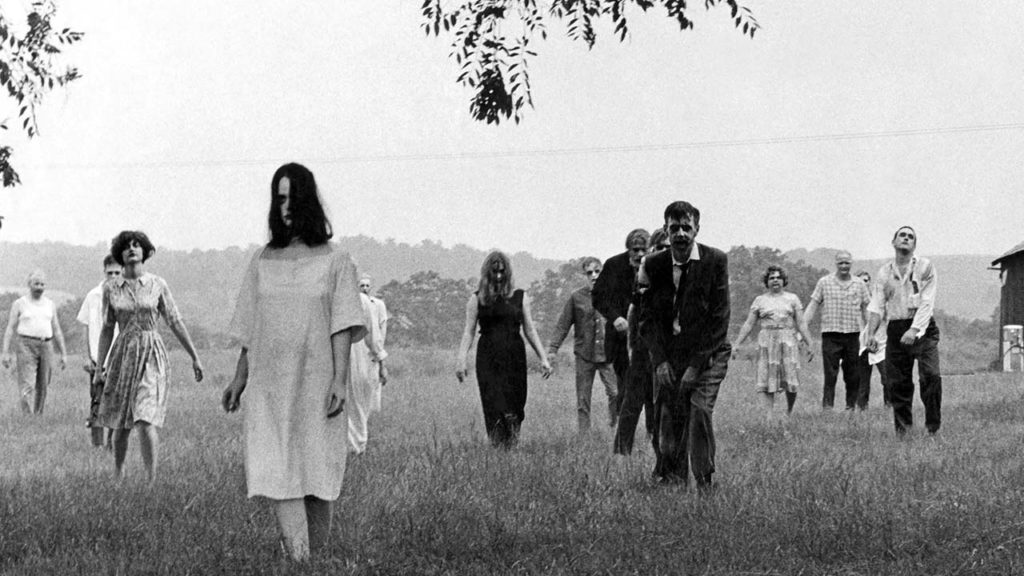
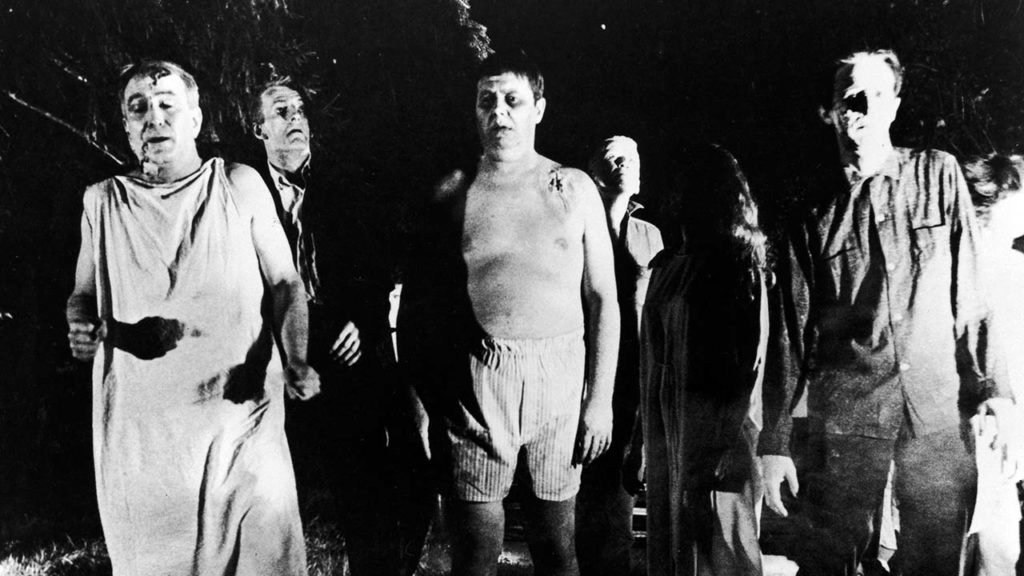
Day of the Dead (1985) is the third episode in George A. Romero’s continuing tale of civilization’s collapse in the event of a global zombie epidemic. This and the big-budget Land of the Dead (2005) are tied for the worst entries in the series. What makes the first two (Night and Dawn) of merit is their surprisingly acute social satire, but here Romero loses his critical focus in favor of gore and general unpleasantry with little redeeming value.
After the initial wave of undead in Night of the Living Dead and the collapse of cities and suburbia in Dawn of the Dead, Romero now jumps still forward in time. Several months into the zombie plague, a dozen humans huddle isolated in an underground bunker. Their fortress is sufficient to protect them from the barbarians outside the gates, but they have lost radio contact with the outside world. They make occasional sorties to nearby cities via helicopter, but encounter nothing but more hordes of zombies. For all they know, they are the last humans on the planet.
When there’s no more room in hell, zombies will break through the styrofoam walls
The disparate batch of survivors in Night of the Living dead was essentially a cross-section of civilization, but Romero narrows his focus here onto the military and scientific worlds. The humans trapped underground include three scientists, two civilians, and seven soldiers. All of them are slowly losing their minds save for level-headed scientist Dr. Sarah Bowman (Lori Cardille), valiantly researching a cure. As is now customary in Romero’s zombie flicks, Sarah is an atypical protagonist for a horror movie. The most capable and sane character in Night of the Living Dead was a black man (Duane Jones), a huge deal for movies of any genre in 1968, and still rare now. Sarah is a woman, another social group historically subjugated by society, not to mention typically reduced to screaming eye candy in horror movies.
The nerve-wracking 28 Days Later (2002), director Danny Boyle’s contribution to the zombie genre, borrowed this scenario of an isolated batch of male soldiers acting without command, surrounded on all sides by hostile forces, and locked in a fortress with only one woman. Not surprisingly, things get ugly. To a one, the soldiers are despicably racist and illogical. But leader Captain Rhodes (Joe Pilato) is actually correct about one key fact of their situation: the head scientist they have been ordered to defer to is indeed totally mad. Dr. Matthew “Frankenstein” Logan (Richard Liberty) is more interested in domesticating zombies into slaves than he is in either curing (as Sarah is trying to do) or eradicating them (as, naturally, the soldiers would have it). His star lab rat is a captive zombie dubbed Bub (Sherman Howard). The chained and tortured Bob is surprisingly sympathetic, possibly even moreso than heroine Sarah. He’s also the first instance in Romero’s movies of an intelligent, self-aware breed of zombie we won’t see again until twenty years later in Land of the Dead. But neither film makes much of the concept of zombies as a new life form, as opposed to the classic remorseless adversary typical for the genre.
Bub Zombie wants his MTV
As discussed in our review of Night of the Living Dead, one key aspect of the zombie genre that has fueled its continuing appeal over the years is that a plague is a great leveler. Everyone is vulnerable to disease. Everyone is equal after death (or is that undeath?), be they male or female, rich or poor, of any race. And for the survivors, once society breaks down (and it always does when the undead walk the streets), all the money and creature comforts in the world become irrelevant.
You’ve been reading an entry in our George A. Romero Zombie Cycle Film Festival. Join us in revisiting all five canonical episodes in the original epic zombie saga:
Zombie godfather George A. Romero waited more than a decade to create Dawn of the Dead, the first sequel in his zombie cycle that would eventually number five (soon to be six) installments. Night of the Living Dead was marketed under the tagline “They won’t stay dead,” which beautifully told audiences all they needed to know. Still, the marketing teams behind Dawn of the Dead were able to find room for improvement and crafted the even more memorable “When there’s no room in hell, the dead will walk the earth.” Gone is the classic oxymoron “Living Dead.” Now and for the rest of Romero’s zombie movies, the foes are known simply as “The Dead.”
Dawn of the Dead doesn’t feature any characters from the original film (unsurprising, as none of them made it through alive), but there’s no reason why it can’t be seen as taking place about three weeks after the onset of the same plague witnessed by an isolated bunch of people in the Pennsylvania countryside in the original film. This time around, we open in Center City Philadelphia, as a different batch of survivors nobly keep a television station operational as society slowly collapses about them. Conditions eventually break down in the studio as well, and two of them selfishly escape to seek safe ground via helicopter. As they lift off, note the best image of all Romero’s zombie films: in the background, lights eerily switch off floor-by-floor in a skyscraper. In a rare case of artful restraint on Romero’s part, his camera lingers on the scene just long enough for it to register.
Bringing new meaning to the phrase “shop ’till you drop”
The team of survivors includes two contrasting pairs. Pilot Steve (David Emge) is the weak link in the group, while station manager Gaylen (Francine Parker) is the heart and brains. Two very different SWAT commandos throw their lot in with these civilians: the diminutive but athletic and enthusiastic Roger (Scott H. Reiniger), and the tall, quiet, and serious Peter (Ken Foree). But together, the two soldiers are more than the sum of their parts and manifest leadership qualities. Echoing the social subtext of the original film, race becomes irrelevant (Peter is black and Roger is white) and the two become fast friends.
Gaylen, Steve, and Peter in their consumerist paradise
The four set down upon the roof of a suburban shopping mall, a relatively new American invention in 1979. They purge it of lingering zombies and turn it into what is equal parts fortress and paradise. It is here where one realizes that Dawn of the Dead is probably the most openly satirical of all Romero’s zombie movies. It’s impossible to miss the critique of our materialist consumer society, as these survivors gleefully take whatever they want off the racks, for free. Even the stoic commandos are thrilled by the opportunity to go on an unlimited shopping spree. They live off fine wine and canned caviar as the barbarians are literally at the gate. You know it’s the end of the world when shopping mall muzak is the soundtrack for our heroes’ systematic mass zombie slaughter and corpse collection. Infamous Italian horror director Dario Argento composed the soundtrack as well as served as script consultant.
Roger is not a morning person, it seems
Unfortunately, Dawn of the Dead fizzles with a weak ending, especially compared to the pitiless conclusion of Night of the Living Dead. Internal strife and the zombie hordes assembling outside are not their only problems. A ragtag caravan of roadwarrior survivors arrive and disrupt the stalemate. But the central consumerist satire still resonates enough for the movie to have been effectively remade in 2004 by director Zack Snyder, without Romero’s involvement.
You’ve been reading an entry in our George A. Romero Zombie Cycle Film Festival. Join us in revisiting all five canonical episodes in the original epic zombie saga:
I haven’t had the pleasure of seeing what is now recognized as the first zombie movie ever made: White Zombie (1932), starring none other than Bela Lugosi. But arguably, George A. Romero’s Night of the Living Dead (1968) is the actual zombie urtext. It preceded the first of its four official sequels by almost a decade, but laid down the definitive template for the great flood of derivatives, remakes, homages, and ripoffs to come. Night of the Living Dead is in the public domain, and can be legally downloaded for free from Archive.org.
One may wonder about the mental health of such obsessive zombie fans, but now that this blog is hosting a Romero Zombie Cycle film Festival, I must now count myself among them. Also, the word “zombie” is just kind of fun to say. Zombie, zombie, zombie. Perhaps sensing the recent spike in the zombie zeitgeist, Romero himself has picked up the pace of his zombie cycle, adding fresh new entries in 2005 and 2007, with yet another planned for the near future.
What exactly is the appeal? The basic zombie conceit is uncomplicated. Indeed, the Night of the Living Dead marketing tagline “They won’t stay dead!” pretty much says it all. Simply, any and all dead people (no matter what the manner of their expiration) will inevitably come back to life as unthinking, unfeeling, carnivorous monsters. There’s something pure to Romero’s original concept, without the complexities added by later zombie stories. Horror and science fiction blog io9 posits that war and social upheaval correlate with spikes in zombie movie production. Danny Boyle’s 28 Days Later (2002), forever retooled the zombie concept for a world obsessed with contagious diseases (SARS, AIDS), and the essentially animalistic badness of human nature (torture, terrorism). Boyle’s zombies don’t want to eat; they are just plain mad.
“They won’t stay dead!”
Romero’s zombies have some rudimentary intelligence and are able to open doors, employ simple tools like bludgeons, and are afraid of fire. But they have no remnants of their former memories or personalities, and exist only to sup upon the living. Common to nearly every zombie tale is that an epidemic effects a breakdown of societal order, be it on a micro (such as the classic horror movie scenario of a few survivors locked in a farmhouse in Night of the Living Dead) or macro scale (witness the total collapse of civilization in Brooks’ novel World War Z). There’s a basic pessimism inherent in the genre; everything we regard as human is fragile. Faced with zombie hordes, the living turn on each other, cut and run, or totally shut down.
Romero & John A. Russo’s Night of the Living Dead screenplay includes some pseudo-scientific technobabble concerning a returning space probe contaminated with radiation from Venus, but for all intents and purposes the origin of the phenomenon is irrelevant to the story. Later zombie films would introduce the concept of a blood-transmitted virus, but it is irrelevant here whether or not any victim is contaminated by a germs or extraterrestrial radiation. Merely dying is all it takes to become a monster. In a way, Romero’s original conception of the zombie, absent of any plague metaphor, is the bleakest of all variants. Human society will be forever changed in a world in which even those that die naturally will have to be decapitated before they revive as beastly ghouls.
Ben (Duane Jones) greets the undead hordes
Like all of Romero’s zombie flicks, Night of the Living Dead is set in the Pittsburgh, PA area (except Day of the Dead, which is the odd one out for many reasons to be discussed in the forthcoming review). The opening sequence is set in graveyard littered with American flags, perhaps meant as a silent allusion to the vast numbers of fresh corpses being sent back from the Vietnam War. A random assortment of survivors barricade themselves in a farmhouse. Romero tells Parallax-view.org that the cast and crew actually lived in that farmhouse while filming: “We had no bread. We were literally sleeping out of that farmhouse, chopping ice out of the tank behind the toilet bowl in order to wash our faces, and we were taking baths out in the creek.”
In the best horror movie tradition, we have a cross-section of society with representatives of every gender, age, class, and race: a traumatized woman, a young couple, a classic nuclear family, and a lone black man. For all intents and purposes, their various social standings are erased as they all must unite to defend themselves against a common foe. Ben (Duane Jones) proves himself the most intelligent, sane, and capable of the bunch. But the humans can barely agree on anything, and expend most of their energy on infighting. One suspects that they wouldn’t be able to get along even without the zombie hordes assembling outside.
Night of the Living Dead is notorious for remaining unrated by the MPAA, proudly showcasing a considerable amount of gore (and even a little nude zombie derriere) unprecedented in 1968. But I think it’s fair to say that the true reason the movie is remembered as more than a cheapie horror flick is its African American protagonist. Of superior intelligence and maturity than everyone else, he alone (spoiler alert!) survives while the rest of the gang self-destructs.
But unbeknownst to him, authorities have mobilized to sweep the countryside in order to execute any and all shambling zombies. It’s impossible to ignore this group’s resemblance to a lynch mob of the white male establishment, bearing scythes and hunting rifles. Given this scenario, one might predict the powerful, racially charged ending. In an interesting stylistic choice, the final sequence is told as a photomontage, a series of still images showing us the tragic aftermath of what happens when the supposedly civilized “living” are given free reign to indulge in their bloodlust.
You’ve been reading an entry in our George A. Romero Zombie Cycle Film Festival. Join us in revisiting all five canonical episodes in the original epic zombie saga:
In 2007, the National Science Foundation invited legendary filmmaker and documentarian Werner Herzog to make a film about Antarctica. With only seven weeks to plan and shoot, and with an austere crew of exactly two (Herzog himself and cinematographer Peter Zeitlinger), he produced the stunningly beautiful film Encounters at the End of the World.
Right away, Herzog declares he is not a “tree-hugger” or “whale-hugger.” Instead, he wonders why civilization is more concerned about endangered species than it is about its own disappearing languages and cultures. He made it clear to his sponsors that he had no interest in making “another penguin movie,” of course a backhanded reference to the smash hit documentary March of the Penguins. For a brief period around 2005, it seemed everyone was obsessed with the peculiar lifecycle of penguins, finding in them metaphors for everything from the sanctity of marriage to evidence of homosexuality in nature. But it turns out even Herzog couldn’t resist the pathos inherent in the penguin lifestyle. He became fascinated by the regular occurrence of individual penguins becoming disoriented, and determinedly marching off alone to certain starvation and death. His camera catches one obliviously scooting off towards the mountains, away from the relative safety of the ocean and his comrades.
Some of the otherworldly underwater footage by Henry Kaiser the inspired Herzog to investigate Antarctica
But Herzog is interested more in the humans that migrate to Anarctica. As is his custom, he narrates the film himself and openly wonders whom he will find there. Some of the unusual characters he encounters are a philosopher operating a forklift, a humanitarian driving a bus (the continent’s single largest vehicle), a linguist tending plants on a continent with no languages, and a journeyman plumber descended from Aztec royalty. Most Herzog-ian of all is an Eastern European man unable to speak of his traumatic escape from “behind the iron curtain.” He keeps a large backpack full of survival gear, everything he would need should he have to leave at any moment. He puts it as being “in search of adventure,” but it seems he has left many places before he came to this one, so he is most likely doing more escaping than adventuring. He is not unlike Dieter Dengler, the subject of Herzog’s Little Dieter Needs to Fly (1997), who keeps a cache of foodstuffs in his home long after escaping a Laotian prison camp in 1966.
Werner Herzog & Peter Zeitlinger
Antarctica represents “the end of adventure.” There are no more “white spaces on the map.” But most of the people Herzog finds there are scientists, making it clear that there are many discoveries left to be made. Of interest to Herzog is not only the research itself, but why it is being conducted in one of the most inhospitable places on earth. Zoologists study naturally tame seals, especially enjoying their truly bizarre underwater communication that one likens to Pink Floyd.
Geologists flock to Mount Erebus, one of the the earth’s only three stable open volcanos, whose “lava lake” is essentially the Earth’s exposed mantle. The world’s only two other open volcanoes are both located in politically unstable countries, it being preferable for scientists to risk being pelted by exploding bombs of molten rock in subzero temperatures than to be shot by bullets in hotter climes.
In a separate experiment, The University of Hawaii is attempting to detect neutrinos. These subatomic particles are omnipresent in abundance, but are almost impossible to observe directly. The reason to come to Antarctica is to escape the distorting background radiation of civilization, a metaphor if I’ve ever heard one.
Herzog dedicated Encounters at the End of the World to critic and longtime advocate Roger Ebert. It was nominated for an Academy Award for Best Documentary, his only nomination to date. How the Academy could overlook the sublime and haunting Grizzly Man (2005) is beyond belief.
I saw Henry Selick and Neil Gaiman’s Coraline on its opening day in my favorite movie theater, the best possible venue to see any remotely visually ambitious movie: the Clearview Ziegfeld in New York City. Fittingly, my tickets were misprinted “Caroline,” a misnomer that is a recurring plot point.
Coraline was written and directed by stop-motion animation genius Henry Selick, whose patient and precise hands also created the utterly mad pleasure The Nightmare Before Christmas (often erroneously credited to Tim Burton, who produced). As if Coraline needed any finer pedigree, it was based on the fine novella by Neil Gaiman. Gaiman is a longtime favorite of this blogger, at least since my buying the very first issue of The Sandman new off the rack in 1989.
Coraline and his later The Graveyard Book are both ostensibly aimed at “young adults,” which I guess means whomever is old enough to understand most of the words. Such a categorization is more about marketing and the convenience of knowing where to shelve titles in bookstores and libraries, anyway. As is also the case with his children’s books The Day I Swapped My Dad for Two Goldfish and The Wolves in the Walls (both illustrated by frequent collaborator Dave McKean), they’re all basically for anyone that likes to read.
Coraline traverses the portal into John Malkovich’s brain
Gaiman, once famous for possibly having the record for most unproduced projects in Hollywood, has been tearing up the movie biz of late. Just to name a few highlights, he wrote the script for McKean’s sumptuous film Mirrormask, had his fantasy novel Stardust (originally illustrated by Charles Vess) adapted into a film by Matthew Vaughn, and co-wrote the brilliant script for Robert Zemekis’ Beowulf with Roger Avery. As is his custom now for all his pending projects, Gaiman has been blogging and Tweeting about the Coraline adaptation all along, a process rudely interrupted by his winning the Newbury Medal for The Graveyard Book. His mantle is now officially groaning under the weight of all his trophies, medals, Very Important Prizes, and suchlike.
Gaiman was not directly involved with the making of Coraline (beyond being on good terms with the filmmakers and making the occasional consultation), but was pleased the finished product and especially with how well it was marketed by Weiden+Kennedy. Frequent readers of his blog will be familiar with how he blames Stardust’s relatively disappointing box office (in the US, anyway) with a marketing campaign that misrepresented what the film was actually like (the precise analogy he used went something like “more Princess Bride, less Ella Enchanted“). But I feel that this kind of heightened level of communication between artist and audience made possible by the internet might sometimes be too much information.
Close to the release of Stardust, I recall Gaiman urging readers to see the film on opening weekend or even opening day if at all possible, the narrow window that in today’s movie industry determines the perception of success or failure. This time around, he made a point of mentioning that Coraline‘s production company Laika had basically bet the entire farm on the film. I have been working for movie companies for years and am familiar with perpetual job insecurity. I was happy to go see the film right away anyway, but I would have rather not worried about whether or not I was protecting someone’s job. Thankfully, Coraline appears to have performed above expectations on its opening weekend, and all is well.
The Other Father gives us our 3D money’s worth
Apologies for the rambling preamble. On to the movie: Coraline (voiced by Dakota Fanning) and her family move into the ground-floor apartment of a crumbling rural house. Her parents are busy gardening writers without the time to actually garden, let alone to pay much attention to their only child. Coraline’s biggest problem is that she’s unhappy at being so often left alone. I suspect that most overprotected kids whose parents take them to see this movie will have trouble identifying with a kid who has too much freedom.
The residents of the neighboring apartments are at least as eccentric as those of The Sandman‘s The Doll’s House. Russian acrobat Mr. Bobinsky (Ian McShane), may or may not be training rodentia to take part in a Mouse Circus. Coraline gets off on the wrong foot with unloved oddball Wybie (Robert Baily, Jr.), who takes his name from “Why be born.” British comedy duo Dawn French and Jennifer Saunders appear as Misses Spink & Forcible (two Gaiman-esque names if there ever were any), a pair of well-aged actresses living in the basement.
Coraline discovers a long-forgotten doorway hidden behind furniture and layers of wallpaper. Not unlike the very similarly diminutive door in Being John Malkovich, it is a gateway to another world. Whereas the portal to Malkovich’s brain resembled the gross inside of a digestive tract, this one is part cobwebby cave and part glowing funhouse tunnel. On the other end of the door is another, better version of Coraline’s milieu.
In the real world, no one gets Coraline’s name right, but in the Other World, everyone knows her. She is well fed, the garden is a luxurious Eden sculpted in her image, her bed is made, and her toys are new. But alas, her Other Mother (Teri Hatcher) has constructed this enticing simulacrum just to ensnare her. Coraline is about to abandon the real world for this coddled existence, when she is given the price: she must sew buttons over her eyes. This is point in the film when adults squirm and kids squeal with delight. Creepy, creepy, creepy!
The Other Mother serves Other Omelettes for breakfast
Roughly the first three-quarters of the film is genius-level setting of tone, character, and atmosphere. It falters only when a rigid plot structure appears out of nowhere and forces the narrative onto fixed rails. Cat (Keith David), the only other creature that can travel between worlds, tells Coraline that the Other Mother likes games. This key characteristic would have been better shown than told, for Coraline is able to turn the tables by simply challenging her to a game. The Other Mother immediately acquiesces, and is apparently unable to resist a game in the same way that the mythological Sphinx can’t resist a riddle (a plot point that also figures in Mirrormask).
Coraline’s challenge is equal parts game and bet: if she can find the five souls The Other Mother has trapped before her (her parents and three other children), she must release them all. Finding three hidden objects hidden in different virtual worlds is a classic video game scenario. Coraline has no shortage of other MacGuffins to lose and recover, including a key and an Eye Stone (a magical jewel fortuitously provided by the actresses). Indeed, a tie-in videogame exists, which no doubt doesn’t have to stretch the story to structure its own narrative.
Also disappointing are the three children the Other Mother has already captured. Their trio of cutesy voices that compliment and encourage Coraline are the most conventional aspect of the film, not in keeping with the rest of the film’s enjoyably macabre tone. But actually, maybe this all makes sense… the kids are definitely not as bright and spunky as her, for she alone has the brains to escape and defeat the creature.
The comedy stylings (and alarmingly large bosoms) of French & Saunders
Stop-motion animation is one of the oldest filmmaking techniques, but Laika (based in Portland, Oregon) and Aardman Animation (makers of Wallce & Gromit and Chicken Run) are still making films more dazzling than the most advanced CGI. The reason is quite simple: you’re looking at moving photographs of physical objects crafted by human hands. Like Beowulf, Coraline is being shown in many theaters in 3D. If possible, the technology seems to have improved even since U23D, let alone since the 1950s. But as animated movies such as The Incredibles and WALL-E have proved, all the technology in the world must play second fiddle to a good story.
Gaiman has been saying in interviews lately that his books for kids are creepier than his novels for adults (including American Gods and Anansi Boys). In keeping, Coraline is wonderfully deranged, weird, and twisted. By far the eeriest sequence is the opening credits, featuring the hands of a creature we later learn is the Other Mother, ritually disemboweling a puppet and reconfiguring into a simulacra of Coraline. Watchdog site Kids-In-Mind nearly goes into meltdown counting the discrete instances of violence and disturbing imagery, and expect to read a great many reviews cautioning parents to keep sensitive kids away. But I suspect most kids will love this film, and will probably be better off for having their imaginations poked and prodded in ways that safer pap wouldn’t. One of the reasons I love movies is to experience the mad visual imaginations of directors like Selick (and Burton, McKean, Terry Gilliam, Michel Gondry, Tarsem, etc.), and it’s a good thing “kids’” movies like Coraline are here to warp youngsters minds early.
Redbelt is writer/director David Mamet‘s ode to jiu-jitsu, of which he himself is reportedly a purple belt. Mike Terry (Chiwetel Ejiofor) is a struggling black belt jiu-jitsu instructor, one of the few remaining practitioners of martial art in its authentic Japanese origins.
The professional combat sport association MMA (Mixed Martial Arts) has tainted the martial art with commercialism and spectacle akin to professional wrestling. In contrast, Terry is a noble warrior with an absolute code of honor, like Robert Scott (Val Kilmer) in Mamet’s Spartan (2004). Terry is a former special forces soldier, with a past in one or both Gulf Wars he does not wish to discuss. One of his favorite aphorisms becomes something that he realizes he must live up to himself: “There is no situation from which you cannot escape.” He’s a fearsome fighter, able to win a bar fight without throwing a single punch. But another of his aphorisms, “competition is weakening,” reflects his choice to teach self-confidence and reliance, not aggressive combat.
“Competition is weakening”
Like many of Mamet’s films, Redbelt features many of his regular stable of actors: Rebecca Pigeon (Mamet’s wife, who also performed the music), Ricky Jay, David Paymer, Joe Mantegna, and a cameo from Ed O’Neil. Anyone familiar with Mamet’s films would know to suspect a character played by any one of these actors is up to some mischief, especially if the latter two are seen to be in any kind of collusion. Significantly for a playwright/writer/director known for his characteristically dense dialog, the last long sequence is mostly wordless.
Mamet states Redbelt is firmly in the fight film genre, singling out the two recent examples of Million Dollar Baby and Cinderella Man. Like the superb Spartan, it’s also something of a samurai movie. Just don’t call it a martial arts or action flick. It also includes healthy doses of two other Mamet obsessions: the long con and the corruption inherent in business. The most obvious advantage of the long con in storytelling terms is that it automatically provides a structure for a fiendishly complex plot, as it did for both House of Games (1987) and The Spanish Prisoner (1997).
“There is no situation from which you cannot escape”
Mamet’s recurring theme of institutional corruption in the business world is probably best expressed in Glengarry Glen Ross. But in his book Bambi Vs. Godzilla (2007) and movie State & Main (2000), Mamet reveals the one particular business that fascinates him the most: Hollywood. As he states in the electronic press kit included in the Redbelt DVD, moviemaking is a business like any other, but the particulars of its moral bankruptcy fascinate him.
This manifests in Redbelt as Terry is seduced by Hollywood as embodied by aging action star Chet Frank (Tim Allen). Frank first finds leverage in the fact that Terry is broke, but also recognizes that he is is secretly prideful, and seeks approval and recognition for the burden of honor he has been carrying for so long. These flaws make him manipulatable. Frank initially seems to provide the solutions to his problems, but turns out to be the precise inverse of his name: all empty promises, facades, scams, and pretense.
The two corrupt worlds of Redbelt are both hungry for meat: professional sports need fighters to run through the grinder, and the movie business eats up ideas as raw material for its product. They find both in Mike, and neither wants to pay for what they try to take from him.
As a huge title card reads immediately at the end of the film, Solaris was “written for the screen and directed by Steven Soderbergh.” I am a big admirer, but that seemed a bit egotistical even to me. Perhaps an overenthusiastic end-credits designer is to blame? Or maybe the studio wanted to capture some more of that lucrative Ocean’s Eleven magic by playing up the Soderbergh/Clooney brand?
But writing and directing credits, however many feet tall, barely begin to describe Soderbergh’s role. For this and many of his other films, he serves as his own Director of Photography (and even physical camera operator) under the pseudonym Peter Andrews and also as editor under the name Mary Ann Bernard. So, obviously, Soderbergh is one of the few mainstream filmmakers with the luxury of near-total control over his films. Like Kubrick, he produces, writes, directs, operates the camera, and edits. But while Kubrick was a control freak (in the best sense), the modest Soderbergh is lauded as being more collaborative and especially as a sensitive director of actors.
“I was haunted by the idea that I remembered her wrong, and somehow I was wrong about everything.”
The DVD edition includes an excellent commentary track of Soderbergh in conversation with co-producer James Cameron, the original director attached to the project. Soderbergh asks Cameron what he thought of how he approached the material. Cameron points out that Soderbergh took a more “internal” approach than he would have, and both agree in good humor that Cameron would have included more car chases. More than Soderbergh’s grand total of zero, anyway.
Depending on how you count, Soderbergh has only directed two remakes: Ocean’s Eleven and Solaris (The Limey was a kind of homage or mash-up remix of the English crime classics Point Blank and Get Carter). The source material of the Polish novel Solaris by Stanislaw Lem has proven a rich mine for cinema. Russian filmmaker Andrei Tarkovsky directed the original adaptation in 1972 as the Eurasian answer to 2001: A Space Odyssey. The basic concept also drove films as diverse as Paul W.S. Anderson’s Event Horizon (which is horrible but has uncommonly spectacular special effects and art direction) and Danny Boyle’s Sunshine. Soderbergh’s version of Solaris is credited as being based more on the original novel the 1972 film, with barely a mention of Tarkovsky even in the DVD commentary track. In his essay for the 2002 Criterion Collection edition of the original Solaris, Phillip Lopate states that Lem was unhappy with Tarkovsky’s interpretation, and was looking forward to what he expected to be a more faithful translation by Soderbergh.
“And death shall have no dominion.”
Solaris is set at an unspecified point in the future, distant enough for humanity to have perfected the technology to leave the solar system. Kelvin (George Clooney) is a shrink who is himself deeply emotionally damaged. Indeed, the theme of both this and the original film could be summed up as “physician heal thyself.” We first see him hosting a group therapy session for survivors of an unspecified tragedy. Since the movie was released in 2002, it’s possible this was intended as an analogy to a 9/11-like event. But judging by how every scene set on Earth is drenched in darkness and persistent rain, perhaps there was some kind of ecological catastrophe.
Single and with no family, Kelvin is an ideal candidate for a solo trip to investigate mysterious goings-on in a space station orbiting the distant gas giant Solaris (pay attention for the brief cameo by John Cho as a governmental emissary). Unlike Tarkovski’s extremely leisurely pace, this version wastes no time; Kelvin’s boots are on the space station less than 10 minutes into the film. This is the point where any readers wary of spoilers ought to stop reading.
Kelvin encounters Snow (Jeremy Davies, supremely well-cast), a man understandably gone stir-crazy from being cooped up on a haunted space station. But it becomes clear that he himself may be one of the forces doing the haunting. Evidently, the planet Solaris somehow draws upon the strongest emotional resonances in visitors’ brains and manifests them as living beings. These incarnations are most decidedly not a blessing for anyone. For Clooney, it’s an echo of his dead wife Rheya (Natascha McElhone); for the captain Gibarian (Ulrich Tukur), it’s a copy of the son he left behind on earth; for Snow, it’s… another version of himself. The “Snow” that Clooney meets is, in effect, his own ghost; he killed his own creator within seconds of his birth. The faux Snow’s weird behavior is not that of a man gone mad but of a not fully-formed human, bluffing his way through unfamiliar human interaction. One has to wonder what kind of man is so alone or self-obsessed that the most important person encoded in his emotional memories is himself.
“I could tell you what’s happening, but I don’t know if it would really tell you what’s happening.”
Kelvin and Rheya originally bonded over the Dylan Thomas verse “and death shall have no dominion,” but the emotionally fragile woman committed suicide after he left her. Tortured by the renewed presence of her in his life, and the perplexing puzzle of Snow’s doppelgänger, he begins to question his own existence: is he someone else’s ghost? But he doesn’t take the question to the next logical step: is there anyone in the world with enough emotional investment in him to cause him to haunt them?
Solaris is both Soderbergh and Clooney’s first and only science fiction. It was marketed with a misleading poster suggesting a romance while obscuring any hint of science fiction. Even after Batman & Robin, it is admittedly kind of funny to see Clooney in a spacesuit, especially when he was relatively early in his career as a movie actor (after years in television sitcoms and dramas). One can’t imagine Clooney’s Hollywood ancestor Cary Grant appearing in a space opera.
But Solaris tries to have it both ways: to be somehow above science fiction but still be overloaded with enough pseudo-scientific technobabble to fill several Star Trek epics. The sensitive, emotional tone of the film is shattered as soon as scientist Gordon (Viola Davis) starts lecturing the audience about proton beams breaking up fields of Higgs Particles (or something along those lines). Such technobabble cheapens the premise. Indeed, the talky screenplay makes everything too explicit and concrete, especially compared to 2001: A Space Odyssey, which says so much more with so many fewer words.
The opening credits of Andrei Tarkovsky’s 1972 film Solyaris state it is “based on the science fiction by Stanislaw Lem.” It’s perhaps telling that the term “science fiction” is used in place of simply “novel.” This faint hint of apology may hint at a lack of respect for the original Polish novel or the entire science fiction genre as serious literature. A similar ambivalence echoes decades later in the advertising campaign of director Steven Soderbergh’s2002 remake, emphasizing the romantic melodrama over the fantastic, futuristic setting.
Stanley Kubrick’s 2001: A Space Odyssey had arrived only a few years before Solaris, and was by a long shot the most serious stab at intellectual, literary science fiction cinema yet filmed. In his essay for the 2002 Criterion Collection DVD edition of Solaris, Phillip Lopate outlines three ways Tarkovky wished to distance his film from Kubrick’s. He found 2001: A Space Odyssey “cold and sterile,” and set out to infuse his own science fiction with “passionate human drama.” Unlike its predecessor’s gleaming high-technology, Tarkovsky built run-down and filthy sets for the space station, and found futuristic earthbound locations in the contemporary cars and architecture of Japan. Finally, Lopate points out that Solaris shares more themes with Alfred Hitchcock’s Vertigo than 2001, namely, “the inevitability of repeating past mistakes.”
Kelvin sees dead people
The links between the two films go beyond the thematic into the political; Solaris is frequently cited as the Soviet Union’s answer to 2001: A Space Odyssey, so it ought to be viewed in the context of the Cold War. 2001: A Space Odyssey preceded actual manned moon landings, the US’ most definitive victory in the space race. Kubrick’s visuals were so effective that they spawned the still-simmering rumor that the moon landings were falsified using footage directed by Kubrick. But before all this, 2001: A Space Odyssey must have seemed like a threat or promise made to the USSR: saying, in effect, that the US is going to be first in space and the first to make first contact with alien intelligence.
So in this context, it’s hard not to interpret Solaris as at least partly a propaganda countershot. It too illustrates how the society of its makers and audience also have the brainpower and resources to extend their empire into space. But most unlike 2001: A Space Odyssey, Tarkovsky and co-writer Fridrikh Gorenshtein never allude to politics or even mention the names of other countries.
Kubrick’s film envisions no end to the Cold War, even at least thirty years into the future. Kubrick’s vision of the future is actually a wicked satire, showing how little he expects humanity to evolve despite significant technological advances. His future humans still engage in petty squabbles and apocalyptic brinksmanship in the face of a potentially paradigm-shifting revelation: the discovery of definitive evidence of alien intelligence in a manufactured monolith buried on Earth’s moon. The US scientists and government officials investigating the monolith seem unmoved by the powerful notion of alien contact, and instead hold boring boardroom meetings and pose for photographs.
In stark contrast, Tarkovsky’s Solaris has no sense of humor at all, about anything. Perhaps the most significant trait Solaris shares with Kubrick is a penchant for long takes. As Lopate also notes in his Criterion essay, atypically for a Russian filmmaker, Tarkovsky favored long takes over Eisensteinian montage.
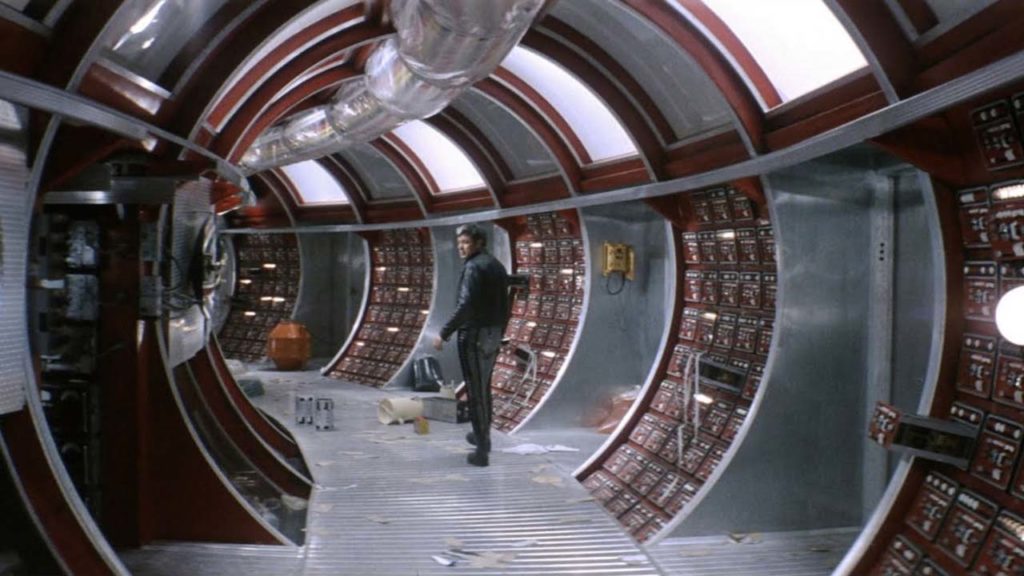
Kelvin inspects the ductwork
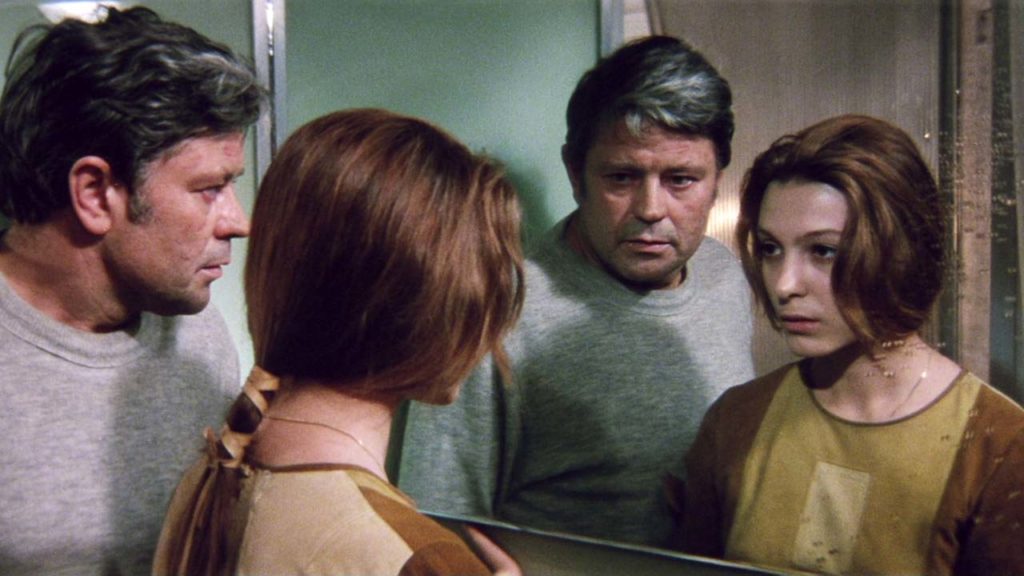
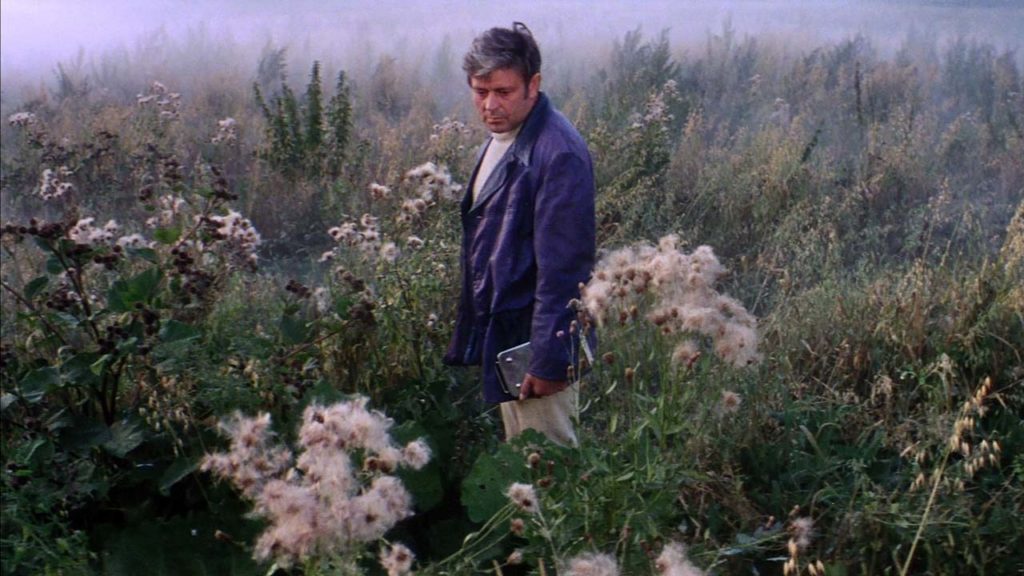
In this vision of the future, the Soviet Union operates a scientific research station in orbit over the ocean planet Solaris. An entire school of study called Solaristics has sprung up around the study of the ocean’s peculiar properties. Astronaut Berton (Vladislav Dvorzhetsky) returns to Earth with controversial claims that the Solaris ocean somehow creates physical manifestations of landscapes and monstrous creatures on the planet’s fluid surface. Dr. Gibarian (Sos Sargsyan), still stationed at Solaris, sends for his old friend, psychiatrist Chris Kelvin (Donatas Banionis). Berton, haunted and prematurely aged by his experiences, visits Kelvin at his father’s home in an attempt to warn him about what he is surely to experience, but Kelvin rudely dismisses him. We later learn the source of Kelvin’s misanthropy: his wife Hari (Natalya Bondarchuk) committed suicide after he left her some years before.
Kelvin arrives at Solaris to discover that Gibarian has already committed suicide. The strange manifestations Berton reported on the Solaris oceans are also occurring on board. Every surviving scientist still aboard the space station is haunted by “guests,” their euphemism for the apparitions that, as best they can determine, are somehow culled from their most emotionally intense memories. In due course, Kelvin’s dead wife reincarnates in a confused, partially-formed state. She is dazed and doesn’t quite understand who she is or why she is there, and doesn’t “remember” that she is dead. When she tries to undress, she discovers her dress is completely sewn shut; Kelvin’s imperfect memories of her apparently don’t include buttons ‘n’ zips. Kelvin also experiences feverish nightmares in which he confuses Hari with his long-dead mother.
The twice-doomed Hari (Natalya Bondarchuk)
In a kind of filmed suicide note, Gibarian tells Kelvin the manifestations have “something to do with conscience,” indicating that the common origin of every guest is that they are each the primary object of guilt in an individual’s mind. Gibarian asks Kelvin “did you see her yet?” suggesting that he sent for him because he correctly predicted Kelvin’s guest would be his dead wife Hari. The presence of Gibarian’s guest (a little girl) was evidently for him an intolerable curse, but perhaps he imagines it would be a gift for Kelvin to have Hari back. But the whole situation begs the question: if the authorities know about the manifestations, why would they agree to send such a psychologically damaged man as Kelvin?
When Kelvin attempts to leave Hari alone in his quarters, the not-quite-human creature manages to smash through the doorway in pursuit. She instinctively doesn’t want to be left alone, but can’t explain why. A suitable science fiction explanation might be that she somehow senses that she may literally dematerialize when Kelvin’s brain is not within proximity. Or her newly-formed mind may be suffering echoes of what the “real” Hari felt when she committed suicide after Kelvin left her. What if Kelvin becomes comfortable living with this reincarnation of Hari, and his guilt for the original woman’s death lessens… will her reincarnation then disappear?
Kelvin at home in Mother Russia
An observation: like Lindsay Anderson’s If…, Solaris uses a mixture of black & white and color film. For most of the first hour, black & white footage initially signifies either film clips or teleconferencing (note that the film correctly predicts widescreen HDTV monitors and webconferencing in the future). But later sequences appear in black and white, without internal justification: first as Berton drives dejectedly back into the city (filmed in the city landscapes of Japan), and later as Kelvin locks himself in his cabin on Solaris. To confuse the matter still further, Kelvin brings a home movie with him from Earth, which is in color! I don’t have a theory to explain these logical discrepancies; I’m just pointing them out.
I’m surprised to find to find that I did not like the film as much as my first viewing almost a decade ago. Solaris is as talky and overwritten as its ostensible model 2001: A Space Odyssey is elegantly quiet. Totally self-serious and humorless, its three-hour running time is frankly a little trying on the patience. In his 1977 appreciation of the film reprinted in the Criterion edition booklet, Akira Kurosawa reports he was stunned by the expense when he visited the set, equivalent to 600,000,000 yen at the time.
But he defends the significant length of the early scenes set on Earth, which he interprets to be intended to instill nostalgia for Kelvin leaving nature behind forever. Indeed, the time spent on Earth in the early parts of the film does prefigure a significant homecoming at the end, when Kelvin seems to return to a dreamlike vision of his father’s house. The formerly lush and moving natural scenery landscape is now wasted and frostbit. It rains inside as well as out, suggesting a kind of baptism or rebirth in the waters of Solaris.
Lou Reed‘s 1973 album Berlin is a concept album relating the tale of a doomed woman named Caroline living in the eponymous city. The term “concept album,” then and now, invokes immediate condescension from fans and critics alike, calling to mind the progressive rock excesses of 1970s megabands The Who (Tommy and Quadrophenia), Genesis (The Lamb Lies Down on Broadway), and Yes (Tales from Topographic Oceans). The poet and arty downtown Manhattanite Reed might have better served himself by referring to Berlin as something more fancy-sounding, perhaps a “song cycle.”
Reed’s previous album Transformer was a great commercial success, debuting the enduring hits “Satellite of Love”, “Perfect Day”, and “Walk on the Wild Side”. To follow it up with something like Berlin may have been loaded with artistic integrity, but was asking for trouble in terms of making a living. I recall reading that enough material was written and recorded for it to be a double-LP, but it was too much for a single LP, so the work was unsatisfactorily edited down to a single disc before release (I can’t find a source for this factoid online, but I believe it was related in the liner notes of his 1992 retrospective boxed set Between Thought and Expression). Produced by Bob Ezrin (whose concept album credentials also include Pink Floyd’s The Wall), it was a commercial disaster at the time. So, cursed from the beginning, the full studio version has apparently never been released.
Emmanuelle Seigner in Lou Reed’s Berlin
In retrospect, Reed now seems to have been compelled to flee from commercial success, or at the very least was bound and determined not to repeat himself. Reed’s other infamous commercial disaster Metal Machine Music was another deliberate provocation: even the most open minded musicologist might charitably characterize it as earsplitting noise. But Berlin is different, hated more for its intensity and subject matter than its sound. Several of the songs are lovely, but wow is the complete work depressing, full of anger, venom, resentment, death, despair, and guilt. The song “The Kids” is especially harrowing, ending with a tape of children wailing.
“Caroline says / While biting her lip / Life is meant to be more than this”
Over time, the album was eventually rediscovered. One of those reappraising Berlin was no less than artist and filmmaker Julian Schnabel. So it came to be, that 33 years after its release, Schnabel proposed to Reed that Berlin really ought to be a film. Schnabel is obviously attracted to artists dedicated to their work with utter conviction: revolutionary New York Artist Jean-Michel Basquiat in the eponymous biopic, the gay poet Reinaldo Arenas in Castro-era Cuba in Before Night Falls, and the paralyzed writer Jean-Dominique Bauby in The Diving Bell and the Butterfly. The Berlin DVD bonus features include a brief conversation with Reed and Schnabel on Elvis Costello’s show Spectacle, in which Schnabel describes his attraction to the cinema from the perspective of a painter: he reverently refers to the canvas-like movie screen as “The Rectangle.”
Something best appreciated by seeing Reed perform live is that he is a great guitarist. He’s also visibly in surprisingly good shape for a former junkie (sorry, but it’s true). Does he practice yoga? Reed in performance is supremely cool and detached, but some startlingly real emotion comes through in his vocal delivery; he spits out the lines “they took her children away” from the song “The Kids” with real venom.
Antony dances the rock minuet
Original guitarist Steve Hunter rejoined Reed for the Berlin tour, and can barely contain his pleasure, despite the grim subject matter. Bob Ezrin himself conducts with great enthusiasm, but oddly, he seems to be facing the drummer, away from the choir and woodwinds. One of my favorite bassists, Fernando Saunders, doesn’t really get to shine, but perhaps it was my sound system that couldn’t do him justice. Julian Schnabel’s daughter Lola directed film clips projected during the performance, starring Emmanuelle Seigner as Caroline.
So Reed finally got a chance to present Berlin live, as a whole piece. Now the once-denigrated work has become a world tour, a theatrical feature film, a live album, and a DVD. Reed is now considered a New York deity, not the erratic addict he was back in the day. His career is far from over and there’s plenty of time for more drama, but could this be his ultimate revenge?
The encore includes a special treat, a lovely version of “Rock Minuet” sung by Antony Hegarty (of Antony and the Johnsons) in his otherworldly voice. “Rock Minuet” was not from the original album, but a special request from Schnabel, who rightly felt it belonged. But it’s followed by a bummer: a desultory performance of the Velvet Underground standard “Sweet Jane”. It’s a letdown that after the emotionally intense proceedings, that Reed seems truly bored here and just walks through a song he’s probably performed hundreds if not thousands of times.
Dean DeBlois’ documentary film Heima (meaning “coming home” or “at home”) follows the band Sigur Rós on their summer 2006 tour of their home country Iceland. The tour consisted of mostly free, unannounced concerts, and with the band in three basic configurations spanning the continuum of the purely acoustic to the fully electric. The four core members Jónsi Birgisson, Georg Hólm, Kjartan “Kjarri” Sveinsson, and Orri Páll Dýrason perform several acoustic songs just for the camera. The extended band (including string ensemble Amiina) is also seen performing outdoors, fully Sigur Rósunplugged, at a concert protesting an environmentally destructive dam to be built by the Icelandic government. Finally, in contrast, we also see the full band in indoor concerts with dramatic lighting and video effects.
Sigur Rós live in concert
Many Sigur Rós songs are sung in an invented language called Vonlenska (“Hopelandic”), adding to the universality and international appeal of their music. For the uninitiated, Sigur Rós are a key representative of the musical genre “post-rock,” which generally refers to highly evocative, cinematic, largely instrumental music sometimes compared to movie soundtrack composition. Other notable bands working in roughly the same idiom include Mogwai, Explosions in the Sky, and Múm. In my opinion, you can trace the genre’s heritage back to the progressive rock of Yes and King Crimson.
Sigur Rós live in concert
Interview clips and stunning landscape images punctuate the film, making it almost as much about Iceland itself as the band. The most incongruous clip is from the avant-garde band’s unlikely appearance on the Late Late Show with Craig Kilborn. They discuss being unprepared for the business side of a career in music (lawyers, contracts, etc.), but understand that they have to think of the future.
The second disc of the two DVD set features full uninterrupted performances, but with no two songs played in sequence, let alone a full concert. The fragmentation of both the main documentary film and the supplementary features is mildly disappointing. However, the band has plans for a full concert film directed by Vincent Morisset.