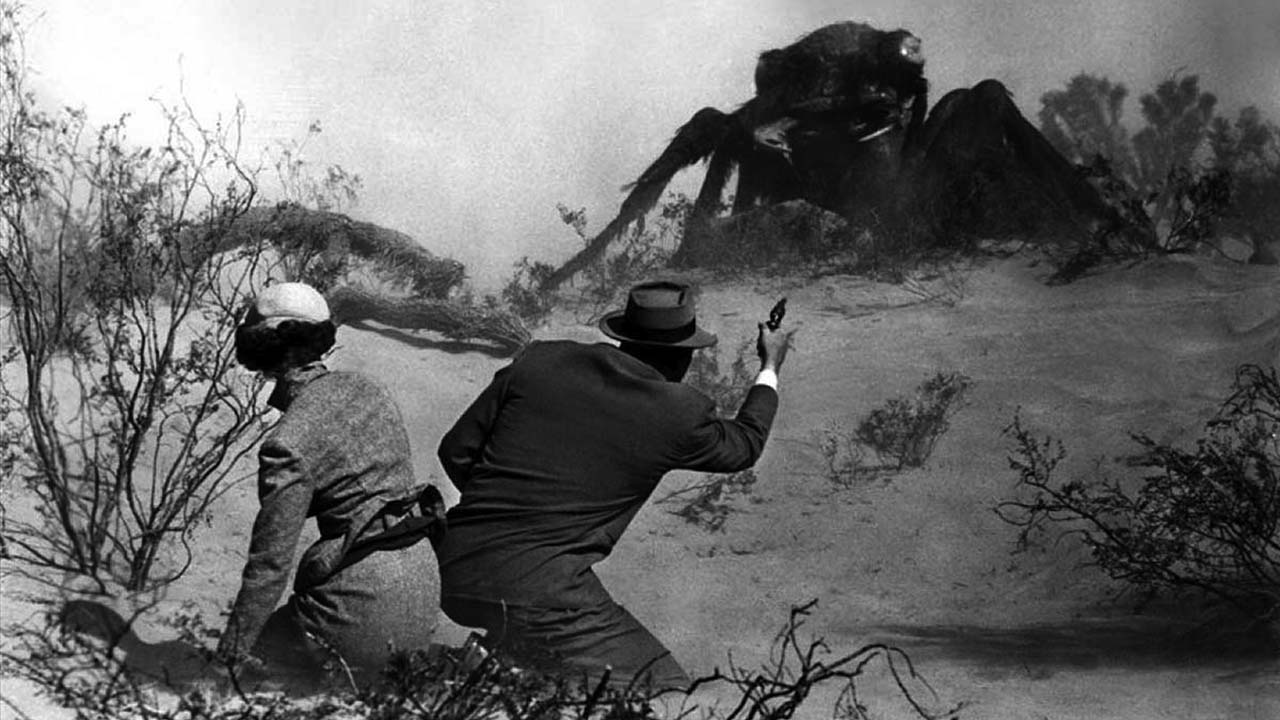
Gordon Douglas’ Them! (1954) is far more polished, slick, and straight-faced than its b-movie premise (and exclamation point!) would suggest.
The subplot involving a traumatized orphan is genuinely distressing to watch, James Whitmore gives a rather modern haunted performance, and some of the effects are surprisingly gruesome. From a giant monster crushing a human torso in its mandibles, to our heroes tiptoeing through a gooey clutch of insect eggs, you can draw a straight line to Dan O’Bannon, Ridley Scott, and H.R. Giger’s ideas for Alien.
I have faint memories of watching an edited-for-TV version as a child, so this rewatch was suffused with a little extra eeriness, as I occasionally recognized a scene or image. For some reason, the repeated references to “unexplained sugar theft” echoed in my memory, and I still can’t tell if it was intentional comedy. To modern audiences, the aggressive banter between Pam (Joan Weldon) and Graham (James Arness) is simultaneously toxic and hilarious.
It’s also interesting to note the very-1950s preoccupation on authority figures maintaining secrecy and public order. Were this to be made today, the cast of characters would be a ragtag band of misfit teenagers and/or science nerds, and the government/police/military would be absent or ineffective. There would probably also be a pair of single parents and/or divorcées in the mix.
It would have been more fun to watch this hot mess earlier, during the miniature cultural moment that briefly dominated social media discourse. It seems that the juicy, gossipy disasters must have occurred mostly behind the camera, for the actual film itself isn’t a total fiasco. I’ve unfortunately seen the not-dissimilar Serenity (2019), and I’m here to tell you that Don’t Worry Darling is a five-star, 100% fresh tomato, two-thumbs-way-up masterpiece in comparison.
For audiences conditioned by Black Mirror, the only real suspense is waiting to see if the inevitable twist will be more Westworld– or Matrix-flavored. In other words: is our hero Flo trapped in a Stepford robot body or an Oculus Rift prison?
But take a step back and consider the core premise: does anybody think that if toxic incel/misogynist/extremely-online/gamergate types were to have the opportunity to construct a virtual fantasy world, that it would amount to mere Leave it to Beaver cosplay? (but TBH, featuring a Dita Von Teese NPC is understandable; I’m only human)
In its final moments, Olivia Wilde’s film does make a fitful attempt at adding complexity: we learn at least one woman has consciously elected to live in this man’s world. It’s too much, too late, and yet not enough.
Tag yourself: “He lives on anxiety, coffee, and chocolate.” It me; can relate.
Tony Maylam’s Split Second is probably forever doomed to be a cult favorite, but it’s a pity it’s not better known. It has a wild, sometimes even manic electricity that covers up most deficiencies. I happened to watch it back-to-back with another forgotten 90s sci-fi, Screamers, which is as much a drag as Split Second is a good time. A boring bad movie is the pits, but a bad movie with verve can be a blast. Good thing Split Second is the latter.
It’s right behind me, isn’t it?
It hails from that very specific trenchcoat / combat boots / spiky hair / round tinted glasses moment in the early ’90s, with all the look and feel of cyberpunk without the cyber. It’s almost kind of a relief to see a sci-fi movie that isn’t packed with PDAs, virtual reality goggles, floppy discs, or other gizmos. The sets, costumes, and art direction are all nice, but would have probably looked better had the studio lights not been cranked all the way up. Also of note: the goopy monster suit looks so much like 2018’s computer-generated Venom that it seems beyond coincidence.
Kim Cattrall rocking her Vulcan hairdo from Star Trek: The Undiscovered Country
Rutger Hauer is entertainingly eccentric and committed throughout, and has an unexpected chemistry (a baseline requirement for the buddy cop genre) with Alastair Duncan — if a little less chemistry with Kim Cattrall. She’s super-cute here, sporting what looks like Juliette Binoche’s haircut from The Unbearable Lightness of Being, but (check calendar) it’s probably her Vulcan hairdo from Star Trek: The Undiscovered Country.
As over the top and ridiculous it is about everything else, Split Second is unexpectedly clear-eyed about climate change. This near-future dystopia is a waterlogged London beset by extreme weather, poverty, crime, vermin, and pestilence. It makes the roughly contemporaneous Waterworld look like the cartoon it is.
With a release history more tangled than a TNG time travel plot, Star Trek: The Motion Picture is now finally available in its most complete form yet: a 2022 4K remaster of the 2001 Director’s Edition of the 1979 film. Got that?
Engadget has the full details, but in short, don’t call it a “restoration”. The original elements have been fully rescanned and regraded, with effects recreated, all suitable for contemporary screens. Thankfully for the Trek completist, the basic edit has not changed — so there is no “new” canonical material to trigger a warp core meltdown as Memory Alpha is updated. After more than 40 years, the movie finally no longer has a “yeah, but…” asterisk attached to it.
The cast of Star Trek: The Motion Picture model their jumpsuits and miniskirts.
But I still just can’t get behind it. While it has many of the typical Trek trappings (cosmic alien first contacts, tension between workplace hierarchies and personal relationships, and an overemphasis on Spock — more on that later), it lacks the core spirit of Star Trek, which for my latinum, is gee-whiz model UN nerds in space.
It was also always fatally out of step with the times. It borrowed all the wrong things from prior landmarks like 2001: A Space Odyssey (the ponderous psychedelia, conflict with artificial intelligence, the too-tight jumpsuits and too-short skirts), but not the Flash Gordon adventurism that Lucas and Spielberg would employ to define action and sci-fi in the coming decade.
Spock’s voyage beyond the infinite.
Back to Spock: The character is the most overused aspect of Trek, appearing in the original series, the animated series, The Next Generation, Discovery, Strange New Worlds, and almost every movie (including the J.J. Abrams reboots). It’s not fair of me to complain about Spock oversaturation when talking about the very first movie, long before the character was run into the ground. But even so, it all just feels so tedious and simplistic. I understand the character appeals to people on the autism spectrum, but doesn’t the concept of a neurotypical person consciously electing to suppress emotion, out of a cultural/religious impulse, undercut the life experiences of those born that way, without that choice?
The character of Spock may be a challenging exercise for any actor, but on the evidence here, I’m not sure that Leonard Nimoy did much more than simply gaze at everything and everyone impassively. And he’s not the only one who seems emotionless: Ilia (Persis Khambatta) is already an alien ice queen when we meet her, so it isn’t much of a transformation when she is reborn as a walking Siri/Alexa device. And Decker (Stephen Collins) never seems too perturbed when the woman he loves is abducted and assimilated.
Drinking game: down a Romulan ale every time someone says “Spock!” or “orifice”.
The torturously complex premise of Christopher Nolan’s Interstellar requires a constant stream of exposition throughout, something I don’t recall being a problem in the director’s other time twisty scenarios like The Prestige and Inception. It’s also less emotionally urgent than either, perhaps indicating that the high-concept structure overwhelmed everything else.
If Coop (Matthew McConaughey) — and by proxy, the audience — needs to have everything constantly explained to him (before, during, and after anything happens), maybe he’s not the right person for the job. I know, I know, he’s the pilot, and realistically each member of such a crew would have their area of expertise. But perhaps the protagonist of the film, and the one that is most lauded by humanity at the end, should have been either Murph (Jessica Chastain) or Amelia (Anne Hathaway).
And I think maybe we were supposed to feel sentimental affection for the robots? I couldn’t even tell you how many there were.
Maybe this isn’t fair, but I couldn’t help but associate Ad Astra with Joker. If Joker is a shallow remix of Taxi Driver and King of Comedy, Ad Astra is a bland smoothie of Solaris and Apocalypse Now, with a cavalcade of stars you may remember from Space Cowboys and Armageddon. I half expected Harrison Ford to appear, standing in a corner, creepily ordering Brad Pitt to “terminate, with extreme prejudice” — so it’s more Apocalypse Now than 2001: A Space Odyssey, which at least had the decency to have jokes.
Brad Pitt has a few issues to work out before he can open his heart to Liv Tyler.
But really, Ad Astra is merely the story of an emotionally repressed mope (Brad Pitt), working through his daddy issues by haphazardly murdering a bunch of people just like his dad (Tommy Lee Jones) did — as if they were mere bureaucratic red tape stopping the only person in the universe that can save the universe from saving the universe — and then, having saved the universe, finally becoming ready to open his heart to Liv Tyler. Anybody out there have any empathy for someone who can’t open their heart to Liv Tyler? Pure fiction!
And as for its pseudo-sciencey verisimilitude, somewhere, Kim Stanley Robinson is banging his head against his writing desk.
Criticizing the plots of popcorn action blockbusters is usually a fool’s errand. Nobody cares if Hobbs & Shaw makes any sense, but surely it’s fair game in the Terminator franchise, where untangling pseudo-scientific time travel logic is 99% of the fun.
So the biggest disappointment of Dark Fate (other than its singularly unmemorable title, and the cruel execution of a digital Edward Furlong avatar) is that it offhandedly tosses its biggest question marks into a trashcan of exposition. I’m glad this movie revolves around three women, and relegates Arnold Schwarzenegger to a supporting role, but it seems to me that if your story involves a robot assassin that reprograms itself for good, after a lifetime of guilt and regret, that deserves more than a few perfunctory lines of exposition.
While we’re on the topic of telling-not-showing: Dark Fate introduces a new, rather creepy idea to the clichéd evil A.I. subgenre. Rather than a diabolical Matrix-style plan to subjugate humanity, the A.I. in Dark Fate simply turns off the world’s power and then sits patiently on its circuitry butt for a few decades while most of humanity kills itself off. Again, like Schwarzenegger’s Cyberdyne T-800 developing a conscience offscreen, this is far more interesting than any of the car chases or plane crashes.
My brilliant wife had the following absolutely perfect appraisal of the first two entries in the new Star Wars trilogy, which I will paraphrase here:
“Most of the criticism of The Force Awakens was absolutely correct, but I loved it anyway. Most of the criticism of The Last Jedi was absolutely wrong, but I loved it anyway.”
In other words: yes, we acknowledge the consensus that J.J. Abrams’ The Force Awakens was a stealth remake of A New Hope, somewhat lacking in imagination, but wow was it thrilling.
Then Rian Johnson’s The Last Jedi faced an even fiercer backlash: mostly directed at its female characters, its rejection of Star Wars‘ royal lineage nonsense, and for directly addressing the military industrial complex issue that all previous films had ignored. These criticisms infuriated us; for these aspects were exactly what made The Last Jedi one of, if not the best of the entire series. (sorry, Empire, I will always love you too)
Perhaps the worst of The Rise of Skywalker’s many failings is relegating two of its best new characters (John Boyega as Finn and Kelly Marie Tran as Rose) to the sidelines.
But after seeing The Rise of Skywalker, this formulation is disrupted. With J.J. Abrams back in the director’s chair, the concluding chapter retreats from the progress made in the second film, and seems to have pulled off the impossible: disappointing everybody. If it’s not the worst Star Wars movie, it’s certainly the most disappointing. Instead of rating it out of five stars, I want to rate it with a countless number of exasperated sighs.
Hands up, who hoped Star Wars would rewind all the way back to The Return of the Jedi? Anyone?
Even more than the unwanted spinoff product Rogue One and Solo, The Rise of Skywalker seems to have been designed by spreadsheet in an antiseptic Disney boardroom, in a misguided attempt to appease a toxic fandom riven by the divisive The Last Jedi. Star Wars is not my personal sentimental favorite story (that would be Doctor Who), but my generation grew up with it and I can’t help but have an emotional attachment. I could enumerate The Rise of Skywalker‘s various plot deficiencies here, but it’s the smothering of wonder and spirit that really hurts.
My thoughts here are a kind of spoiler — not for revealing plot details, but for sending out bad vibes. Hopefully there are some viewers (especially kids) that don’t read complaints like this and get some joy from the movie. Here’s hoping that with time, The Last Jedi is retrospectively recognized as the height of the entire franchise.
Although easily overlooked among the Steven Spielberg and Tom Cruise filmographies, I actually rather enjoy their 2005 War of the Worlds remake.
Unfortunately, what makes it unique also sabotages it:
It’s practically a requirement for the alien invasion genre that the protagonist be the big hero that saves the world. Refreshingly, Cruise’s character here is just a blue-collar guy trying to survive, minute-to-minute. Trying his best, making errors of judgement, and sometimes just wearily trudging along from incident to incident along with crowds of fellow refugees. Compare and contrast with the hyper-competent expert he typically plays: the world’s premiere spy, race car driver, or fighter pilot.
Although I’ll bet Cruise probably performed much of his own stunts as usual here, the film isn’t structured around major set pieces like much of his later work. Instead of watching Cruise actually jump out of an airplane, free climb, or crash a motorcycle, here he’s mostly seen operating shipping cranes and running away from stuff.
[spoilers for a 120 year old novel] The premise of the source material is inherently uncinematic, even if it is quoted directly in the prelude and coda by one of cinema’s greatest voices, Morgan Freeman. It’s just plain strange that no one from the creative, financial, or distribution teams insisted on reworking the material to give humanity (if not Cruise’s character himself) a more active role in defeating the aliens.
It’s also infected with that weird ultra-grainy cinematography in vogue at the time. I blame Ridley Scott for that, most evident in Hannibal and Black Hawk Down.
“You get an E for effort and an F for fracking it up.”
That just about sums it up. I was a big fan of the mid-2000s Battlestar Galactica reboot and its sister series Caprica, but had somehow overlooked this pilot for a second prequel spinoff. Belatedly seeing it now, the plot seems too slight and insubstantial to possibly set the stage for an ongoing series.
Not only were BSG and Caprica thematically complex (grappling with war, terror, fanaticism, politics, ethics, artificial intelligence, etc.), it was also blessed with a knockout cast (especially the volcanic Edward James Olmos), but everyone in Blood & Chrome is as flat and affectless as the greenscreen virtual sets and digital lens flare.
Worse, Blood & Chrome is near-devoid of the big ideas that drove Caprica, which was probably too smart for its own good. The pop culture hill I will die on: Caprica was a smarter show than the similarly-themed Westworld will ever be. Discuss.