As a true comedy auteur, Tina Fey’s acting has always come in tandem with her own writing. This double act has progressed from improv comedy at The Second City, to head writer for Saturday Night Live, to supporting player in the feature film Mean Girls, (for which she wrote the screenplay), and finally to executive producer and star of her own sitcom 30 Rock.
Baby Mama, written and directed by Michael McCullers, marks Fey’s first star turn in a project which she did not originate or write. Still, it certainly feels a lot like a Tiny Fey joint. Judging by the general tone and the chaotic improv of Fey’s partner-in-crime Amy Poehler, I suspect the two enhanced the production with a fair amount of script-doctoring.
Indeed, Fey’s character fits firmly in the public persona of Endearingly Neurotic Thirtysomething Single Girl established on SNL’s Weekend Update, as Ms. Norbury in Mean Girls, and as Liz Lemon in 30 Rock. The Tina Fey Notlash notwithstanding, she is evidently more grounded in real life, and married with a child. Meanwhile, the fictionalized “Tina Fey” is the idol of every girl with glasses and crush of every boy with… uh, glasses.
Fey must have an impressive rolodex, for like her flagship TV show 30 Rock, nearly every little role is Baby Mama is filled by a familiar face. When not being amused by alumni from The Daily Show and SNL, we’re treated to Steve Martin as a wild and crazy organic food magnate and Sigourney Weaver as an initially creepy but ultimately sympathetic fertility doctor. But personally, I wouldn’t dare make fun of Sigourney Weaver’s age, lest she come after me with a flamethrower or a space forklift.
As a public service, this blog would like to issue a warning to anyone that under the impression that Se, jie (Lust, Caution) is an NC-17 erotic thriller. Judging from the marketing campaign alone, one might understandably imagine that the latest film from the director of Sense & Sensibility and Eat Drink Man Woman would be a sexy drama suitable for viewing with a significant other, but be warned that most of it is quite far from titillating. In fact, the first of three sex scenes can only be classified as a rape (albeit one complicated by the characters’ complex relationship).
Se, jie is set in 1942 Japanese-occupied Shanghai, with flashbacks to the few years preceding. A naive but sincerely dedicated bunch of Chinese student activists form a terrorist cell, with the aim to assassinate collaborator Mr. Yee (Tony Leung). Theater student Wong Chia Chi (Wei Tang) discovers she is a natural actress and gifted improviser, which unfortunately also makes her a superbly qualified as a undercover spy.
To fully inhabit her cover story as a married woman, she must first lose her virginity. This happens almost simultaneously with her cell losing their metaphorical virginity as they messily execute their first righteous assassination. As Paul Newman discovers in Alfred Hitchcock’s Torn Curtain, murder is hard work, and takes time.
Se, jie was released in the same year as Paul Verhoeven’s Black Book and concerns many of the same themes: wartime occupation, violent resistance, and the use of sex as undercover ingratiation. But while Verhoeven couldn’t resist front-loading his film with plenty of cheesecake, Ang Lee and James Schamus take the high road and don’t pretend that the morally empty Mr. Yee isn’t violently twisted, and that Wong Chia Chi doesn’t absolutely suffer for her cause.
Had I seen The Assassination of Jesse James by the Coward Robert Ford earlier, I might have included it among my Most Disappointing Films of 2007. Certainly not because it’s “bad,” for could I make a better movie myself? Could I make a movie at all? And who appointed me a critic, anyway? But this blog is about my personal reactions to movies, so here goes.
Assassination was praised to the high heavens by publications including Sight & Sound, so I had expected it to be one of the year’s gems. And indeed, the acting is excellent and Roger Deakins’ cinematography is breathtaking. But I would describe the movie as “novelistic,” not necessarily a good thing with cinema, as opposed to, you know, novels.
Assassination no doubt inherited its notably slow pace (not in and of itself a problem for me) from its source material, the novel by Ron Hansen. I haven’t read it, but I suspect my own chief complaint likewise derives from the book: the omniscient narration. I’m not one that thinks voiceover narration is a screenwriter’s crutch to be avoided at all costs, but there are two extremes in which it can be misused: to redundantly explicate the action seen on screen or to impart information better shown that told. The Assassination of Jesse James does both.
Through amber fields of grain
I wish I had made a note of an example or two, but there are numerous instances of narration that could simply have been cut for not adding anything to what we’re watching onscreen at the moment. But on the opposite end of the spectrum, one of the most significant events of the story, Ford’s ultimate disillusionment with James and decision to betray him to the law, happens offscreen and is offhandedly recounted by the narrator. Ford approaching the authorities to become a criminal informant would have made for a dramatic scene.
Although the comparison is not quite fair, I am I huge fan of the HBO series Deadwood and couldn’t help but contrast the two in my head. Please set aside for a moment the only roughly related settings (Deadwood is set in 1870s South Dakota, and Assassination in 1882 Missouri) and bear with me for a moment.
The James Gang in happier days
Most obviously, actor Garret Dillahunt appears in both. Dillahunt may have been typecast as a 19th Century sort, but his characters could not be more different. The Francis Wolcott of Deadwood is an educated, urbane, and yet dangerously perverted proto Master of the Universe, a far cry from the suicidally ignorant Ed Miller in Assassination. But where the two diverge, and Deadwood certainly prevails, is the dialogue. David Milch’s scripting is the kind of astonishingly profane poetry that might result when characters with Victorian educations find themselves living in the ass-end of the world. I found myself spoiled by my memories of the prematurely-cancelled Deadwood, and wished Assassination had a little more of its poetry.
But enough griping – time for the praise! Roger Deakins‘ cinematography is delicious, full of warm oranges and deep unbroken fields of black. A notable visual effect used to open new chapters in the story is a narrow field of focus with a blurry halo, suggesting old daguerrotypes (similar to what I’ve seen recently in The Illusionist). Guest critic Snarkbait christened the effect “Ye Old Timey Filter No. 4,” but according to an interview with Deakins in American Cinematographer (no longer online: theasc.com/ac_magazine/October2007/QAWithDeakins/page1.html), the filter is his own invention and appropriately called the Deakinizer.
One of Roger Deakins’ many striking silhouette images throughout The Assassination of Jesse James by the Coward Robert Ford.
There is fine acting all around, and two fun cameos from James Carville and Nick Cave (who cowrote the film’s music). Casey Affleck rounds out an excellent year in his career after Gone Baby Gone with a great performance as Robert Ford, obviously not billed above Brad Pitt but arguably the main character. Sam Rockwell (as Charley Ford) is especially great near the end of the film, as his simple-minded character tragically breaks down. Pitt makes a charming and earthy, yet plainly sociopathic Jesse James. James’ curse is that he’s always the smartest man in the room, but one need only witness the particularly unhinged laugh Pitt gives him to see how lunatic and criminal the man actually is.
I lied, one more complaint: Mary-Louise Parker & Zooey Deschanel, both fine, name actors, appear in miniature roles with minimal dialogue. Perhaps their characters were similarly minor in the original novel, but they seem underserved in the film. Perhaps the female presence in the actual lives of these historical figures was not significant, but to return to Deadwood for a moment, Deadwood repeatedly proved it is not historical revisionism to include women in a modern-day portrait of a bygone era.
This blogger may have to burn his Rock Snob card, for I just watched and enjoyed the Blue Man Group concert film The Complex Rock Tour Live. I’d long assumed that the Blue Man Group’s seemingly permanent residency on Lafayette Street in downtown Manhattan was some kind of tourist trap like Mars 2112 or Jekyll and Hyde, but now I’m wishing I had looked closer.
For any others that may also have prematurely dismissed them, the Blue Man Group is equal parts performance art collective, percussion ensemble, and, well, blue. The Complex Rock Tour DVD captures the group live in 2002, with a show that is at once both an actual rock concert and an ironic commentary upon one.
I had to fight the suspicion throughout that a blue-clad trio of catburglars had slipped into my apartment and raided my cd collection. As I watched, I started to compile in my head a list of artists that must have been influences:
Emergency Broadcast Network. EBN was a trailblazing multimedia performance group that fused Marshall McLuhan-esque media theory with techno, all in the style of a television news broadcast from hell. Their caustic and aggressive social commentary is a far cry from The Blue Man Group’s squeaky clean naïveté, but it’s hard not to watch footage of their live performances without seeing an ancestor of the Complex Rock Tour‘s ironic infographics.
Laurie Anderson’s Home of the Brave concert film (1986). All the ingredients are here, albeit in artier form: film, performance art, mime, masks, dance, etc.
Peter Gabriel and Robert LePage’s Secret World Live and Growing Up Live tours were as much theater as rock concerts, utilizing simple yet hugely symbolic shapes and props: a tree, an egg, the moon, etc.
Talking Heads’ Stop Making Sense concert film (1983), for all the same reasons as Laurie Anderson and Peter Gabriel above.
King Crimson. Some of the Blue Man music bears more than a passing resemblance to the polyrhythmic tuned percussion King Crimson employed in the early 1980s with tracks like “Waiting Man” and “Neil and Jack and Me.” Not only that, one of the members of the Blue Man band can be spotted played the Chapman Stick, popularized by Tony Levin.
Rock Snobs might be surprised to hear traces of even more modern music in the Blue Man Group repertoire. I caught snippets of the instrumental so-called “post-rock” of UNKLE, Battles, and Explosions in the Sky.
And finally, the one influence the Blue Men actually namecheck with a (brief) cover version in their show is Devo, but I don’t own any of their music! Maybe I should take this as a recommendation.
As humorous and toe-tapping as The Complex Rock Show is, the Manhattan-based Blue Man Group end the proceedings with “Exhibit 13”, a haunting piece incorporating footage of actual World Trade Center debris that showered over Brooklyn only a few months prior. The piece is available online.
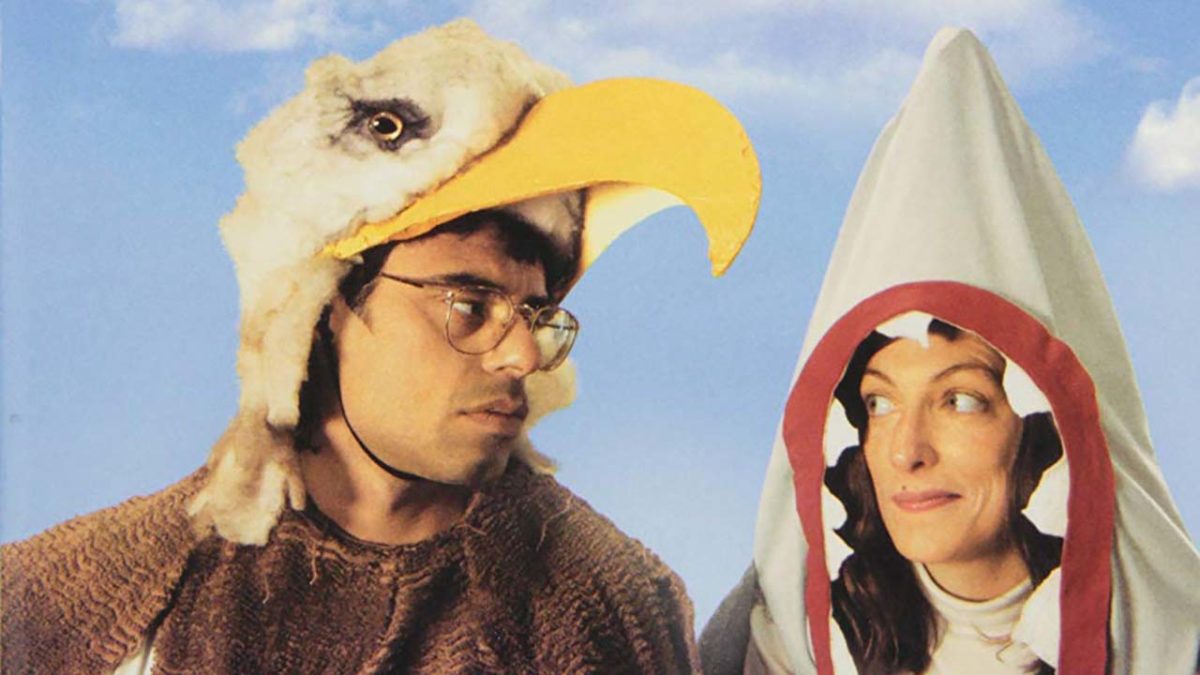
I’m not sure I took Taika Waititi’s Eagle vs. Shark as it may have been intended. A sort of New Zealand answer to Napoleon Dynamite, Eagle vs. Shark is the story of two misfit losers finding each other when no one else will have them. But I found one character as sympathetic as the other deplorable, while I suspect writer/director Waititi intended them to be seen as a good match, and deserving of a happy ending together.
Lily (pretty actress Loren Horsley, dressed down in frumpy clothes) may not be looking forward to any New Zealand beauty pageants, but she’s not un-cute. But being possibly the sweetest and nicest girl on the planet does not work to her advantage; awkward and over-earnest, she’s unable to say no to anybody, even when getting fired or dumped. Her only friend is her sweetheart brother, a cartoonist and world’s worst impressionist. Her favorite answer to each of life’s many disappointments is “it doesn’t matter.”
Fish or fowl?
We first meet Lily at her dead-end mall job at Meaty Bun, the sort of joint where layoffs are managed by literally pulling names from a hat (and even that is rigged). She has fallen in love with Jarrod (Jemaine Clement), a douchebag with a mullet who works at the nearby video game store. Jarrod is a true nerd: creepy and violently deranged. We learn later he is motivated by the impossible ideal of his over-achieving martyred brother (although there are family secrets to be uncovered there), and possesses an illegitimate daughter.
Jarrod and Lily have matching moles (not to be confused with the progressive rock band of the same name), and Lily is able to impress him with her natural talent at a gruesome video game. But beyond that, there is little connection beyond their shared isolation.
Pitching a tent
So I found myself rooting for something at odds with what the film presents as a happy ending: for Lily to break free of the poisonous dick Jarrod. Lily does manage at one point to say no to someone for the first time; she turns down a date with an even bigger loser than Jarrod. But despite this small sign of personal growth, her unrequited love for him is so absolute that even after he tries and fails to beat up a paraplegic, she goes on a suicide watch to protect him from his brother’s fate.
To be more positive, and to explain my three-star rating despite all the negativity above: I found Lily and her brother very endearing and the film often extremely funny. Awesome stop motion animation sequences throughout illustrate the love story through two anthropomorphized damaged apples.
The Bank Job is notable for being an at least partly “true” expose into the spectacular (and successful) robbery of Lloyds Bank in London in 1971. For whatever reason, an anonymous participant of the investigation chose to cooperate in the making of this fictionalized film rather than a book or magazine article. If even partly true, this expose would have held more weight as, say, a Vanity Fair article than a fictionalized theatrical film.
The far-reaching conspiracy story fingers the royal family, parliament, MI-5 & 6, the police, and even contemporary black power figure Michael X in a massive cover-up successfully withheld from the public for over 35 years. After being portrayed less than flatteringly in the 2006 film The Queen, the royal family is now surely even less amused with The Bank Job‘s allegations against Princess Margaret.
With its clever nonlinear structure, gruff alpha-male anti-hero (Jason Statham), and untrustworthy femme fatale (Saffron Burrows), The Bank Job seems at first a solid entry into the heist genre in the tradition of Rififi, Thief, and The Italian Job. But the tone shifts as the stakes rise, to a more serious and violent don’t-trust-anyone thriller a la the Bourne trilogy.
It was a weird experience to finally see the original film for the soundtrack to which I’ve listened to countless times. Brian Eno and Daniel Lanois’ Apollo: Atmospheres & Soundtracks is a gorgeous piece of work, and very much colored my expectations of what the film would be. Having long pictured a largely abstract compilation of otherworldly lunar footage, I was surprised to find For All Mankind a more straightforward documentary than what was already in my head. (Bits and pieces from the compilation album Music for Films III also appear.)
Unlike In the Shadow of the Moon, the 2007 feature documentary on the same subject, For All Mankind exclusively uses original footage taken during the Apollo Missions, much of it by the astronauts themselves. The absence of new narration or footage rightly places the emphasis solely on the achievements of the original participants. But a drawback is that the interviewees on the soundtrack are not identified (the Criterion DVD edition includes an option to display subtitles identifying the speakers).
I was completely ignorant that NASA first began spacewalks during the Apollo missions. I was under the impression they began during the later space shuttle missions. In retrospect, it makes perfect sense that NASA would test spacewalks in orbit over the Earth before attempting to step out of a capsule onto the moon, but: Wow!
The astronauts were very conscious of Stanley Kubrick’s 2001: A Space Odyssey. Each astronaut could bring one cassette tape to play on a portable deck, and one chose Strauss’ “Also Sprach Zarathustra”. Another describes seeing the moon surface up close as being like something from 2001.
Due to the film’s nature of being comprised of original footage, there’s perhaps too much of the astronauts goofing off in zero-G, and not enough of the spectacular lunar footage. But it goes to show that even the pilots selected for being the most sane and calm people in the word still turn to excited kids when playing in outer space (with the rare exception to prove the rule).
There’s a huge interest in Japanese manga and anime in the US, but it’s rare for an anime feature film to get a theatrical release. From the name and poster alone (indeed, what caught my own interest), one might not even guess Paprika is foreign-language, let alone anime. Anime is a medium, not a genre, but it does have a certain popular perception in the US: either the apocalyptic sci-fi of Akira or the fairy tale fantasia of Spirited Away. And that’s not even taking into account the expectations of a generation of kids that grew up watching the dubbed Robotech and Star Blazers serials (which would be exemplified by… me).
The popular perception is not wrong; I’m not an anime expert, but Paprika has several of the superficial trappings: cybernetic technology (like Ghost in the Shell), a ghostlike female creature (like director Satoshi Kon’s earlier Millennium Actress), and an exponentially growing world-eating beast (like Akira and America’s own The Blob). But what sets Paprika apart is its psychedelic imagery, adult themes, and sheer weirdness.
Valley of the Dolls
Like Blade Runner, it’s equal parts detective story and science fiction, with a splash of horror. The mystery genre provides a structure for the nominal plot: Paprika is the dream alter ego of Dr. Atsuko Chiba, a dream researcher building a machine for use in psychoanalytic dream analysis. The device they’re building is called the “DC Mini”, a name which, every single time, made me think of DC Comics’ miniseries. Chiba’s Blade Runner-esque mission is to track down three missing DC Mini devices, and their co-creator.
I hate it when that happens
Paprika even shares a theme with Blade Runner: the moral repercussions of new technologies. If dreams are a kind of “place”, and can be a shared reality (like the world of The Dreaming in Neil Gamain’s Sandman comic book series), what is the difference between it and real life? The potential of one world bleeding into another is very literally dangerous. One of the film’s villains uses the dream reality to commit a very disturbing form of rape, and another goes so far as to label the technology a potential form of terrorism: “Implanting dreams into other people’s heads is terrorism.” This is not hyperbole in the film’s universe: the city is almost destroyed by dreams.
Two final little things:
What’s the deal with the name? Is it a translation issue, or something about Japanese culture (or cuisine) I’m not aware of? A metaphor of spices and recipes is used at one point, but it still seems oddly random.
A key character is movie-obsessed cop, an amateur filmmaker in his youth. His noirish dreams only further expand the Blade Runner parallels. Paprika explicitly equates movie watching with dreams and memory.
I very much loved writer/director Noah Baumbach‘s previous film The Squid and The Whale, blessed with an excellent script and superb performances all around (especially by the versatile Jeff Daniels – heartbreaking in Pleasantville, and capable of humanizing no less an icon than George Washington in The Crossing).
Margot at the Wedding features another dysfunctional family, but so spectacularly so that the characters didn’t seem recognizably human to me. I don’t think the problem is as simple as merely identifying with the particulars of their lives (abusive father, celebrity lifestyle, etc.), for I also had little in common with the family in The Squid and The Whale.
It’s like De Palma’s Sisters meets Allen’s Interiors
Margot (Nicole Kidman) brings her son to her family home for her sister’s Pauline (Jennifer Jason Leigh) wedding to layabout Malcolm (Jack Black). Pauline is the sole family member insecure Margot can physically face, which she can only manage through passive aggressive games asserting her superiority. We barely glimpse a third sister and their mother, from whom Margot literally flees. They feud with the strangely savage neighbors, providing yet another set of characters for Margot to look down upon.
Unlikely Jack Black Romantic Pairing (no. 845 in a series)
Margot’s favorite pastime is armchair psychoanalysis coupled with a kind of inverse hypochondria. Obsessed with detecting symptoms of mental illness in everyone around her (the irony being that she’s often correct), she fails to diagnose herself. She’s a fiction writer whose work bears more than a passing resemblance to her family’s history. Margot’s failure of imagination amounts to a kind of theft, and is a central theme of the movie. “How much of your work is autobiographical?” is no doubt a cutting question nearly every writer (including Noah Baumbach) hears at least once a day. Margot’s lover Dick (Ciarán Hinds) even uses it as a weapon to publicly attack her. It is cruel, but in her case, accurate.
The first thing to say about You Kill Me is to give props to Ben Kingsley, if for no other reason than my fear that he will break my kneecaps if I don’t. Even after his terrifying turn in Sexy Beast, it’s still a surprise to see how perfectly natural for him to inhabit a role like Frank, an almost superhumanly talented mob assassin. For a man of a certain age who once played Ghandi, he can certainly act up some serious physical menace. But You Kill Me gives him a chance to enrich this character type instead of merely repeat it. In Sexy Beast, he was funny because he was so very extremely menacing. Here, his character is menacing and funny.
You Kill Me is a bicoastal film, literally illustrating Frank’s different worlds by setting the action in two different cities. In Buffalo, You Kill Me shares with The Sopranos a look into the operations of modern-day gangsters. Their lives are somewhat less exciting than the fantasy lucrative lifestyle seen in The Godfather and Scarface, but still sharply divided by cultural heritage and identity. Frank may seem to be a pathetic figure, but when sober, he is the sole factor keeping his small-time Polish crime family in business.
Yeah, I find alcoholic assassins irresistible too
The problem is, he is sober less and less when the story opens, and his family must fix him in order to survive. So Frank is ordered from Buffalo to San Francisco to dry out, leaving behind his family (both by blood and criminal association) and yet quickly forging a new one: Dave (Bill Pullman), a shady real-estate dealer no better than a gangster himself; Tom (Luke Wilson), a gay fellow alcoholic; and implausible love interest Laurel (Téa Leoni, also an executive producer).
This man played Ghandi
The problem with Laurel is not only the creepy age differential (a long-standing Hollywood pox from which it seems even indies aren’t immune), but with her underdeveloped character. What little we learn of her history (a recently deceased, unloved stepfather) seems insufficient to explain what makes her so lonely and desperate that she would attach herself to possibly the most unstable and unreliable person in the world. What happened to her to make her so blasé and amoral that she clings so fervently to Frank and cross the country to risk her life for him?