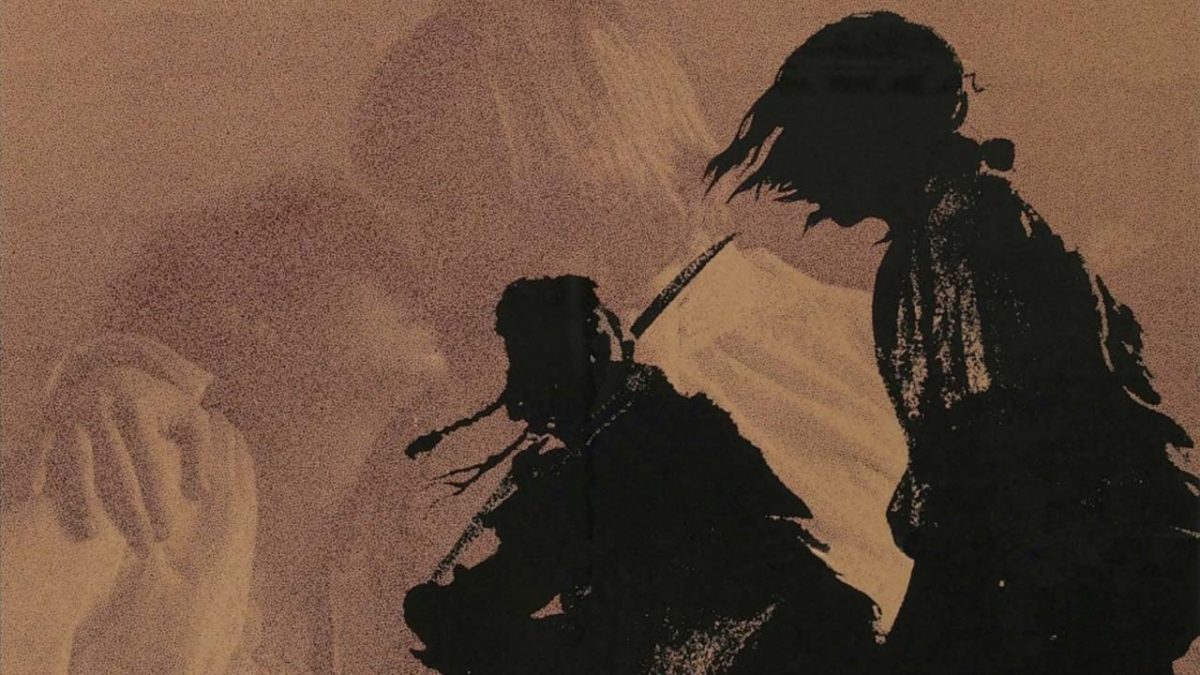
Ridley Scott’s first feature film The Duellists (1977) is based on the Joseph Conrad short story “The Duel.” Feraud (Harvey Keitel) and D’Hubert (Keith Carradine), two French soldiers serving under Napoleon, become loyal enemies locked in a lifelong adversarial relationship. D’Hubert, eager to appease his superiors and advance his career, volunteers for a mission in which he obliviously humiliates Feraud. Both men are at fault: D’Hubert for his ambition, and Feraud for obsessively nursing his perpetual grievance. Their personal battles supersede French history, with even the reign and fall of Napoleon a mere backdrop to their personal feud.
Don’t let the frilly sleeves fool you, Feraud (Harvey Keitel) will frite your pommes and manger your croissant
The Duellists is respected for the historical authenticity of its French military uniforms and depictions of period wartime conduct, but Keitel and Carradine’s flat American accents threaten to undo its achievements in verisimilitude. Luckily, the important bits, the duels, are staged silently. Scott, with his background in advertising, films everything beautifully, although one does catch glimpses of the occasional lamp and smoke machine. The landscapes during the final duel are especially breathtaking.
Wild Bill Hickok is a comin’ ta getcha, Mr. White!
I’ve seen hardly any of Carradine’s movies, but I do have great respect for his brilliant portrayal of one of America’s first celebrities, Wild Bill Hickok, in the HBO series Deadwood. And Keitel gets to show off his serious muscles in a gratuitous arm-wrestling sequence.
Although every Coen Brothers film is unmistakably theirs alone (can the Auteur Theory apply to more than one person at once?), Joel and Ethan have a reputation for rarely making the films audiences want or expect from them at any given time.
Clooney and McDormand give this movie two thumbs up.
After Fargo, when everybody wanted another snowy midwestern noir, Joel and Ethan gave the world The Big Lebowski instead. After a recent string of genre experiments like the Hepburn & Tracy-esque romantic comedy Intolerable Cruelty and a remake of Ealing comedy The Ladykillers, the Coens surprised everybody yet again with the dead-serious nailbiter No Country for Old Men. And, perhaps because they just can’t help themselves, they give us whiplash all over again with Burn After Reading.
John Malkovich being John Malkovich.
Ostensibly another caper comedy like The Big Lebowsi, Burn After Reading is actually more amusing than hilarious. The characters are a peculiar kind of stupid common in Coen films: unaware of their limitations, yet maniacally driven. But the mischievous Coens undermine the light entertainment value of the film by punctuating the convoluted noirish plot and seemingly light tone with scenes of extreme violence.
Brad Pitt is in possession of, as they say in movies like this, certain documents.
At the time, The Big Lebowski featured many of the Coens’ repertory players (John Goodman, Steve Buscemi, John Turturro). In contrast, Burn After Reading sports the marquee names Clooney and Pitt, perhaps giving it more attention than it can hold. But its biggest hindrance to joining the ranks of the best of the Coen Brothers is that it lacks a highly memorable (and quotable) character like H.I., Marge, or The Dude.
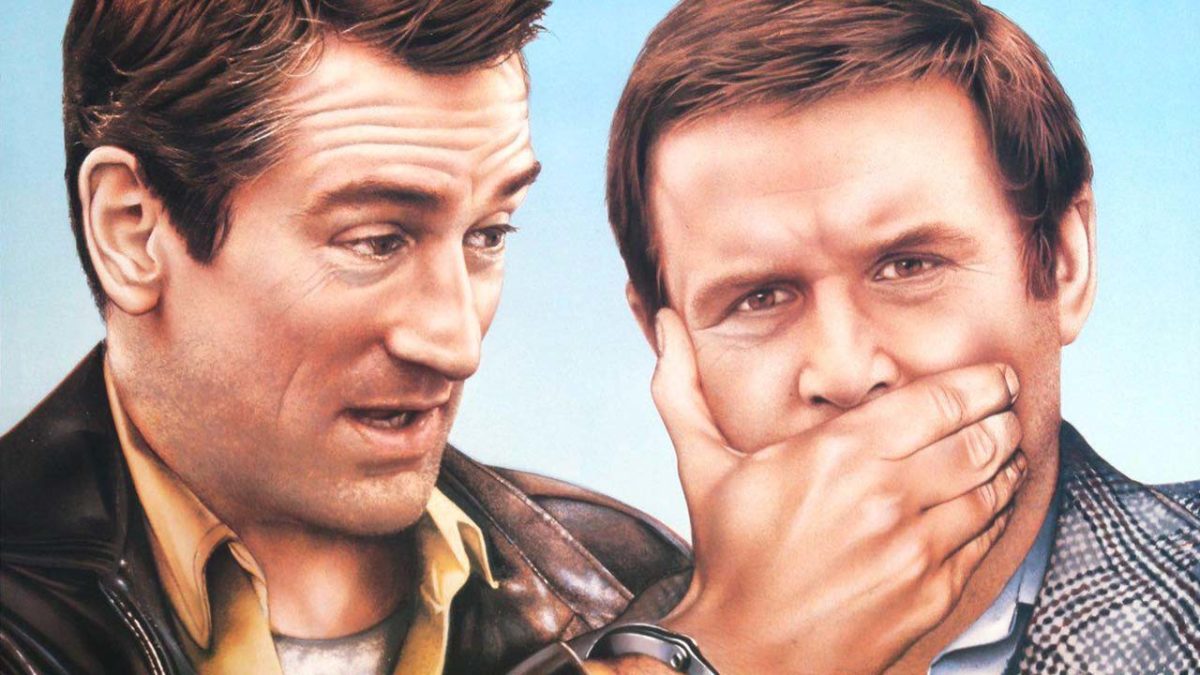
Martin Brest’s Midnight Run is an appealingly loose comedy built on a solid premise. It’s a classic, almost cliched Hollywood scenario: Jack Walsh (Robert De Niro) is one of the world’s last honest cops, rewarded for his integrity by divorce and demotion to the humiliating (and dangerous) level of bounty hunter. His handler Eddie Moscone (Joe “Joey Pants” Pantoliano) raises the lucrative prospect of One Last Job: to escort chief witness Jonathan Mardukas (Charles Grodin) in a federal mob case across the country, pursued both by the feds (led by the imposing and perpetually aggrieved Yaphet Kotto) and the mob (the ageless Dennis Farina) alike.
It’s for you
Walsh has personal business with mob boss Serrano, and so the task quickly becomes a journey of the soul for him. The template is 3:10 to Yuma: an intelligent, articulate “bad guy” travels with gruff and serious “good guy” with money problems and deep-seated resentment for being punished for his honesty. But all this is beside the point. The true pleasure of the movie, and the cause of its continued cult appeal, is all in the actors’ interplay. Grodin has all the hilarious dialog, much of it with the feel of improvisation. In contrast, De Niro seems only equipped to continually retort with “Shut the fuck up,” perhaps by choice to be true to his character as opposed to a failure of creativity. Why has Grodin been in so few movies?
Yaphet Kotto does not suffer fools lightly
Also of interest is an early score by Danny Elfman, later to gain a reputation for whimsical fantasy music for Tim Burton and The Simpsons. Brest, the director of Beverly Hills Cop, stages a massive multi-car chase approaching the absurdly funny levels of The Blues Brothers.
Midnight Run is actually not all that funny a comedy, not that thrilling a thriller, nor that penetrating a character study. But it is nevertheless great fun to watch, and crying out for a sequel.
David Koepp’s Ghost Town pulls at the heartstrings without being too nauseating. With a tagline that implies The Sixth Sense as a romantic comedy, its tone and subject matter are roughly comparable to As Good As It Gets: the thawing of a misanthrope with some good qualities. It mostly earns it, but the last 2-3 lines of dialog don’t feel natural — the sort of thing a screenwriter might jot down first, and then later write an entire screenplay around. It’s a real bittersweet irony for Bertram’s (Ricky Gervais) first real friend (Greg Kinnear) to literally disappear.
Poor Téa Leoni is once again saddled with an age-inappropriate love interest, as she was with Ben Kingsley in You Kill Me. I can’t picture Gwen and Bertram as lovers, but I can see them as forging a real friendship, amidst their unique situation. Their characters are well-drawn enough that I can buy his ironic wit appealing to her while her supposedly perfect fiancé may be a good human being but is utterly humorless.
Guillaume Canet’s Ne le dis à personne (Tell No One) enjoyed a surprisingly wide US theatrical release for a French film without huge English-speaking stars (except for Englishwoman Kristin Scott Thomas, perfectly fluent in French). Roger Ebert rightly compared the tightly crafted thriller with The Fugitive, placing it squarely in Hitchcockian wrong-man-accused territory.
Pediatrician Alex Beck (François Cluzet) finds himself the prime suspect of his wife’s murder, eight years prior. This being a French film, the fortysomething Beck was married to the utterly gorgeous younger Margot (Marie-Josee Croze, great in Julien Schnabel’s The Diving Bell and the Butterfly). One might accept this as a given premise of the story, for sometimes old coots really do bag hot young wives, had the film not ruined it by demonstrating via flashback that the characters are supposed to be the same age.
Run Beck Run
I found Tell No One more focused and engaging before the conspiracy widens to an almost absurd degree, enveloping even a Senator in a vast cover-up. I will admit to being confused at times; to grasp the details and convoluted timeline, viewers will have to remember character names, not faces, as the chronology of some key plot points are conveyed via exposition (that is, told, not shown).
Funny how bad things happen to people who skinny dip in movies.
Hints of the recent race/class tensions in France are built into the plot: Beck’s equanimity as a pediatrician earned the trust of some less privileged thugs on the wrong side of the law. That they will aid him when no one else will ironically demonstrates his essential goodness.
Wong Kar-wai’s first English-language film My Blueberry Nights is mostly set in bars and diners across America. His characters all indulge in the four great American pastimes: eating, drinking, gambling, and driving.
Nobody films beautiful women, or should I say, nobody films women beautifully, like Wong Kar-wai. In Blueberry Nights, he has no less than four famous female faces to worship with his camera:
Norah Jones – Perhaps not the most natural of actors, but her speaking voice is as emotionally expressive as it is in her famously languid, evocative music.
Chan Marshall (aka Cat Power) – Like Jones, Marshall is a musician and not an experienced actor, but her cameo is bittersweet and effective.
Rachel Weisz – The New York Times one described Weisz as “the thinking man’s sex symbol,” but here she portrays a seemingly dim character with a cruel streak.
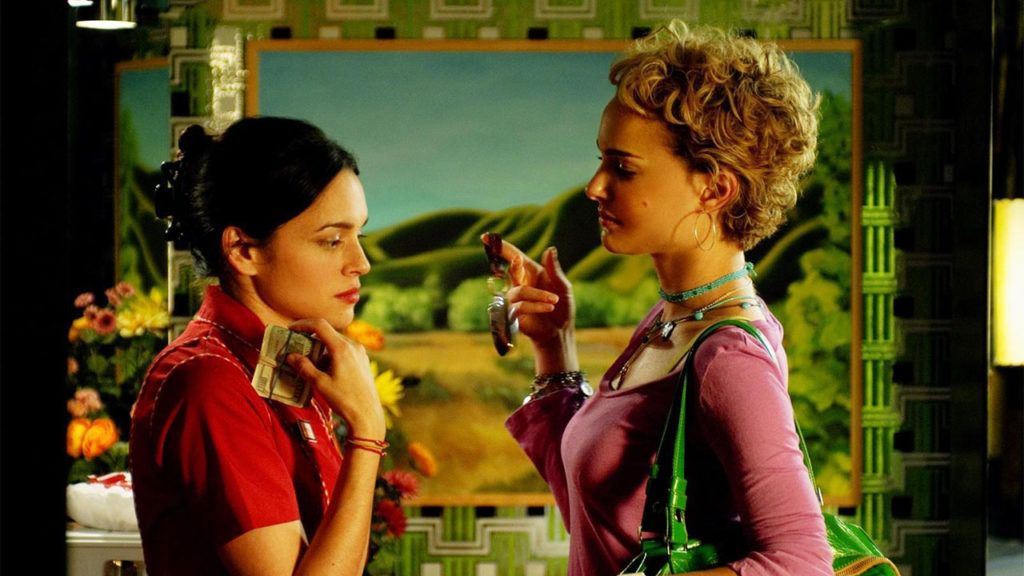
Natalie Portman – Like Weisz, Portman plays against type as a troubled young gambling addict with an Electra complex.
Natalie Portman offers Norah Jones an offer she can’t refuse
It’s impossible to miss the central metaphor: every morning, diner proprietor Jeremy (Jude Law) ritually bakes a blueberry pie. Never eaten, it is thrown out whole every night. It may be undesired for the time being, but every day there is a fresh chance for it to find someone who hungers for it.
Since we’ve last seen Mick Travis (Malcolm McDowell) in O Lucky Man!, he’s moved to America and rediscovered his lust for power and profiteering. Now a member of the media (with no less than Luke Skywalker – Mark Hammill – on his crew), he has returned to his homeland on a mission to expose corruption at Britannia Hospital. On the eve of a visit from Her Royal Highness the Queen, known to the efficient staff as the time-saving acronym H.R.H., the Hospital board risks all to facilitate Dr. Millar’s (Graham Crowder) insane medical experiments. His atrocities are on a par with Mary Shelley’s Frankenstein, but with special effects and camerawork straight out of Sam Raimi’s Evil Dead.
Malcolm McDowell spritzes the Britannia Hospital morgue with a little Febreeze
This vision of 1982 British society is crippled on all sides. The unions have pursued their noble aims of workers’ rights to an absurd degree to which virtually all work has come to a halt in favor of perpetual sandwich breaks. The hippies and activists are too enraged and violent to lend any credence to their causes of peace and equality. Officious red-tape-obsessed suits are barely in control, making insincere compromises just to get through the day. The media fails at their job because they’re too wasted on drugs to so much as operate their equipment. And most frustrating to all, none of the phones work.
Mark Hammill gets the munchies
So the final entry in director Lindsay Anderson’s “Mick Travis” trilogy is obviously yet another satire of British society, this time with a hospital serving as its metaphorical microcosm. It sails a bit too far over the top for my tastes, especially in comparison with the excellent If…, which is so much more effective for spending most of its running time in strict realism before spiraling off into anarchic fantasy.
This blogger is a longtime fan of director Michael Mann, counting Heat, The Insider, and Collateral among my favorite films. But I still can’t find much love for what is probably his most popular movie, The Last of the Mohicans, which seems to lack his typically intense focus and clarity.
Based on the James Fenimore Cooper novel, it falls prey to the sometime fate of literary adaptations: failure to capture a narrative too big to fit into feature film length. It’s not until the long chase sequence where it truly becomes a movie, and Mann engages his superlative skills in exploring character through elaborately staged action, as he did even more so with the extraordinary downtown L.A. shootout in Heat.
The most interesting thing about The Last of the Mohicans is that the top billed star Daniel Day-Lewis is not actually the title character or the focus of the story. Hawkeye possesses many names (born Nathaniel Poe and also known as Natty Bumppo), but one of them is not the title of the novel or film. If I’m not mistaken, Chingachgook (Russell Means) doesn’t speak a word until the very end, which also happens to be the end of his people.
I really wanted to like The Dark Knight. Director Christopher Nolan (also cowriter with brother Jonathan) and star Christian Bale have long proved themselves thoughtful, serious filmmakers, but if they have one common flaw it might be a terminal deficiency of levity. The Dark Knight inarguably has all the hallmarks of quality, intelligence, and craft, but it makes a miscalculation in tone.
Aspiring to the cinematic heights of epic crime melodramas like Heat and The Godfather Part II, The Dark Knight overshoots the limits of its source material and becomes oppressively grim and depressing. One of the film’s marketing taglines was The Joker’s catchphrase “Why so serious?”, a question it should have taken to heart itself. Batman is, after all, a dude who dresses up in a rubber bat suit with pointy ears.
The Dark Knight takes its name from the seminal 1980s graphic novel The Dark Knight Returns by comics auteur Frank Miller, but is not an adaptation. At this point, an adaptation would be redundant anyway, as Miller’s general tone and interpretation of the character as an obsessed, psychotic loner has informed every Batman film so far. Spider-Man 2 remains, for me, the only film adaptation of a comic book superhero property to strike the right balance between comics’ heightened reality and cinema’s more grounded literalness.
Pick a card… joker’s wild
This blogger grew up with Tim Burton’s two original Batman films, which took the character “seriously” insofar as giving him a reasonably plausible psychological motivation. But they also plopped the character down in an obviously fantastical parallel universe in which such things as rocket-powered penguins and literal death by laughter were real. In contrast, the two Nolan / Bale films drain all the wit and whimsy from the core Batman mythos, and place him in a decaying, corrupt, crime-ridden city straight out of 1940s pulp noir novels.
Living in modern-day New York City, it’s almost impossible for me to imagine Russian and Italian organized crime families being so powerful as to commandeer five big city banks for money laundering purposes, and yet that is a key plot point in the supposedly serious and realistic The Dark Knight. Indeed, any viewer of The Wire and The Sopranos will know that what contemporary organized crime families are capable of is far more mundane. Comic book fans will realize this is the same mistake often made in post-80s comic books: mistaking bloody murder and mayhem for “realism.” If The Dark Knight wanted to be taken so seriously, it could have begun by tweaking its depiction of the contemporary real world.
Internet rumor has it that Christian Bale is in this movie
Every emotion, motivation, and plot point is pushed to such an absurd degree of pretentious gravity and self-seriousness that it almost becomes comic. The precise moment where the film irrevocably lost me is the scene in which the grievously disfigured Harvey Dent (Aaron Eckhart) bellows at Detective Gordon (Gary Oldman) from his hospital bed, commanding him to speak his old derogatory nickname gleaned from years of working internal affairs cases: Two-Face. The performances were so exaggeratedly despairing and melodramatic that I frankly started to laugh.
What little deliberate humor there is is misplaced and awkward. As before, there is some levity to be mined from Bruce Wayne’s deliberate pretense to aimless trust-fund wastrel. Most of Alfred’s reliably dry dialogue amuses, mostly thanks to Michael Caine’s superlative ability to command the audience’s attentions and sympathies. But other stabs at humor misfire; during The Joker’s extended siege on Harvey Dent’s motorcade, one of the security guards provides a running commentary on the proceedings, as if the audience needed any verbal cue that an about-to-be collision with a tumbling helicopter is a bad thing indeed.
The action, while spectacular, is nevertheless mostly plausible, save for Batman and Rachel (Maggie Gyllenhaal)’s fall of some 20 stories from Wayne’s penthouse apartment onto the roof of a car. How is it even remotely believable that they could survive without a scratch? I doubt such a plot device would pass muster in a vintage Batman comic book.
An outtake from Michael Mann’s Miami Vice
The performances are good all around, but The Dark Knight could very well be subtitled the Heath Ledger and Aaron Eckhart Show. Christian Bale, the ostensible star of the proceedings, is given little to do. I assume his hoarse Batman voice is meant, in story terms, to prevent him from being recognized as Bruce Wayne while also making him sound more scary. Instead, he seems asthmatic and out of breath. Morgan Freeman summons his reliable gravitas to plays Batman’s supremely capable beard, Lucius Fox, the nominal head of Wayne Industries. Maggie Gyllenhaal is a huge improvement over Katie Holmes. Although just as young and stylish, it is slightly easier to suspect disbelief that she is the top District Attorney in Gotham. Gary Oldman provides another example of his ability to subsume his physical appearance behind makeup and props (as in Hannibal and Dracula), but here he is all cuddly fatherly warmth and righteous but fair vengeance (basically a retread of his characterization of Sirius Black in the Harry Potter films).
Hey, there’s a female presence in this movie?
Setting aside the nostalgia and goodwill surrounding his premature death, Heath Ledger is indeed amazing. Even if he hadn’t died shortly after completing the role, his performance as The Joker would likely be remembered alongside other classic cinema nightmares: Anthony Hopkins as Hannibal Lecter in The Silence of the Lambs, Robert Mitchum as Harry Powell in The Night of the Hunter, and Kevin Spacey as John Doe in Se7en. One of the best aspects of the character is the clear emphasis that he’s not in the least bit interested in the traditional pasttimes of Batman’s colorful rogues’ gallery. Rather, his aim is to foment anarchy, even self-aware enough to ask “Do I look like a man with a plan?” He does occasionally let rip with a maniacal laugh on a par with the great Jokers of the past (no less all-time great scenery chewers than Jack Nicholson and Cesar Romero, but most of the time he’s creepiest when not even smiling.
One nice idea that isn’t fully developed is that this Joker doesn’t have the standard comic book “secret origin.” This Joker tells two very different stories explaining how he became both physically and mentally scarred. It’s possible he may not even remember how he became the way he is, but even if he does, does it matter? Which is all the more scary.
Vantage Point is an awesome technical achievement, and I don’t mean that to damn it with faint praise. Director Pete Travis and writer Barry Levy demonstrate excellent plotting, spatial sense, editing, logistics, and continuity. As a thriller it moves forward relentlessly, and feels comprehensible, self-contained, and very satisfying.
It is structured around a single gimmick, but it’s a good one. As one of the cinematic children of Rashomon (including The Usual Suspects and Courage Under Fire), it retells the same event from multiple points of view.
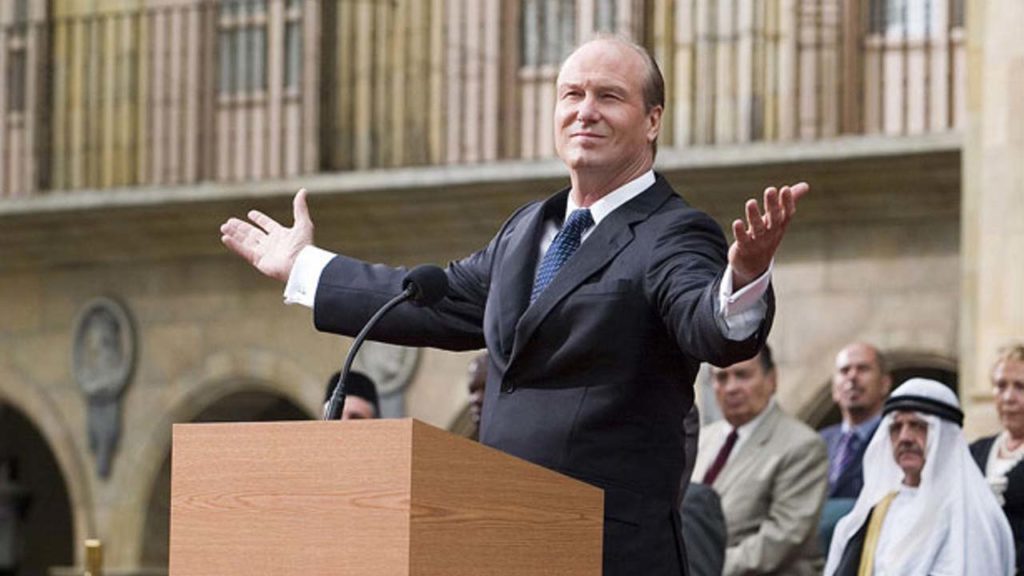
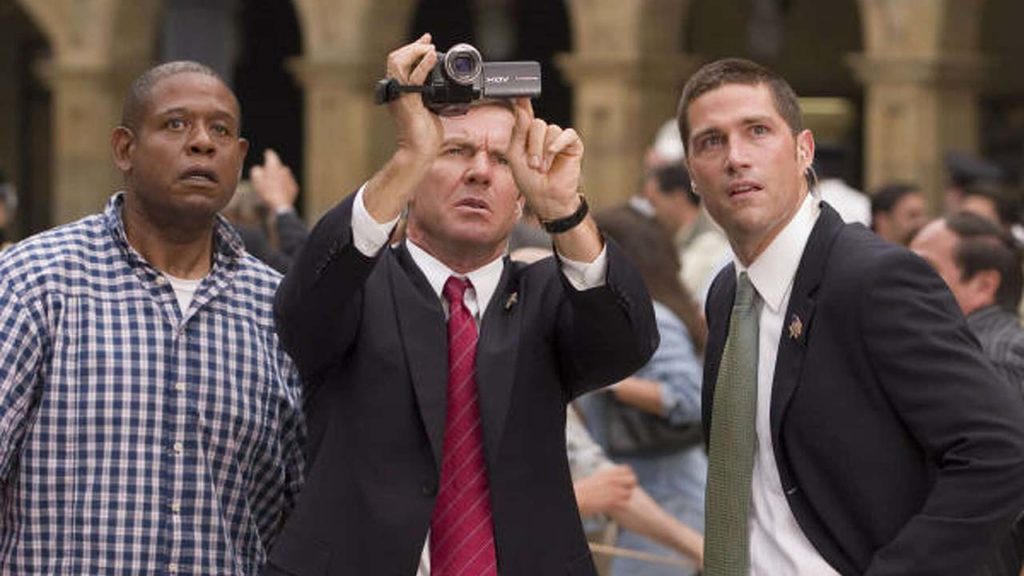
An assassination attempt on the US president in Spain is foiled by veteran Secret Service agent Thomas Barnes (Dennis Quaid) and civilian Howard Lewis (Forest Whitaker). The advantage of this structure is to withhold information and create suspense. The first time we spot Lewis, from the hyper-cautious Barnes’ perspective, he seems to be acting fishily. But when we soon see the events from his point of view, we learn he’s an innocent.
But the structure works the other way; almost a full hour passes until we see fellow Secret Service agent Taylor’s (Matthew Fox) side of the story, and the simple fact of his prolonged absence causes the audience to suspect him. At about the one-hour mark, the rigid, neat structure breaks down and we begin to see slivers of each character’s experiences mixed together, as they all draw to a single time and place for the climax.
A turkey in every pot and a thriller in every multiplex
But the crucial falling-down point of the movie is the trumped-up assassination plot itself, which is seemingly crafted for maximum storytelling drama and not real-world terrorist efficacy. Would an actual successful assassination be so hi-tech and complex? This plot relies on lots of wireless technology, split-second timing, blackmail (coercing someone to perform key tasks better done by someone the plotters could count on) and at least two inside men (one of whom must have spent almost a lifetime preparing).
This is how terrorism works only in the movies. Real-life assassins tend to be lone gunmen who manage to slip through security with their sheer unpredictability, and terrorist attacks like Oklahoma City and 9/11 didn’t depend on technology more complex than fertilizer and box cutters. While we’re on the subject, what are these particular assassins’ motivations, exactly? It becomes clear they don’t wish to kill the president but to capture him. Whatever they hope to accomplish, they seem quite pleased with themselves.
OK, everybody skootch in a little… say cheese!
All of these questions are negated in the end by a news broadcast that claims that a lone assassin has been shot and killed. This conclusion plays to the public’s lust for conspiracy theories than continues to plague 9/11 and the JFK assassination.
Extra observations:
One of the biggest plot twists is spoiled in the trailer.
Barnes is a cliche we’ve seen before, played by Clint Eastwood in In the Line of Fire.
There’s an oddly tiny role for Sigourney Weaver as television news director Rex Brooks. Was there more intended for her character? Perhaps she took the role for an opportunity to spend a few days in Spain.
Hey, it’s Hollywood’s go-to middle eastern guy, Said Taghmaoui (from The Kite Runner and Three Kings). He does turn out to be a villain, but so do two white dudes, so the movie totally isn’t racist.