Tokyo! is a portmanteau film comprised of three shorts set in the eponymous city, all by directors not themselves from Japan: Michel Gondry and Leos Carax from France, and Bong Joon-ho from South Korea.
Gondry’s “Interior Design” is based on the comic book Cecil and Jordan in New York by Gabrielle Bell, with the action transposed to Tokyo. At first, her low-key love story doesn’t seem to bear Gondry’s characteristic whimsical surreality, but by the end her collaboration with Gondry makes perfect sense. Young couple Hiroko (Ayako Fujitani, daughter of Steven Seagal) and Akira (Ryo Kase) move to Tokyo, with the hope of finding audiences for Akira’s pretentious films. Without prospects, they crash on the floor of a childhood friend’s miniscule flat and quickly outstay their welcome.
Their optimism to find jobs and an apartment is quickly dashed – only Akira is suited to menial work, and they can’t even afford the city’s dingiest rat traps. Like April (Kate Winslet) in Revolutionary Road, Hiroko doesn’t have much ambition of her own beyond supporting her artist partner. After going to extraordinary lengths on Akira’s behalf without feeling appreciated, Hiroko undergoes a fantastical transformation and winds up literally supporting a different artist. The significance of title comes clear as she literally becomes part of the scenery.
Hiroko and Akira in Tokyo
In Carax’s scatological “Merde,” Tokyo is terrorized by a madman with a twisty ginger beard and a rigorous diet of flowers, yen, and cigarettes. The “sewer creature” (so named by the media) is relatively harmless until he discovers a cache of grenades in a forgotten World War II-era bunker buried beneath the city. Only after he uses Imperial Japan’s own weapons against them in a terrible massacre is he tracked down in his sewer lair and apprehended. At this point, Carax’s short film becomes a courtroom drama, in which eccentric French magistrate Maître Voland (Jean-François Balmer) claims to be able to interpret the terrorist’s ravings, not least including his name: Merde (“shit”).
His scandalous speeches incite Japanese self-loathing and racism, but the populace curiously fails to question whether Voland is some kind of mad ventriloquist voicing his own prejudices through the mouth of an idiot. Merde becomes a pop icon; dueling gangs of picketers chant “FREE MERDE” versus “HANG MERDE.” Merde is sentenced to a Christ-like execution (which also very much resembles a similar sequence in Lars Von Trier’s Dancer in the Dark), followed by a caption that threatens a sequel set in New York.
“Free Merde!”
Bong Joon-ho’s “Shaking Tokyo” is the tale of a unnamed hikikomori (shut-in) living alone in a totally ivy-covered house, financially supported by a father he hasn’t seen in years. The agoraphobe (Teruyuki Kagawa) has become accustomed to a life of loneliness and rigorous routine. One day he meets a cute pizza delivery girl (Yu Aoi), out of his league, but apparently with her own share of crippling emotional issues.
She passes out in his foyer during an earthquake (not uncommon in the volcanic islands of Japan), and the hikikomori reboots her using her self-tattooed buttons on her body that appear to literally control her mood and health. The smitten loner escapes his self-created prison to seek her out again. He finds a city full of shut-ins, for whom even another earthquake isn’t enough to keep them out of their own homes for long.
The HBO miniseries Generation Kill comes from David Simon and Ed Burns, the masterminds behind the superlative series The Wire. Simon himself is a former journalist, the state of the industry thereof being a primary preoccupation of the fifth season of the The Wire. So it makes sense that he would be drawn to a war story seen through the eyes of a fellow writer.
Generation Kill is based on the nonfiction book by Evan Wright, a Rolling Stone reporter embedded in the US Marine Corps 1st Reconnaissance Battalion, the first boots on the ground during the 2003 invasion of Iraq. Actor Lee Tergesen plays Wright as a wide-eyed innocent among perverse killers, delightedly scribbling the marines’ colorful boastings in his notebook, when not dodging sniper fire. The most quotable is the manic driver Corporal Josh Ray Person, well-cast as James Ransone, basically reprising his character Ziggy Sobotka from The Wire season two.
The marines’ lingo flashes back to pop culture circa 2003, which already seems so very far away. A rumor spreads that J-Lo is dead, reminding us of the brief period when Jennifer Lopez was the most famous woman on the planet. Everyone’s a “dog” or “bra” (not as in the undergarment but as in “bro”). In between harrowing battles (which the warriors long for but hate when they arrive), much of their experience is comprised of long stretches of boredom. They supply their own soundtrack, recollecting what lyrics they can and recreating every part of a song a cappella with great enthusiasm.
Cpl. Josh Ray Person: “When my band opened up for Limp Bizkit in Kansas City, we fucking sucked. But then again, so did they. The only difference is that they became famous and I became a marine.”
After exhausting the conversational value of their bowel movements and each other’s alleged sexual orientations, there’s nothing but time to talk about the origins and motivations of the war. One popular theory is that it is a nothing but another race war. As one soldier puts it, it’s “White man’s destiny to rule the world” and “White man won’t be denied.” Or is it to clear the ground for more Starbucks franchises? Or maybe it’s a war over the scarcest resource of all: virgins.
Marines are trained to depersonalize and vilify the enemy, all with the aim of being effective killers. So they are essentially ill-equipped for a 21st century war in which they are expected to request permission before engaging any target, and for situations in which they must deal diplomatically with the civilian population — some of which may be threats in disguise, but most often are just people who either need their help or would rather they just leave. When the marines do wish to offer compassion, they are thwarted by their command or by cold hard reality — oftentimes there’s nothing they can do.
They’re also fatally underequipped in a literal sense: they’re issued less body armor than Wright was able to purchase on eBay, they have state-of-the-art nightvision goggles but no batteries, and as if they didn’t stand out enough, they’re clad in the wrong camouflage style. They subsist on only one M.R.E. (Meal, Ready to Eat) each day, supplemented with copious caffeine pills, Skittles, Hustler, and Skoal. But as one marine quips, “Semper Gumby – always flexible.” As characterized here, these Marines never miss an opportunity to bitch, but pride themselves on being able to “make do.”
Lt. Col. Stephen ‘Godfather’ Ferrando: “What’s foremost in Godfather’s mind? We’re still very much in the game, gentlemen.”
Aside from the frustratingly elusive Iraqi army or suicide bombers, there are few antagonists marines hate more than Reservists, the Army, and their own incompetent command. But they gradually learn that their superiors are often far wiser than they realized. Lieutenant Colonel Stephen “Godfather” Ferrando (Chance Kelly) (so nicknamed because of a hoarse voice derived from lung cancer) nearly causes a mutiny by refusing to aid a fatally injured Iraqi boy. In a rare deference from a man that has no need to explain himself to his subordinates, he explains in detail why he made his decision: it was literally impossible to save the boy.
Later, he reveals to the reporter that he is always fully conscious of ineffective commanders like the grossly incompetent Captain Dave McGraw (Eric Nenninger), known to his detractors as “Captain America.” Godfather can’t always act on every single infraction, lest policing his people become his entire role in the military machine. Even the reprehensible Sergeant Major John Sixta (Neal Jones) turns out to be more canny than anyone suspected; he knows his job is to make himself into a cartoon villain against which the men can direct their frustrations. His role is part of the time-tested marine tradition: a morale-building figure. And for audiences of this series, a bit of comic relief (“That helmet is the proppity of the Yoo-Ess-of-Ay!”).
I found the series to be disappointingly fractured, no rival at all to Simon and Burns’ masterpiece The Wire. Only the sublime final scene rises to the vaulted heights The Wire regularly reached. One marine had spent weeks shooting and editing a home movie of the invasion. When the company finally reaches Baghdad, they find they literally cannot watch the completed movie. Each walks away, in silence, one by one. In the tradition of The Wire, this closing montage is set to a perfectly chosen piece of music (Johnny Cash’s apocalyptic “When the Man Comes Around”) and sends shivers down the spine.
Ari Folman’s Waltz With Bashir could easily be filed away under any or all of the following genres: documentary, autobiography, memoir, journalism, and nonfiction. If there’s one thing all of these have in common, it’s that none make for natural cartoons. The exception that proves the rule is Marjane Satrapi’s Persepolis, which began life as a pair of graphic novels before being adapted into an animated feature film. Waltz With Bashir takes the opposite route, starting as a film and ending up as a book. Could animated versions of Joe Sacco’s Palestine and Art Spiegelman’s Maus: A Survivor’s Tale be far behind?
Folman has lost his memories of a key experience during his service in the Israel Defense Forces during the 1982 war in Lebanon. A conversation with a friend sparks a fragment of memory involving the Sabra and Shatila massacre. The Israeli Defense Force surrounded Palestinian refugee camps in Beirut, but stood by as the Phalangists, a Christian Lebanese militia, entered and massacred a still unknown number of Palestinian civilians. Was he really there, as he now seems to recollect? Did he have anything to do with it?
Folman speaks of memory as “something stored in my system,” as if his brain were merely a computer, disassociated from any culpability in the massacre. He merely witnessed it, but it was enough for him to subconsciously erase his memories over the intervening years. He seeks out old comrades in the search of someone else who served with him and may help fill in the blanks in his memory. Like a detective story, the search for clues provides a useful storytelling device while providing an episodic narrative structure.
The title refers to a fellow soldier that madly waltzed with a machine gun while surrounded on all sides by Lebanese fighters. “Bashir” is Bashir Gemayel, the assassinated Phalangist commander lionized by Lebanese, and a celebrity on a scale that one Israeli likens to how he felt about David Bowie.
Folman is an artist as well as a filmmaker; at one point he asks one of his old friends if it’s OK to sketch his family during their interview. His visual sense manifests in Waltz With Bashir‘s stunning images, composition, and color. Like Star Wars: The Clone Wars and Ghost in the Shell: Stand Alone Complex, it features stiff, simplified characters atop fully-rendered 3D environments. Human faces are crudely rendered with small looped expressions, when not totally still (note that the 2D vector animation is not the same technique used in Waking Life or A Scanner Darkly). They contrast sharply with the fluid movement of the detailed, complexly lit vehicles, backgrounds, and weapons. If such stylized human figures were a deliberate artistic choice, what is to be gained? A few possible explanations:
As recent CGI movies like Final Fantasy: The Spirits Within, The Polar Express, and Beowulf have proven to their detriment, the uncanny valley (the point at which a simulation of a human becomes almost, but not quite, realistic and thus creeps audiences out) is a very real problem facing animators as technology progresses. All three of these are technological marvels, but the human characters are still just one step away from dead-eyed zombies.
In the most practical sense, animation is useful to create images of historical events where no cameras were present. Folman does recount seeing journalist Ron Ben-Yishai boldly film the aforementioned firefight in which his friend had his machine-gun-waltz with Bashir, so perhaps some actual footage existed for reference.
The dreamlike unreality of animation plays into Folman’s theme of the mutability of memory.
Like Isao Takahata’s stunning Grave of Fireflies, animation makes it slightly easier to watch painful events. Takahata’s emotionally draining film involved a little girl slowly starving to death after the World War II firebombing of Japan, and Waltz With Bashir features such images as a field full of dying horses and the corpse of a child buried in rubble. The end of the film snatches away this distancing technique; we finally see archival footage of the massacre’s aftermath.
Is it fair to criticize the film for taking the Israeli point of view in a story about the Sabra and Shatila massacre? Save for one woman that appears in the actual footage seen at the end, Palestinians literally don’t have a voice in the film. But neither, for that matter, do the Phalangists. In the case of this historical event, Israelis were passive bystanders, neither victims nor oppressors. If to bluntly ask what Waltz With Bashir is for, it does three things: First, it’s a meditation upon the complexity and unreliability of human memory. Second, it’s an act of journalism; returning the Sabra and Shatila Massacre to the public consciousness. Third, it’s one man’s personal coming to terms with his past.
As Pottermania began some years ago, I recall being amazed at how similar it all seemed to Neil Gaiman’sBooks of Magic, which predates J.K. Rowling’s first Harry Potter novel by about five years. In it, boy wizard Tim Hunter, equipped with broken glasses and an owl, is prophesied to be an immensely powerful wizard. The forces of good and evil each seek to manipulate his upbringing in an effort to claim him for their own. For Gaiman fans, it was tempting to cry plagiarism. But subtract the glasses, and substitute the owl for a cute droid or two, and you could just as well be describing Luke Skywalker.
The generation that grew up with the Harry Potter books will just as surely sit rapt through the movies as they will quibble about the compromises made in their adaptation. Beware what follows is from the perspective of an older non-fan, who’s read the first book and seen the movies, but doesn’t hold them deep in the heart as the Harry Potter generation does.
Alan Rickman and Maggie Smith demonstrate to the upcoming generation of British actors how it’s done.
David Yates’ Harry Potter and The Half-Blood Prince is very, very long, and demands that the audience has retained an awful lot of lore from the previous movies (but again, the counterargument stands: you can say the same about Star Wars and Star Trek). I found the trailer totally incomprehensible, and the movie at times befuddling. I longed for a less novelistic and more movie-like narrative.
When a MacGuffin is finally introduced late in the movie, it adds a much-needed dramatic spark to drive the story, giving Harry (Daniel Radcliffe) and Dumbledore (Michael Gambon) a clear quest. But for those of us without a Potter wiki stored in our brains, what they seek — a Horcrux — is not clearly explained, despite reams of exposition from Dumbledore, plus a recap from Harry and Hermione (Emma Watson) at the end. Apparently there is more than one, two have already been found, and a third turned out to be counterfeit?
Helena Bonham-Carter plays her baddie with relish.
It must have been quite a gamble to cast such a large troupe of child actors, trusting that they would grow into the acting profession over the course of several years. I wouldn’t say any of the child actors are bad, but they’re all unsurprisingly outclassed by the large complement of veteran British actors.
Timothy Spall and Helena Bonham Carter both play baddies with relish, but I can’t say I recall much about who they are and what motivates them. Nor whether returning characters played by Emma Thompson, Gary Oldman, and David Tennant are still good and/or evil, alive and/or dead. Didn’t Oldman appear in a fireplace in one of the previous movies? I guess he’s feeling better now. I can’t keep this stuff straight.
Alan Rickman is superb as always, every line reading a delicious mixture of humor and menace. As with Ian McShane in anything, Rickman is doing Shakespeare while everyone else is in a soap opera. His character Snape turns out to be the titular Prince, which I suppose raises two questions for the next installment: was his dangerously annotated potions textbook deliberately left to fall into Harry’s hands? And: what’s the significance of the nickname? He appears to be some kind of double-agent.
Emma Thompson excitedly explains all the Potter lore to non-fans like myself.
Recurring villain Draco (Tom Felton) remains a wet noodle. Every movie sets him up as Harry’s nemesis at school, as well as cosmically fated for evil as Harry is for good. But he always winds up spanked and running away crying like a baby. It’s unclear to me if we’re supposed to consider him a real threat, but perhaps I’m overthinking things, and it is simply childish wish fulfillment that the school bully always get his embarrassing comeuppance.
Most of the rest of the movie is concerned with the teens’ romantic lives. I don’t happen to recall Ginny (Bonnie Wright) being a significant character in the previous movies, so the mutual infatuation between her and Harry seemed to have developed offscreen between movies.
But what has always puzzled me the most about this whole epic is Harry himself. What makes him so special? He’s not necessarily the most clever (Hermione of course), brave, or powerful. From what I recall from the backstory, his biggest claim to fame is that he survived an attack by the Dark Lord Voldemort. But the world’s most powerful wizard Dumbledore apparently trusts Harry more than anyone else. Surely there’s any number of more experienced wizards he could have brought along with him to look for the Horcrux; why did he specifically need Harry?
The electronic/disco/pop/rock group MGMT has made a huge splash, earning spots on tours with no less than Paul McCartney and Beck. The wildly catchy “Time to Pretend,” “Electric Feel,” and “Kids” (the latter featuring a truly deranged music video) are not out of keeping with the rest of their repertoire in terms of style and instrumentation, but the infectious hooks do stand apart from the forgettable rest. At their Celebrate Brooklyn concert in Prospect Park on July 1, they debuted a few new songs set for their forthcoming sophomore album that didn’t immediately grab me either.
MGMT live in Prospect Park
For a band called “synth-hippies” by Pitchfork, they all looked rather clean-cut to me (but they evidently have a very young and boozy audience – one kid passed out and literally collapsed on our feet only a few songs into the concert). Their sound may be very electronic and a throwback to disco, but their live instrumentation is very rock guitar oriented. The only exception being “Kids,” for which the band put down their analog instruments and let the synthesizers and sequencers take over, even recreating a live fadeout.
Explosions in the Sky is an instrumental post-rock quartet from Texas. Their characteristic formula of a chiming guitar power trio on top of pulsating drums is a bit more palatable than their extremely loud, menacing Scottish peers Mogwai (read our review of their April show in New York). Personally, I hear a kind of homogeneity to much of Explosions’ music that I don’t hear in other post-rock outfits like Mogwai, Sigur Ros, and Tortoise.
To oversimplify their history, the band is primarily known for two factoids. In an unfortunate coincidence, their album Those Who Tell the Truth Shall Die, Those Who Tell the Truth Shall Live Forever, released a few days before 9/11, featured a cover illustration of a plane and a caption reading “This plane will crash tomorrow.” Long before I actually heard any of their music, I do recall this story helping to feed the 24-hour-a-day broadcast news hysteria that followed. Better bolstering their repute, they composed the popular score to Peter Berg’s 2004 film Friday Night Lights, and they’ve attracted a significant fan base – selling out outdoor Central Park Rumsey Playfield even in the rain.
The band’s designated spokesman Munaf Rayani began the show by announcing it was their 10-year anniversary as a band. They played for about an hour and half without interruption, blending songs together into a continuous flow. From where I stood, the appreciative audience recognized and cheered many tunes. But Rayani apologized at the end of the show for things having “going off the rails,” and they walked off without an encore despite there still being some time before the Central Park curfew. For all I know, that may be their custom, but it was really surprising, and audibly disappointed everyone around me. Awkward.
Robert Wise’s The Day the Earth Stood Still is one of the few essential science fiction movies that has lasted, overcoming dated special effects, acting styles, and the end of the Cold War — the provider of subtext for many a horror story. In the company of Forbidden Planet (Shakespeare’s The Tempest in space), The Blob (an invasive species consumes the population), and Invasion of the Body Snatchers (smalltown America succumbs to the ultimate conformity), it continues to resonate decades later, even being reimagined in 2008 as an ecoparable.
Immediately striking is the dissonant score by Bernard Herrmann, of Psycho fame. The evocative piece over the opening credits sounds just like an outtake from Brian Eno’s ambient album On Land, thirty years early.
Michael Rennie as Klaatu in The Day the Earth Stood Still. Evidently they have Brylcreem in space.
Wise shows us humanity’s first alien contact through the quaint filter of period radio and television; rest assured, “scientists and military men” are on the case. Klaatu (Michael Rennie), a suave caucasian humanoid male alien, and his pet robot Gort (Lock Martin) park their UFO on a baseball field on the Mall in Washington D.C. His polite request for an audience with the United Nations goes rebuffed, for during the height of the Cold War, not even a flying saucer, an alien in a silver jumpsuit, and a giant robot is enough to convince the nations of the world to sit down and talk. Klaatu’s flying saucer is surrounded by hilariously lax security, and he is briefly taken into custody before handily escaping into the D.C. suburbs.
Klaatu has learned mid-Atlantic accented English from radio and television broadcasts, and outwardly appears perfectly humanoid right down to his slicked-back hair (they evidently have Brylcreem in space), so all he needs to blend in with the masses is to simply steal someone’s dry cleaning. He checks into a spare room, with some shots directly quoting Alfred Hitchcock’s 1944 classic The Lodger. He befriends young Bobby (Billy Gray) without a hint of suspicion, dating the film more than anything else.
Klaatu tries to get his message through to a pacifist scientist, but he’s discovered, shot, and dies. Gort, programmed to activate in such an event, threatens to exact an unspecified violence upon humanity. But Klaatu has already taught his interspecies ladyfriend Helen (Patricia Neal) the robot-mollifying fail-safe codephrase “Klaatu barada nikto.” Gort ceases his hostilities, and instead revives Klaatu using machinery on their ship. Klaatu claims his new lease on life is only for a limited time, for true resurrection is only the domain of “the Almighty Spirit”.
The remarkable fact that he believes in a God goes unremarked upon; both he and the humans to whom he’s speaking simply take it for granted they’re talking about the same deity. This line stands out for a reason; the dialogue was reportedly inserted at the request of the MPAA, who objected to Klaatu’s godlike powers of resurrection. Failing to reach the world’s leaders, he settles for the next-best thing: an assembled group of scientists (all, of course, white males). Message delivered, he leaves Earth in a huff.
Lock Martin as Gort in the Day the Earth Stood Still. Klaatu barada nikto! Don’t tase me, bro!
So, let’s recap: an otherworldly visitor with a message of peace-or-else is executed, rises again, and ascends into the heavens. Do I have to spell it out?
But if Klaatu is analogous to Jesus, let’s take a closer look at his message. He claims Earthlings’ warlike behavior is of no interest to the spacefaring species of the universe, as long as it’s contained to one planet. But the interstellar community is beginning to fear that Earthlings are about to discover interstellar travel, and they will not permit humanity to bring their atomic weapons with them. Klaatu is the representative of other societies that have already passed through this phase, whom, unable to curb their violent impulses on their own, came up with a solution to police themselves: a fleet of lethal robots programmed to eradicate anyone that violates the truce.
So they use weapons to deter the use of other weapons? What kind of message is that to a Cold War audience living under the nightmare of Mutually Ensured Destruction? To the 21st Century viewer, the immediate worry is whether or not we could ever trust an artificial intelligence to impartially keep the peace. Indeed, whole science fiction franchises have been built upon that very theme, including 2001: A Space Odyssey, Blade Runner, The Terminator, The Matrix, and Battlestar Galactica.
But perhaps I’m being too literal. It’s a simple movie, but is it a simple analogy? Is the army of Gorts a symbol for Earth’s nuclear arsenal? No, because that’s exactly what Klaatu wants humans to put away. According to The New York Times, producer Julian Blaustein “told the press [the film] was an argument in favor of a ‘strong United Nations.’” But the U.N. is denigrated as petty and ineffective in the movie; they won’t deign to merely listen to Klaatu’s speech. The overall message is very cynical: even more advanced aliens aren’t able to curb their violent impulses on their own. Klaatu is here to threaten, not save us. If we embark out into space bearing weapons, we’re toast.
The Day the Earth Stood Still is based on 1940 short story “Farewell to the Master” by Harry Bates. Walter Trevis’ 1963 novel The Man Who Fell to Earth (filmed in 1976 by Nicholas Roeg, starring David Bowie) shares some plot elements (the alien Thomas Newton too bears diamonds as seed money), but veers off into another direction altogether. Newton has no interest in steering humanity’s course. He’s here on a secret mission to save his own people, but falls prey to his own all-too-human weaknesses.
Any friend of this blog will know that I almost universally hate biopics. As I’ve complained in my reviews of Control, The Diving Bell and the Butterfly, and even Walk Hard, I believe that the feature film is fundamentally ill suited for biography.
One seemingly minor lesson from college that wound up sticking with me is Edgar Allen Poe’s definition of the short story as a prose piece that can be experienced in a single sitting (The Philosophy of Composition, 1846). No one expects a serious portrait of a person’s entire life in a few pages, so why should we applaud a movie? The feature film’s two-hour running time is more akin to a short story than to a book-length novel or biography, and yet the biopic is a dominant genre in movies.
I would argue the primary reason biopics routinely get financing and awards is that they give ambitious actors the opportunity to exercise their imitation skills. It pleases audiences who perceive “true stories” as being of greater merit than fiction (mere make-believe!), and pandering to the Academy, who love nothing better than a technically impressive mimicry of an addict or handicapped person. I actually welcomed Walk Hard, for although a terrible movie itself, it finally mocked the formulaic drug-addicted musician biopics Ray, Walk the Line, La Vie En Rose, and El Cantante.
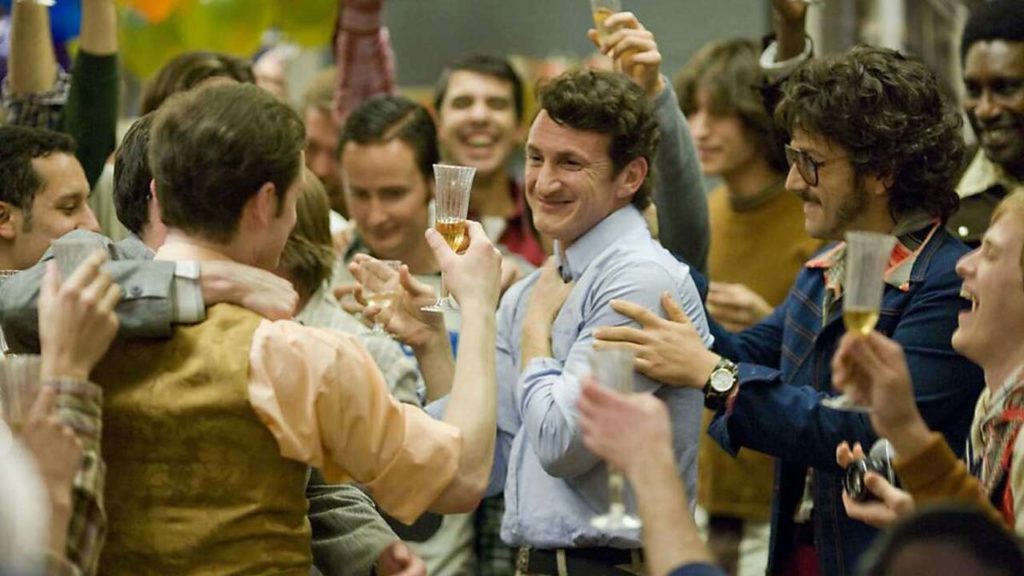
Director Gus Van Sant and writer Dustin Lance Black’s Milk, on the other hand, strikes me as less insincere than its peers. For one thing, it examines only a ten-year span of a man’s life, avoiding the genre’s usual Cliff’s Notes-like approach to summarizing a famous figure’s life into a series of highlights. And yes, Sean Penn did win an Oscar for a lively, spirited performance worlds apart from his natural demeanor. But I believe he, like everyone else involved, approached the project with nothing but the highest integrity, and truly hoped the timely project could affect public opinion.
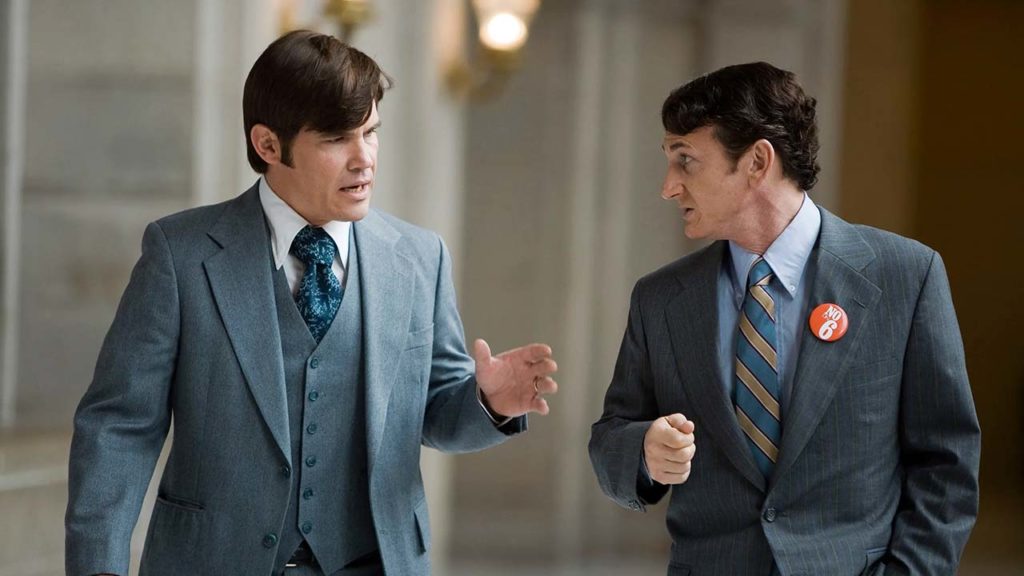
Milk was in theaters during shortly after the national debate over California’s Proposition 8, which denied the right to marry to a significant portion of the population (thanks to commenter Sapphocrat below for the correction). It’s impossible to miss the parallels to Harvey Milk’s struggle in 1978 against Proposition 6, which would have enabled the firing of homosexual teachers and (this is the truly amazing part) anyone that supported them. One of the movie’s biggest achievements is that it emphasized the sheer urgency of the gay rights movement. Equality was not just something that’s time had come. Gays were not only fighting for rights they hoped some day to have; they were fighting to keep the what rights they did have from being taken away.
I must admit that all I knew about Harvey Milk was the tangential bit of trivia that his assassin Dan White (Josh Brolin) was the first to employ the infamous “Twinkie Defense” in court, claiming that a diet of junk food altered his body chemistry and created a temporary state of insanity. Harvey was originally a New York insurance man, closeted from coworkers and family, but not so much so that he couldn’t brazenly pick up a stranger on the subway (with gaydar so fine-tuned that he could immediately tell that what I would assume to a normal-looking dude in 70s fashions was a fellow Friend of Dorothy). Scott Smith (James Franco) urges him to move to California where he can live more honestly. Harvey initially is happy to just live his new life, but becomes politicized as he faces prejudicial opposition to his small business.
Although it may seem to contradict part of my tirade against biopics at the beginning on this post, it might have been illuminating to see a little more of Harvey as a younger man, before he blossomed into a politically aware, out man. We only learn through passing dialogue that he hid not only his sexuality but even Scott’s very existence from his family. If the aim was to compress the essence of Harvey Milk into a short-form narrative, it strikes me that the major dramatic arc would be his transformation from a closeted man into someone that would later ask an entire community to come out at once.
A grotesquely costumed, knife-wielding creep on the Timecrimes (Los Cronocrímenes) theatrical poster promises an exploitative slasher pic along the lines of Texas Chainsaw Massacre. To some degree, considering the degradations made upon a breathtakingly beautiful girl alone in the woods, it is.
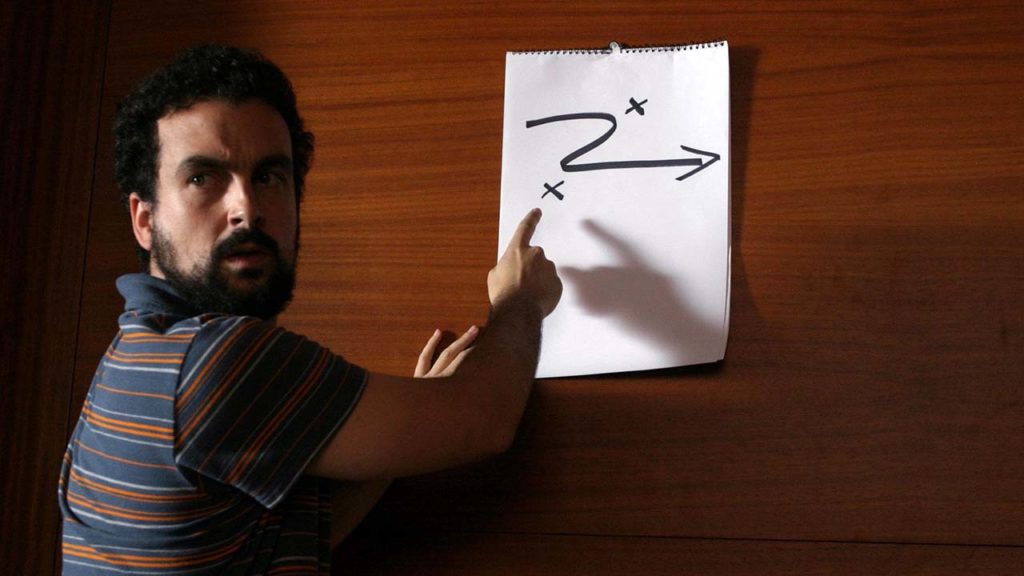
But Nacho Vigalondo’s Spanish science fiction puzzler is a friendlier sibling to Shane Carruth’s Primer (2004), a much more brain-spraining chronological conundrum. Both are rare science fictions that rely on a complexity of ideas rather than special effect eye candy. Vigalondo’s different take on the sci-fi tropes of time travel (more on that later) makes Timecrimes a little easier to follow than Primer.
The film opens with Héctor (Karra Elejalde) driving home from grocery shopping with the hatchback of his car ajar, leaving a string of groceries behind him (yes, it’s a metaphor). He and his wife Clara (Candela Fernández) are outfitting a country home as a retreat for the stressed-out insomniac. We never learn what exactly ails him, or what kind of job affords them such a lifestyle. Little do we realize that violence and chaos is already roiling in the bucolic woods around them. Their neighbor turns out to be a research institute developing a rudimentary time machine. The device is not due to be tested for weeks, but unnamed staffer El Joven (Vigalondo himself), is hanging around the facility to tinker with it without permission.
Timecrimes’ pink boogieman
Héctor encounters an unconscious nude woman (Bárbara Goenaga) in the woods, and finds himself pursued by what he assumes to be her assailant. Taking refuge at the institute, El Joven volunteers to hide him in an apparatus that resembles a hot tub prepared for a milk bath. From Héctor’s point of view, the doors open mere moments later, but he finds himself several hours in the past.
Even though Héctor is the first person to ever travel through time, El Joven seems pretty unamazed that the machine works. He’s also assured of the rules: Héctor must be sure to stay out of the way as his future self comes to the time machine, after which there will once again only be one Héctor in the world. Meeting himself and/or altering events (say, preventing his future self from ever passing back to the past), would cause a cataclysmic paradox.
El Joven never specifies what exactly the results would be, but anyone familiar with Doctor Who, Star Trek, and the aforementioned Primer would know that a temporal paradox could rupture the space time continuum, reverse the polarity of the neutron flow, be really socially awkward, or… whatever.
More illustrative is the paradox at the heart of the Terminator films: the evil artificial intelligence SkyNet sends a cyborg back in time to kill Sarah Connor, before she becomes the mother of SkyNet’s mortal enemy John Connor. Future-John also sends his best friend Kyle Reese back in time, ostensibly to protect his mother. As David Foster Wallace pointed out in his vicious critique of Terminator 2: Judgement Day, the paradox is that both time travelers cause the unwanted future to occur: Reese sleeps with Sarah and becomes John’s father, and the wreckage of the cyborg becomes the technological basis for building SkyNet.
Director Nacho Vigalondo apparently wrote his pitch meeting into his script.
Héctor originally acts impulsively and attempts to contact his past self by phone, and then in person. He makes a series of calamitous errors, and eventually comes to realize that he must shift his strategy to ensure he not disrupt what has already happened to him, but will be everybody else’s future. El Joven only sticks Héctor into the time machine in the first place because a copy of him that already went through told El Joven he had to do it. Héctor kidnaps and abuses La Chica to recreate the perverse scenario the past version of himself encountered. He commits a perverse crime against her, but he rationalizes to himself that it is not for his pleasure (regardless of his sci-fi predicament, his behavior is psychotic).
But the increasingly crazed Héctor tries one last time to change events. He travels back in time again, creating a second temporal loop-de-loop, a third duplicate of himself, and more proliferating walkie-talkies than I was able to keep track of. Héctor only seems to realize near the end of his ordeal that everything is clicking into a predetermined sequence of events, regardless of his direct or indirect interference. Eventually, a calmness comes over him, and he simply sits down and waits for events to finish playing themselves out, knowing there is nothing he can do. So Timecrimes‘ notion of time travel is not actually like that in Star Trek or Terminator, but more like the television show Lost, whose rules stipulate that there is only one unalterable timeline. There is no such thing as a paradox.
La Chica unknowingly helps Héctor out of two different car crashes
Héctor’s time loops are straightened out by the end, with only one version of himself left in the world. But his misadventures in time have left a trail of destruction behind him similar to his spilled groceries in the beginning of the film. La Chica lies dead in his garden, he’s crashed two cars, and the police are coming. La Chica’s necklace is in his pocket, and he’s sure to be found guilty for her death. Perhaps worse of all, a working time machine sits idle at the top of the hill, waiting for more mistakes to be made.
The DVD also includes Vigalondo’s excellent short film “7:35 de la Mañana (7:35 AM)”, in which he exhibits his prowess with the slow reveal of narrative information.
Director Stephen Daldry (The Hours, Billy Elliot), producers Anthony Minghella and Sydney Pollack, and screenwriter David Hare’s adaptation of Bernhard Schlink’s novel The Reader examines evolving notions of German postwar guilt and culpability.
Unfolding across three distinct time periods (1958, 1966, and 1995), The Reader hinges on a significant reveal in its middle that recasts previously seen events. This is not to compare it to more infamous examples of stunt plotting like Fight Club or The Sixth Sense, both easier to introduce without spoiling their big reveals: Brad Pitt and Edward Norton beat each other up for fun! Haley Joel Osment and Bruce Willis investigate ghosts! Without its crucial piece of information revealed midway through, one would be forced to describe The Reader as merely a story about a young man who has an affair with an older woman.
In 1958 Germany, 15-year-old Michael Berg (David Kross) has a summer-long affair with a 36-year-old stranger, Hanna (Kate Winslet). For him, the relationship is heatedly emotional and erotic, but for the strangely dispassionate woman it seems to be about fulfilling some unknown need or hunger that he (or the audience, yet) doesn’t understand. Her sexual advances are sudden and blunt, and he doesn’t even learn her name until their third assignation.
It says right here in our contract that we have to film a half dozen sex scenes…
She bathes him harshly and dispassionately, certainly not as a lover, or even a mother would her child. Hanna repeatedly reinforces their age differential by insisting on calling him “kid,” but reverses traditional age roles by having him read to her. As the summer passes, she more overtly trades sex for reading. The highly regimented Hanna has excelled at her job of selling bus tickets, and faces a promotion. We don’t yet know why, but she doesn’t want to stand out. She abruptly leaves town, cutting off the affair.
In 1966, Michael (still played by Kross) is in law school. As part of a seminar studying the Holocaust, he attends the trial of several accused concentration camp guards, one of whom turns out to be Hanna. Despite managing to hide in plain sight for years, she now unapologetically tells the truth, seemingly unaware of how doing so indicts herself. Michael is horrified to learn that what she calls her “job” was to be a guard at the most infamous of all evil places on earth: Auschwitz. The particular crime she is on trial for is locking hundreds of prisoners inside a burning church. Her self-serving cohorts attempt to pin her as the leader, in order to lessen their own culpability.
One seemingly minor anecdote is told about her habits at the camp: she chose a few young women to feed and protect. The prisoners suspected her of being a lesbian, an exploitation they could understand, but in fact she only asked that they read aloud to her. She would not protect her girls forever; when one met their death, she would simply select another girl. This anecdote is understood by the court to be an inexplicable quirk of an evil person, a mere matter of character, but Michael realizes the truth: she was, and remains, illiterate.
Michael is forced to recast the meaning of their affair in his mind. In a way, he was also her captive, and she similarly used him for her literary edification (and not for, as his teenage mind would have fantasied, love, or at least sexual gratification). Was he somehow to her like the girls she chose in the camp to entertain her? Did she do so out of self-interest, or to give them temporary comfort before they died? Or some combination of the two, a kind of tradeoff?
Kate Winslet is shocked, shocked to learn there are naughty bits in Lady Chatterly’s Lover.
Hanna could absolve herself of at least one charge. By admitting her illiteracy, she could prove that she was not solely responsible for covering up the church incident. But she mystifyingly chooses to accept culpability rather than admit she can’t read. The mystery of the character is how anyone would be so ashamed of their illiteracy that they would effectively condemn themself to a lifetime prison sentence instead of the 3-4 years that her cohorts received.
Michael could help her case by coming forward, but does not. Is he protecting his privacy, or effectively choosing to punish her? Both? In 1995, Michael (now played by Ralph Fiennes, looking and sounding more and more like Laurence Olivier) opts to give her a significant present from afar. He begins with cassette tapes of him reading, and later provides the tools to help her teach herself to read.
A key question is whether or not he has forgiven her for her crimes against humanity, not to mention those against him: breaking his heart and arguably sexually using him. Technically, Hanna is a pedophile. Such crimes are usually imagined as being perpetrated by men. Certainly, films aren’t made where a 15-year-old girl’s relationship with a hot 36 year old male might be seen as a sexual awakening.
But Michael is in fact damaged; as he grows into an adult, his ability to forge solid relationships (either romantically with women, or as a parent to his own daughter) is stunted. When he first met Hanna, he saw her as a sexy adult. But in prison she is reduced to a childlike state, learning to read like a little girl. When the adult Michael comes to visit her, it is he that is the adult and she the trembling dependent looking up to him.
This rare shot from the set of The Reader shows David Kross and Kate Winslet in costume.
Because The Reader is a movie, and movies star stars, and because Kate Winslett is gorgeous and frequently naked, one instinctively wants to sympathize with her character Hanna. But the fact of the matter is that Hanna is a monster. What makes the character interesting is that she evidently can’t see the enormity of what makes her, for lack of a better word, evil.
The eminently practical Hanna does not seem to be a woman of many passions. She even seems surprised at first that the young Michael might be attracted to her sexually. When we meet her, she spends her joyless life alone in a drab flat and mundane job selling bus tickets. We later learn that she approached her “responsibilities” at Auschwitz with the same rigidity. She baldly admits to the events and what she did, not even really hiding behind the standard excuse of just following orders. In her mind, she seems to have been acting out of duty and responsibility to execute (so to speak) the requirements of her job. Hanna is so madly rule-oriented that she equated the subjugation of her prisoners to being a kind of protective responsibility.
A total lack of remorse is a sign of a sociopath, or of someone who is psychologically protecting themselves from confronting what they have done. Whether she compartmentalized her emotions or didn’t have any to begin with, Hanna was able to function as a cog in a giant atrocity machine, and to live on dispassionately afterwards. She must not be alone, for countless people operated just like her, making the Holocaust possible.
Hanna is interesting to compare with costar Fiennes’ role as the Nazi commandant Amon Göth in Stephen Spielberg’s Schindler’s List. Göth was tortured by his attraction to a Jewish woman that his rank (and German society at the time) dictated that he must view as less than human. He is an evil man who nevertheless seems more able than Hanna to faintly glimpse his depravity.
Ralph Fiennes is depressed he’s not in any of The Reader‘s sex scenes.
Ron Rosenbaum took offense to the “Holocaust porn” aspects of both the novel and the film for Slate. Is the story “redemptive,” as Rosenbaum accuses? As I thought about the film more, I think that Hanna’s shame over her illiteracy was something to cling to, when she couldn’t grasp the enormity of her crimes. It was easier for her to allow herself to go to jail under the umbrella, in her own mind at least, of continuing to hide the much lesser of her two secrets. So, I don’t think the film and novel take the stance that illiteracy is a greater shame than enabling the Holocaust; but rather Hanna’s intellectual deficiency is emotionally easier for her to cling to than admit to the oblivious herd mentality that allowed her to rigidly follow the rules and help effect the Final Solution.
Rosenbaum also accuses the film of portraying ordinary Germans as being ignorant of the Holocaust. Perhaps Rosenbaum doesn’t recall the law school sequences in which Professor Rohl (Bruno Gantz), himself a camp survivor, holds a seminar with some of his best law students discussing German guilt and culpability. I found it interesting to consider the first generation of Germans (represented by Michael) that grew up after the war, surrounded by adults that lived through it and had varying degrees of involvement (active or passive). Some of the most reprehensible characters in the film (even more so than Hanna) are her comrades that deny that anything happened. The only character I can think of that may support Rosenbaum’s accusation is the war crimes judge presiding over Hanna’s case. He would have theoretically been in a position of power during the war, but is seen affecting outrage at Hanna’s crimes.
Personally, I found Hanna to be an interesting character, which is not the same as sympathetic. I would describe her as infantilized and not even really worthy of pity. My interpretation of the story is that Michael chose to punish her by allowing her to indict herself on the witness stand, but in her mind it was due to the far more palatable excuse of keeping the secret of her illiteracy. She avoided accepting her own war crimes in order to make it possible to live with herself. The adult Michael gifts her a belated education, which is not necessarily an act of kindness. Perhaps he believes that stimulating her intelligence and imagination might enable her to understand her guilt. If so, he utterly succeeds, for she kills herself. It’s ambiguous whether her suicide is about guilt or simply over her fear of functioning in society after decades in prison.
The biggest clue that the outwardly cold Hanna is even capable of having buried emotions and guilt is the fact that she is interested in books at all. Otherwise, it wouldn’t make logical sense that this dispassionate person who seduces and fucks with as little emotion as she sells bus tickets, works in a concentration camp, or allows hundreds of Jews to burn to death, would have a love for literature.