Category: 3 Stars

Largely Ambivalent

  • Believer Meets Skeptic, in The X-Files: I Want to Believe

    Believer Meets Skeptic, in The X-Files: I Want to Believe

    The first X-Files feature film Fight the Future (1998) was so tightly bound to the complex mythology of the original television series that it was mostly incomprehensible to anyone not already a deeply committed fan. I myself had only seen the odd episode over the years, and as such could barely follow what was going on.

    The unexpected I Want to Believe, belatedly coming about six years after the conclusion of the series and a full decade after the last feature film, is a standalone adventure almost entirely decoupled from the series’ unifying story arc: all that jazz involving an invasion of body-snatching aliens collaborating with the government, all of which may or may not have something to do with sticky black goo.

    David Duchovny and Gillian Anderson in The X-Files: I Want to Believe
    Don’t eat the yellow snow, Mulder.

    Freed of the weight of years of continuity allows this new film to dig into the true core of the series: the relationship between Fox Mulder (David Duchovny) and Dana Scully (Gillian Anderson). These are two people who not only deserve each other (their idea of pillow talk is to discuss toxicology reports) but are actually each other’s yin and yang. Their believer / skeptic dynamic fueled the addictive science fiction aspects of the show, but also the sexual tension that helped make it a hit. They each need each other in order to not self-destruct.

    Scully, a brainy redhead like a grown-up Hermione Granger, is every geek boy’s crush. In the intervening years, she has voluntarily left the FBI to toil without reward as a doctor at the aptly-named hospital Our Lady of Sorrows. As a pragmatic woman who does not operate on faith, a Catholic Church-operated institution is the last place she ought to be. Her counterpart Mulder, since last we’ve seen him, has become the stereotypical bearded recluse. Without the mediating influence of Scully, it’s clear he’s only a few cranky letters to the editor away from becoming the next Unibomber.

    Gillian Anderson in The X-Files: I Want to Believe
    Scully is, as usual, the life of the party

    Meanwhile, next-generation FBI Special Agent Dakota Whitney (Amanda Peet) investigates the alleged visions of a convicted pedophile Father Joseph Crissman (played against type by wacky comedian Billy Connolly). Needing agents with a certain expertise in the weird, she gets the old X-Files band back together. In an unfortunately dropped subplot, it’s evident she crushes on an endearingly oblivious Mulder. In fact, her entire character is unfortunately dropped too soon — dropped down an elevator shaft, that is. Sorry for the spoiler, there, folks.

    The plot is a mélange of hot topics ripped from the headlines, Law & Order style. Ticking the boxes, we have lung cancer, gay marriage, Catholic church pedophilia (the murderer turns out to be the husband of a grown altar boy that the Father buggered years ago), stem cells (Scully attempts to cure a boy’s rare brain disease with research she cunningly finds via Google), grotesque scientific experiments (a plot point refers to an actual Cold-War era Russian experiment that has been making the rounds on the internet recently involving artificially sustaining a dog’s severed head). To top it all off, the movie also features cinema’s most extreme sex change operation since The Silence of the Lambs.

    David Duchvony, Gillian Anderson, and Amanda Peet in The X-Files: I Want to Believe
    Special Agent Dakota Whitney has an appointment with an elevator shaft.

    I Want to Believe was poorly reviewed, and worse, a commercial failure (although, granted, much of the latter was the fault of opening opposite The Dark Knight). The most radical innovation to the X-Files formula is the new version of the famous theme music by electronica outfit UNKLE, so perhaps audiences and critics wanted something new, and not a nostalgia retreat. But it’s an enjoyable film, largely because it’s not without some humor, and against all odds, features a happy ending for the long-suffering couple.

    A note on the DVD: I watched the “Extended Version” cut, so I can’t comment on how significantly it may differ from the theatrical version. Among the bonus features is an interesting featurette in which Chris Carter discusses the “green production” for the movie (the use of hybrid cars, recycling of set materials, etc.), and how he abhors the waste that typically goes into television and movie production. An anti-smoking public service ad is included on the DVD, making one wonder if the recurring theme of lung cancer in the plot was grafted on or an organic component to the plot.

  • Ideaspace Boils to Steam in DeZ Vylenz’s The Mindscape of Alan Moore

    Ideaspace Boils to Steam in DeZ Vylenz’s The Mindscape of Alan Moore

    DeZ Vylenz’s feature-length documentary about the life and work of writer Alan Moore was made in 2003 but not released until 2008. The delay might be easily explained as that of an independent production’s typical struggle for funding, but it’s hard not to guess the timing of this particular film’s lavish release as a deluxe double-disc DVD may have something to do with Moore’s currently elevated profile. The long-awaited theatrical adaptation of Moore and Dave Gibbons’ seminal graphic novel Watchmen finally hits theaters on March 6 2009, after almost 2 decades of fits and starts in Hollywood limbo.

    The Mindscape of Alan Moore is essentially an extended sit-down interview with Moore, intercut with evocative imagery evoking Godfrey Reggio’s Koyaanisqatsi: Life Out of Balance. It moves too quickly to focus on any one aspect of Moore’s long career, and it’s possible to glean more insight into the man just by reading one or two interviews. But it’s apparent that Vylenz’s true interest lies less in Moore’s comics work than in his practice of magic. More on that later.

    Alan Moore in The Mindscape of Alan Moore
    The charmer from Northhampton

    Let’s be frank; Alan Moore is a weird cat. As more than one person has described him, he’s a truly great writer that has chosen to work in “The Gutter” (as it amuses Neil Gaiman to call it): comics. Which is to oversimplify; some of his other work includes several performance art pieces and the stunning prose novel Voice of the Fire. All this has left Moore a cult figure, underestimated even by many fans.

    He is probably one of comics’ best-known marquee names, but while his friend Gaiman frequently tours the globe like a rock star, he’s happy to stay at home in Northhampton. Like Stanley Kubrick, he has an unfair reputation as a kind of eccentric recluse, but reportedly the actual truth is that he is a warm and friendly person who simply wishes to enjoy life in his home town and practice his art.

    Moore began writing comics in the 1980s Reagan/Thatcher Cold War era, which informed the paranoid and apocalyptic air of V for Vendetta and Watchmen. One particular fictional nightmare of Moore’s that he perversely enjoys to point out is V For Vendetta‘s accurate prediction that CCTV surveillance would blanket England by the late 1990s. But further on the topic of political oppression, Moore affirms that while conspiracy theories are everywhere you look (the act of looking creates them, one might say), in fact there are no conspiracies. If the world is rudderless and chaotic, conspiracy theories are mere comforts.

    The Mindscape of Alan Moore
    V approves of this post

    Against his intentions, his dark take on the superhero and science fiction genres was radically influential in the wrong way. Fans and creators who didn’t grasp the deeper themes behind Watchmen forever steered comics into grim and gritty stupidity, mimicking the superfluous sex and violence without the subtext and literary merit that Moore snuck in the back door.

    On its simplest level, Watchmen could be described as what the world would be like if there actually were such a thing as superheroes. The answer being: totally different and yet exactly the same. But looking deeper, Watchmen is actually about the danger of those that claim the power to change the world. It’s impossible to read Watchmen now, two decades after its creation, and not to compare the book’s true villain (whom it would be a cruel spoiler for me to name here) with George W. Bush’s misadventures in the Middle East. Bush and Watchmen‘s villain both manufactured wars with the presumptive belief that they were destined to save the world.

    Moore believes that while a knowledge and appreciation of how cinema works can inform comics, there are things that only comics can do. If comics creators only work with movies in mind, their comics will be like “movies that don’t move.” So, as a result, most of his work was essentially “designed to be unfilmable.” I worry that the forthcoming adaptation of Watchmen will carry on the tradition of missing Moore’s point, and will simply be a dark, nasty, and depressing story of violence, sex, and depravity starring superheroes in sexy tights.

    Rorschach in The Mindscape of Alan Moore
    Rorschach’s cameo appearance

    Moore declared to friends and family on his 40th birthday that he was a magician. Not “magic” as in the pulling of rabbits out of proverbial hats, but as in the exploration of areas outside the realm of science. Magic is the exploration of what science does not cover, but sometimes science describes the world in ways that might sound like magic. Collaborator Dave Gibbons points out the Heisenberg Uncertainty Principle, in which the more we learn what makes up matter and the material world, the less substantial it all seems. We can’t observe or measure it; there’s nothing there.

    Moore defines magic as “The Art,” and if art is the manipulation of words and images to alter consciousness, then art is magic, and a writer is a magician. As Moore says in an interview with Daniel Whiston, his best grimoire (or book of spells) is actually a dictionary. Moore believes writing is a “transformative force than can change society” but by the 21st Century, writing is seen as a mere entertainment. Whereas once, in less rational or scientifically enlightened times, writers were feared.

    A witch could curse your crops or your health, but a writer could afflict you with a satire that could cause an entire community to laugh at you, and worse, for posterity to continue to laugh at you generations after you die. Now, the power of magic is not only underestimated, but abused. Advertisers work magic every day by manipulating and anesthetizing people en masse.

    The Mindscape of Alan Moore
    Doctor Manhattan as Da Vinci’s Vitruvian Man

    Moore posits the existence of what he calls “Ideaspace,” the landscape of the mind and spirit. The various systems of magic, like the Tarot and the Kabbalah, are maps to Ideaspace. He describes how writers and musicians sometimes feel like they are tapping in to something beyond them, as if merely taking dictation.

    I myself once felt a faint, pathetic little echo of I think what Moore is talking about. A high school friend and I used to compose and record instrumental music for guitar and keyboard. Our compositions were of varying degrees of seriousness, many just silly fun, but some fairly ambitious. While jamming around one of our silliest tunes, I still swear I heard a melody in the music that neither of us had played yet. My friend couldn’t hear it even when I figured it out on the guitar and played it over the backing tracks we had already recorded. Perhaps I was just hearing musical overtones that were literally present in the sound waves, but I remain convinced that, as silly as that particular tune was, I very briefly connected into some kind of world of music. I don’t feel like it was a piece of music that I wrote, more like something that was already there, waiting, and I just had to hear it and play it back onto tape.

    But if Ideaspace is real place full of “information” (nonmaterial ideas and inventions), humans are accumulating information at an exponentially increasing rate, and Moore predicts an apocalypse of sorts. If it continues at this rate, the accumulation of information will accelerate to a point where it will effectively approach infinity around 2015. He doesn’t know what will happen, but poetically describes the event as society reaching a boiling point and “becoming steam.”

    Moore’s ideas here are similar to Ray Kurzweil’s notion of the coming Singularity, the point at which computers become so advanced that they can act of their own accord, improve themselves, and in effect become conscious. What Moore has to say here is both fascinating and frightening, but the film falls down by illustrating his big ideas with overly literal special effects sequences showing Northhampton burning.

    A bonus DVD includes lengthy interviews with many of Moore’s collaborators, discussing their own work as well as their collaborations with Moore. Moore’s wife Melinda Gebbie, an American expat and illustrator of the pornographic novel Lost Girls, is more… well, normal than I would have expected. She’s extremely intelligent, with progressive politics, making her an obvious partner for Moore, but to be honest, I expected more of a freak. Also, Dave Gibbons does a wicked impression of Moore.


    Official site: shadowsnake.com

    Must read: The Craft, by Daniel Whiston. An extended interview with Moore on the craft of writing.

  • Competition is Weakening in David Mamet’s Redbelt

    Competition is Weakening in David Mamet’s Redbelt

    Redbelt is writer/director David Mamet‘s ode to jiu-jitsu, of which he himself is reportedly a purple belt. Mike Terry (Chiwetel Ejiofor) is a struggling black belt jiu-jitsu instructor, one of the few remaining practitioners of martial art in its authentic Japanese origins.

    The professional combat sport association MMA (Mixed Martial Arts) has tainted the martial art with commercialism and spectacle akin to professional wrestling. In contrast, Terry is a noble warrior with an absolute code of honor, like Robert Scott (Val Kilmer) in Mamet’s Spartan (2004). Terry is a former special forces soldier, with a past in one or both Gulf Wars he does not wish to discuss. One of his favorite aphorisms becomes something that he realizes he must live up to himself: “There is no situation from which you cannot escape.” He’s a fearsome fighter, able to win a bar fight without throwing a single punch. But another of his aphorisms, “competition is weakening,” reflects his choice to teach self-confidence and reliance, not aggressive combat.

    David Mamet directs Chiwetel Ejiofor in Redbelt
    “Competition is weakening”

    Like many of Mamet’s films, Redbelt features many of his regular stable of actors: Rebecca Pigeon (Mamet’s wife, who also performed the music), Ricky Jay, David Paymer, Joe Mantegna, and a cameo from Ed O’Neil. Anyone familiar with Mamet’s films would know to suspect a character played by any one of these actors is up to some mischief, especially if the latter two are seen to be in any kind of collusion. Significantly for a playwright/writer/director known for his characteristically dense dialog, the last long sequence is mostly wordless.

    Mamet states Redbelt is firmly in the fight film genre, singling out the two recent examples of Million Dollar Baby and Cinderella Man. Like the superb Spartan, it’s also something of a samurai movie. Just don’t call it a martial arts or action flick. It also includes healthy doses of two other Mamet obsessions: the long con and the corruption inherent in business. The most obvious advantage of the long con in storytelling terms is that it automatically provides a structure for a fiendishly complex plot, as it did for both House of Games (1987) and The Spanish Prisoner (1997).

    Emily Mortimer and Chiwetel Ejiofor in Redbelt
    “There is no situation from which you cannot escape”

    Mamet’s recurring theme of institutional corruption in the business world is probably best expressed in Glengarry Glen Ross. But in his book Bambi Vs. Godzilla (2007) and movie State & Main (2000), Mamet reveals the one particular business that fascinates him the most: Hollywood. As he states in the electronic press kit included in the Redbelt DVD, moviemaking is a business like any other, but the particulars of its moral bankruptcy fascinate him.

    This manifests in Redbelt as Terry is seduced by Hollywood as embodied by aging action star Chet Frank (Tim Allen). Frank first finds leverage in the fact that Terry is broke, but also recognizes that he is is secretly prideful, and seeks approval and recognition for the burden of honor he has been carrying for so long. These flaws make him manipulatable. Frank initially seems to provide the solutions to his problems, but turns out to be the precise inverse of his name: all empty promises, facades, scams, and pretense.

    The two corrupt worlds of Redbelt are both hungry for meat: professional sports need fighters to run through the grinder, and the movie business eats up ideas as raw material for its product. They find both in Mike, and neither wants to pay for what they try to take from him.

  • Death Has No Dominion in Steven Soderbergh’s Solaris

    Death Has No Dominion in Steven Soderbergh’s Solaris

    As a huge title card reads immediately at the end of the film, Solaris was “written for the screen and directed by Steven Soderbergh.” I am a big admirer, but that seemed a bit egotistical even to me. Perhaps an overenthusiastic end-credits designer is to blame? Or maybe the studio wanted to capture some more of that lucrative Ocean’s Eleven magic by playing up the Soderbergh/Clooney brand?

    But writing and directing credits, however many feet tall, barely begin to describe Soderbergh’s role. For this and many of his other films, he serves as his own Director of Photography (and even physical camera operator) under the pseudonym Peter Andrews and also as editor under the name Mary Ann Bernard. So, obviously, Soderbergh is one of the few mainstream filmmakers with the luxury of near-total control over his films. Like Kubrick, he produces, writes, directs, operates the camera, and edits. But while Kubrick was a control freak (in the best sense), the modest Soderbergh is lauded as being more collaborative and especially as a sensitive director of actors.

    George Clooney in Solaris
    “I was haunted by the idea that I remembered her wrong, and somehow I was wrong about everything.”

    The DVD edition includes an excellent commentary track of Soderbergh in conversation with co-producer James Cameron, the original director attached to the project. Soderbergh asks Cameron what he thought of how he approached the material. Cameron points out that Soderbergh took a more “internal” approach than he would have, and both agree in good humor that Cameron would have included more car chases. More than Soderbergh’s grand total of zero, anyway.

    Depending on how you count, Soderbergh has only directed two remakes: Ocean’s Eleven and Solaris (The Limey was a kind of homage or mash-up remix of the English crime classics Point Blank and Get Carter). The source material of the Polish novel Solaris by Stanislaw Lem has proven a rich mine for cinema. Russian filmmaker Andrei Tarkovsky directed the original adaptation in 1972 as the Eurasian answer to 2001: A Space Odyssey. The basic concept also drove films as diverse as Paul W.S. Anderson’s Event Horizon (which is horrible but has uncommonly spectacular special effects and art direction) and Danny Boyle’s Sunshine. Soderbergh’s version of Solaris is credited as being based more on the original novel the 1972 film, with barely a mention of Tarkovsky even in the DVD commentary track. In his essay for the 2002 Criterion Collection edition of the original Solaris, Phillip Lopate states that Lem was unhappy with Tarkovsky’s interpretation, and was looking forward to what he expected to be a more faithful translation by Soderbergh.

    Natascha McElhone in Solaris
    “And death shall have no dominion.”

    Solaris is set at an unspecified point in the future, distant enough for humanity to have perfected the technology to leave the solar system. Kelvin (George Clooney) is a shrink who is himself deeply emotionally damaged. Indeed, the theme of both this and the original film could be summed up as “physician heal thyself.” We first see him hosting a group therapy session for survivors of an unspecified tragedy. Since the movie was released in 2002, it’s possible this was intended as an analogy to a 9/11-like event. But judging by how every scene set on Earth is drenched in darkness and persistent rain, perhaps there was some kind of ecological catastrophe.

    Single and with no family, Kelvin is an ideal candidate for a solo trip to investigate mysterious goings-on in a space station orbiting the distant gas giant Solaris (pay attention for the brief cameo by John Cho as a governmental emissary). Unlike Tarkovski’s extremely leisurely pace, this version wastes no time; Kelvin’s boots are on the space station less than 10 minutes into the film. This is the point where any readers wary of spoilers ought to stop reading.

    Kelvin encounters Snow (Jeremy Davies, supremely well-cast), a man understandably gone stir-crazy from being cooped up on a haunted space station. But it becomes clear that he himself may be one of the forces doing the haunting. Evidently, the planet Solaris somehow draws upon the strongest emotional resonances in visitors’ brains and manifests them as living beings. These incarnations are most decidedly not a blessing for anyone. For Clooney, it’s an echo of his dead wife Rheya (Natascha McElhone); for the captain Gibarian (Ulrich Tukur), it’s a copy of the son he left behind on earth; for Snow, it’s… another version of himself. The “Snow” that Clooney meets is, in effect, his own ghost; he killed his own creator within seconds of his birth. The faux Snow’s weird behavior is not that of a man gone mad but of a not fully-formed human, bluffing his way through unfamiliar human interaction. One has to wonder what kind of man is so alone or self-obsessed that the most important person encoded in his emotional memories is himself.

    Jeremy Davis, Natascha McElhone, George Clooney, and Viola Davis in Solaris
    “I could tell you what’s happening, but I don’t know if it would really tell you what’s happening.”

    Kelvin and Rheya originally bonded over the Dylan Thomas verse “and death shall have no dominion,” but the emotionally fragile woman committed suicide after he left her. Tortured by the renewed presence of her in his life, and the perplexing puzzle of Snow’s doppelgänger, he begins to question his own existence: is he someone else’s ghost? But he doesn’t take the question to the next logical step: is there anyone in the world with enough emotional investment in him to cause him to haunt them?

    Solaris is both Soderbergh and Clooney’s first and only science fiction. It was marketed with a misleading poster suggesting a romance while obscuring any hint of science fiction. Even after Batman & Robin, it is admittedly kind of funny to see Clooney in a spacesuit, especially when he was relatively early in his career as a movie actor (after years in television sitcoms and dramas). One can’t imagine Clooney’s Hollywood ancestor Cary Grant appearing in a space opera.

    But Solaris tries to have it both ways: to be somehow above science fiction but still be overloaded with enough pseudo-scientific technobabble to fill several Star Trek epics. The sensitive, emotional tone of the film is shattered as soon as scientist Gordon (Viola Davis) starts lecturing the audience about proton beams breaking up fields of Higgs Particles (or something along those lines). Such technobabble cheapens the premise. Indeed, the talky screenplay makes everything too explicit and concrete, especially compared to 2001: A Space Odyssey, which says so much more with so many fewer words.

  • Andrei Tarkovsky’s Solyaris (Solaris) is Vertigo in Space

    Andrei Tarkovsky’s Solyaris (Solaris) is Vertigo in Space

    The opening credits of Andrei Tarkovsky’s 1972 film Solyaris state it is “based on the science fiction by Stanislaw Lem.” It’s perhaps telling that the term “science fiction” is used in place of simply “novel.” This faint hint of apology may hint at a lack of respect for the original Polish novel or the entire science fiction genre as serious literature. A similar ambivalence echoes decades later in the advertising campaign of director Steven Soderbergh’s 2002 remake, emphasizing the romantic melodrama over the fantastic, futuristic setting.

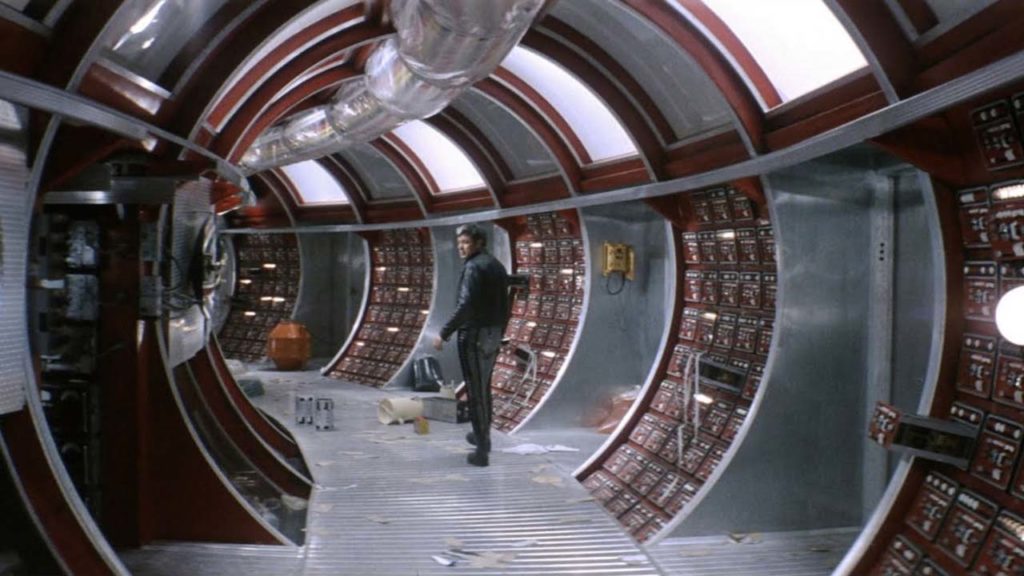
    Stanley Kubrick’s 2001: A Space Odyssey had arrived only a few years before Solaris, and was by a long shot the most serious stab at intellectual, literary science fiction cinema yet filmed. In his essay for the 2002 Criterion Collection DVD edition of Solaris, Phillip Lopate outlines three ways Tarkovky wished to distance his film from Kubrick’s. He found 2001: A Space Odyssey “cold and sterile,” and set out to infuse his own science fiction with “passionate human drama.” Unlike its predecessor’s gleaming high-technology, Tarkovsky built run-down and filthy sets for the space station, and found futuristic earthbound locations in the contemporary cars and architecture of Japan. Finally, Lopate points out that Solaris shares more themes with Alfred Hitchcock’s Vertigo than 2001, namely, “the inevitability of repeating past mistakes.”

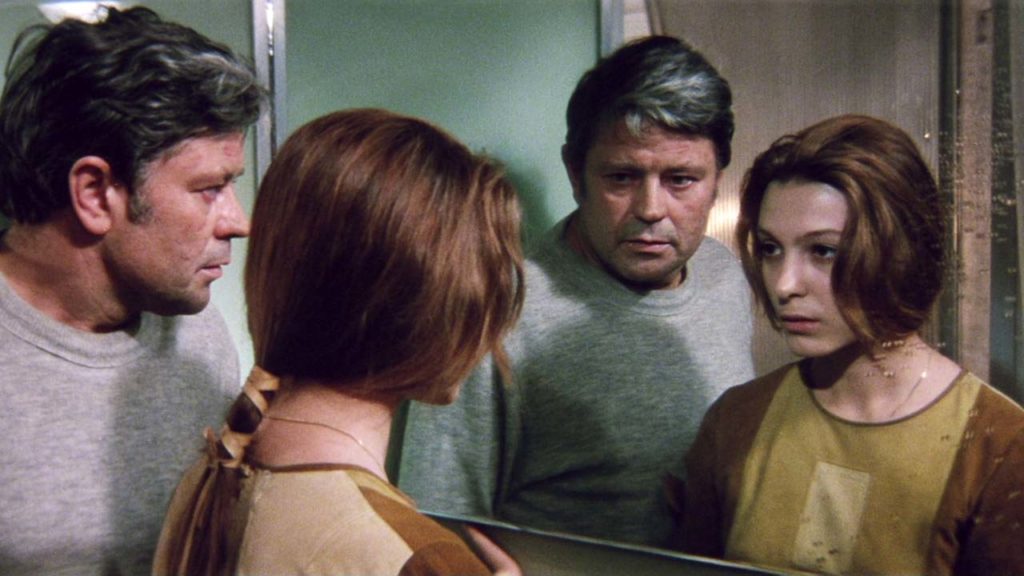
    Natalya Bondarchuk and Donatas Banionis in Solaris
    Kelvin sees dead people

    The links between the two films go beyond the thematic into the political; Solaris is frequently cited as the Soviet Union’s answer to 2001: A Space Odyssey, so it ought to be viewed in the context of the Cold War. 2001: A Space Odyssey preceded actual manned moon landings, the US’ most definitive victory in the space race. Kubrick’s visuals were so effective that they spawned the still-simmering rumor that the moon landings were falsified using footage directed by Kubrick. But before all this, 2001: A Space Odyssey must have seemed like a threat or promise made to the USSR: saying, in effect, that the US is going to be first in space and the first to make first contact with alien intelligence.

    So in this context, it’s hard not to interpret Solaris as at least partly a propaganda countershot. It too illustrates how the society of its makers and audience also have the brainpower and resources to extend their empire into space. But most unlike 2001: A Space Odyssey, Tarkovsky and co-writer Fridrikh Gorenshtein never allude to politics or even mention the names of other countries.

    Kubrick’s film envisions no end to the Cold War, even at least thirty years into the future. Kubrick’s vision of the future is actually a wicked satire, showing how little he expects humanity to evolve despite significant technological advances. His future humans still engage in petty squabbles and apocalyptic brinksmanship in the face of a potentially paradigm-shifting revelation: the discovery of definitive evidence of alien intelligence in a manufactured monolith buried on Earth’s moon. The US scientists and government officials investigating the monolith seem unmoved by the powerful notion of alien contact, and instead hold boring boardroom meetings and pose for photographs.

    In stark contrast, Tarkovsky’s Solaris has no sense of humor at all, about anything. Perhaps the most significant trait Solaris shares with Kubrick is a penchant for long takes. As Lopate also notes in his Criterion essay, atypically for a Russian filmmaker, Tarkovsky favored long takes over Eisensteinian montage.

    Donatas Banionis in Solaris
    Kelvin inspects the ductwork

    In this vision of the future, the Soviet Union operates a scientific research station in orbit over the ocean planet Solaris. An entire school of study called Solaristics has sprung up around the study of the ocean’s peculiar properties. Astronaut Berton (Vladislav Dvorzhetsky) returns to Earth with controversial claims that the Solaris ocean somehow creates physical manifestations of landscapes and monstrous creatures on the planet’s fluid surface. Dr. Gibarian (Sos Sargsyan), still stationed at Solaris, sends for his old friend, psychiatrist Chris Kelvin (Donatas Banionis). Berton, haunted and prematurely aged by his experiences, visits Kelvin at his father’s home in an attempt to warn him about what he is surely to experience, but Kelvin rudely dismisses him. We later learn the source of Kelvin’s misanthropy: his wife Hari (Natalya Bondarchuk) committed suicide after he left her some years before.

    Kelvin arrives at Solaris to discover that Gibarian has already committed suicide. The strange manifestations Berton reported on the Solaris oceans are also occurring on board. Every surviving scientist still aboard the space station is haunted by “guests,” their euphemism for the apparitions that, as best they can determine, are somehow culled from their most emotionally intense memories. In due course, Kelvin’s dead wife reincarnates in a confused, partially-formed state. She is dazed and doesn’t quite understand who she is or why she is there, and doesn’t “remember” that she is dead. When she tries to undress, she discovers her dress is completely sewn shut; Kelvin’s imperfect memories of her apparently don’t include buttons ‘n’ zips. Kelvin also experiences feverish nightmares in which he confuses Hari with his long-dead mother.

    Natalya Bondarchuk in Solaris
    The twice-doomed Hari (Natalya Bondarchuk)

    In a kind of filmed suicide note, Gibarian tells Kelvin the manifestations have “something to do with conscience,” indicating that the common origin of every guest is that they are each the primary object of guilt in an individual’s mind. Gibarian asks Kelvin “did you see her yet?” suggesting that he sent for him because he correctly predicted Kelvin’s guest would be his dead wife Hari. The presence of Gibarian’s guest (a little girl) was evidently for him an intolerable curse, but perhaps he imagines it would be a gift for Kelvin to have Hari back. But the whole situation begs the question: if the authorities know about the manifestations, why would they agree to send such a psychologically damaged man as Kelvin?

    When Kelvin attempts to leave Hari alone in his quarters, the not-quite-human creature manages to smash through the doorway in pursuit. She instinctively doesn’t want to be left alone, but can’t explain why. A suitable science fiction explanation might be that she somehow senses that she may literally dematerialize when Kelvin’s brain is not within proximity. Or her newly-formed mind may be suffering echoes of what the “real” Hari felt when she committed suicide after Kelvin left her. What if Kelvin becomes comfortable living with this reincarnation of Hari, and his guilt for the original woman’s death lessens… will her reincarnation then disappear?

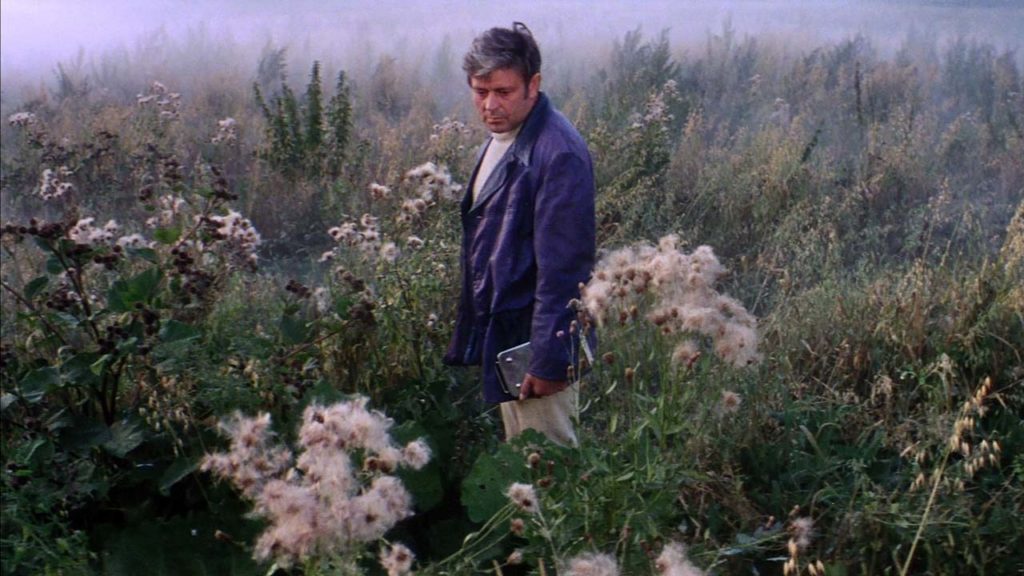
    Donatas Banionis in Solaris
    Kelvin at home in Mother Russia

    An observation: like Lindsay Anderson’s If…, Solaris uses a mixture of black & white and color film. For most of the first hour, black & white footage initially signifies either film clips or teleconferencing (note that the film correctly predicts widescreen HDTV monitors and webconferencing in the future). But later sequences appear in black and white, without internal justification: first as Berton drives dejectedly back into the city (filmed in the city landscapes of Japan), and later as Kelvin locks himself in his cabin on Solaris. To confuse the matter still further, Kelvin brings a home movie with him from Earth, which is in color! I don’t have a theory to explain these logical discrepancies; I’m just pointing them out.

    I’m surprised to find to find that I did not like the film as much as my first viewing almost a decade ago. Solaris is as talky and overwritten as its ostensible model 2001: A Space Odyssey is elegantly quiet. Totally self-serious and humorless, its three-hour running time is frankly a little trying on the patience. In his 1977 appreciation of the film reprinted in the Criterion edition booklet, Akira Kurosawa reports he was stunned by the expense when he visited the set, equivalent to 600,000,000 yen at the time.

    But he defends the significant length of the early scenes set on Earth, which he interprets to be intended to instill nostalgia for Kelvin leaving nature behind forever. Indeed, the time spent on Earth in the early parts of the film does prefigure a significant homecoming at the end, when Kelvin seems to return to a dreamlike vision of his father’s house. The formerly lush and moving natural scenery landscape is now wasted and frostbit. It rains inside as well as out, suggesting a kind of baptism or rebirth in the waters of Solaris.


    Must Read: Solaris by Phillip Lopate

    Must Read: the Organic Mechanic review by Adam Harvey

  • Sigur Rós Comes Home to Iceland in Heima

    Sigur Rós Comes Home to Iceland in Heima

    Dean DeBlois’ documentary film Heima (meaning “coming home” or “at home”) follows the band Sigur Rós on their summer 2006 tour of their home country Iceland. The tour consisted of mostly free, unannounced concerts, and with the band in three basic configurations spanning the continuum of the purely acoustic to the fully electric. The four core members Jónsi Birgisson, Georg Hólm, Kjartan “Kjarri” Sveinsson, and Orri Páll Dýrason perform several acoustic songs just for the camera. The extended band (including string ensemble Amiina) is also seen performing outdoors, fully Sigur Rósunplugged, at a concert protesting an environmentally destructive dam to be built by the Icelandic government. Finally, in contrast, we also see the full band in indoor concerts with dramatic lighting and video effects.

    Sigur Rós Heima
    Sigur Rós live in concert

    Many Sigur Rós songs are sung in an invented language called Vonlenska (“Hopelandic”), adding to the universality and international appeal of their music. For the uninitiated, Sigur Rós are a key representative of the musical genre “post-rock,” which generally refers to highly evocative, cinematic, largely instrumental music sometimes compared to movie soundtrack composition. Other notable bands working in roughly the same idiom include Mogwai, Explosions in the Sky, and Múm. In my opinion, you can trace the genre’s heritage back to the progressive rock of Yes and King Crimson.

    Sigur Rós Heima
    Sigur Rós live in concert

    Interview clips and stunning landscape images punctuate the film, making it almost as much about Iceland itself as the band. The most incongruous clip is from the avant-garde band’s unlikely appearance on the Late Late Show with Craig Kilborn. They discuss being unprepared for the business side of a career in music (lawyers, contracts, etc.), but understand that they have to think of the future.

    The second disc of the two DVD set features full uninterrupted performances, but with no two songs played in sequence, let alone a full concert. The fragmentation of both the main documentary film and the supplementary features is mildly disappointing. However, the band has plans for a full concert film directed by Vincent Morisset.

  • There’s Nothing Pretty: Grant Gee’s Joy Division

    There’s Nothing Pretty: Grant Gee’s Joy Division

    Grant Gee’s documentary Joy Division covers the all-too-brief history of the eponymous post-punk band from Manchester. Joy Division was tragically short-lived, only completing two albums before lead singer Ian Curtis’ suicide in 1980, but disproportionately influential. Their sound is all over the early U2 albums Boy and October, and Interpol has made a career of emulating Joy Division’s sound.

    Gee sets the scene of late 1970s Manchester as a grimy hellhole in which “there’s nothing pretty.” The core members of the band are perversely inspired by a Sex Pistols concert (their review: “shite, a car crash”) to form their own band. Photographer and filmmaker Anton Corbijn took some of the most memorable portraits of the band. Used to Holland’s health care system, he was shocked to see such poverty in England. He describes Joy Division as undernourished and shivering in their thin coats.

    Joy Division
    Joy Division

    Gee also interviews Peter Saville, the graphic designer that created the remarkably stark album sleeves that were almost as influential as the music itself. Tony Wilson (a colorful character who was the subject of Michael Winterbottom’s fantastic biopic 24 Hour Party People) was an early champion, in between his duties as host of the TV show “So It Goes” and Factory Records impresario. Curtis’ widow Deborah does not seem to have participated, but her side of the story appears in the excellent biopic Control, co-produced by her and directed by Corbijn.

    Ian Curtis of Joy Division
    Ian Curtis of Joy Division

    Curtis is described as a regular lad who frequently bought flowers for his wife. In other words, the opposite of punk. But he’s also characterized as “bipolar,” moody and unpredictable even before his epilepsy manifested itself in frequent, dramatic grand mal seizures. His singular stage presence was marked by a peculiar form of dance inspired by his seizures (that he sometimes actually did experience on stage). The necessary drug treatments caused huge mood swings, further compromising his already unsteady mental health. Curtis continued his day job assisting disabled people for the Civil Service even as the band was taking off. In a heartbreaking bit of synchronicity, his classic song “She’s Lost Control” is about an epileptic girl he met though his work.

    Grant Gee’s clear expertise is musical documentary. His 1998 film Meeting People is Easy famously captures Radiohead breaking through to mass popularity as their 1998 album OK Computer is universally declared the album of the year. The frank film shows emotionally fragile Thom Yorke almost physically recoiling from fame, but receiving wise counsel from mentor Michael Stipe of R.E.M. Gee also co-directed the excellent 2005 Gorillaz concert film Demon Days Live at the Manchester Opera House, better even than the studio album that preceded it. Both films have permanent spots on the DVD shelf.

  • Daniel Lanois Maximizes the Room in Here Is What Is

    Daniel Lanois Maximizes the Room in Here Is What Is

    Daniel Lanois is a unique musician, as gifted a singer-songwriter in his own right as he is a collaborator and producer. I originally came to recognize his name after finding it listed in the credits of many key items in my music collection, including Peter Gabriel’s So and Us, U2’s The Joshua Tree and Achtung Baby, and Bob Dylan’s Oh Mercy and Time Out of Mind. His 1993 solo album For the Beauty of Wynona remains an all-time personal favorite.

    The feature documentary Here Is What Is premiered at the Toronto Film Festival in 2007, directed by Lanois, Adam Samuels, and Adam Vollick. It captures the recording of the album of the same name, but also serves as a kind of retrospective and mission statement. Conversations between Lanois and early mentor (now equal) Brian Eno punctuate the film. Lanois states to Eno his intentions for the movie: to create a film about the beauty of music, not everything that surrounds it (which I took to mean hagiography, celebrity gossip, and the sometimes tedious behind-the-sceens documentation typical of the genre). Eno suggests that his film should try to show people that art often grows out of nothing, or from the simplest of seeds in the right situations, not from what outsiders might assume are the miraculous inspirations of allegedly brilliant or gifted artistes.

    Daniel Lanois and Brian Eno in Here Is What Is
    Daniel Lanois and Brian Eno recording their new ambient masterwork, “Music for Staircases”

    Lanois is Canadian by birth, but has a special affinity for the American South, especially New Orleans. He credits New Orleans for the original sensual groove that formed the basis of rock music. Perhaps intended as a visual echo of this theory, the stunningly beautiful Carolina Cerisola often appears dancing in her scanties.

    Lanois details his longtime, fruitful collaboration with drummer Brian Blade. Legendary keyboardist of The Band, Garth Hudson, also joins them in the studio for some truly awesome performances. One of my favorite sequences intercuts between “The Maker” performed by Lanois’ band live in studio, covered by Willie Nelson and Emmylou Harris, and Lanois’ band live on stage. Billy Bob Thornton, still friends from collaborating on the score to Sling Blade in 1996, drops in for a visit. We catch exciting glimpses of recording U2’s forthcoming album (since christened No Line on the Horizon, to be released in February 2009) with Eno and Steve Lillywhite.

    Daniel Lanois in Here Is What Is
    Which button dials down Bono’s ego?

    Lanois names a primarily influence to be the Jimi Hendrix Experience, which he describes as a fairly straightforward rock trio but with ambitious, experimental production. He describes how he himself approaches production, in just one word: “feel.” He reportedly had a contentious relationship with Dylan in the studio, but the resultant albums are classics, and Dylan affirmed that “you can’t buy ‘feel.’” Another Lanois aphorism, “maximize the room,” means to make the most of what you have, rather than invite guest musicians or order up more equipment.

    Here Is What Is features full performances of songs, which is especially welcome compared to two recent music documentaries recently screened by this blog: Low in Europe and You May Need a Murderer, which both shy away from actually showing Low perform. Here Is What Is‘s visuals are sometimes compromised with cheesy video effects. The film is at its best when simply following the hypnotic movements of Lanois’ hands on his pedal steel guitar.

  • Hancock begs to be read as a metaphor, but for what?

    Hancock begs to be read as a metaphor, but for what?

    Peter Berg’s Hancock refreshingly begins in the middle, bypassing the superhero genre’s now-standard structure. But that leaves a great deal of mythology to relate later, especially for a story not based on an already well-known household name like Spider-Man or Batman. But like most superhero movies, it neatly lays groundwork for potential sequels and prequels.

    Will Smith and Charlize Theron play estranged exes, who also happen to be thousands-year-old creatures that are mortal when paired — which begs to be read as some kind of metaphor, but for what? Mary (Theron) is married to a mortal (Jason Bateman), but how does an unemployed P.R. guy afford a gigantic house in L.A.? How did he get his great reputation if he’s unemployed?

    Even when you learn Mary’s back story, her behavior doesn’t make sense. A gross, unfunny sex scene opens a pandora’s box of plot holes: how do they have sex with humans? Not to mention give birth? Is a half-mortal child also superhuman? How did Mary plan on explaining her agelessness to her husband and child? One of them was on the scene as recently as 80 years ago, so why have none of these creatures ever been heard from before, throughout history?

    Will Smith and Charlize Theron in Hancock
    If these two crazy kids can’t make it work, who can?

    Hancock is shot in a notably expressive handheld camera style, and features special effects by John Dykstra (of The Matrix and Speed Racer fame). The DVD bonus features reveal many effects and stunts were done practically. Co-producer Michael Mann has a cameo appearance, and was attached to direct as some point, and the idea of a Mann superhero flick is truly something to imagine.

    A few extra observations on the cast:

    • Casting a major movie star like Charlize Theron in what seems at first to be a small role is a kind of spoiler, but that spoiler is itself spoiled in a fleeting shot included in the trailer.
    • Jason Bateman’s characteristic dry, wry sense of humor is a big asset here, but he doesn’t seem to emote during scenes in which his character’s wife is dying.
    • Eddie Marsan can easily pivot from Mike Leigh’s Vera Drake, to Alejandro González Iñárritu’s 21 Grams, to Michael Mann’s Miami Vice, proving he must be one of the most versatile actors working.
  • Jeff Bridges battles the elements in Ridley Scott’s White Squall

    Jeff Bridges battles the elements in Ridley Scott’s White Squall

    By 1996, Ridley Scott had worked in almost every typical feature film genre: most notably historical drama (The Duellists, 1492), science fiction (Alien, Blade Runner), and police thrillers (Someone to Watch Over Me, Black Rain). But White Squall straddles several genres, sometimes all at once: coming-of-age melodrama, adventure, courtroom drama, and disaster on the high seas (like later peers Titanic and The Perfect Storm).

    Aside from the rare exception of the fantasy Legend, Scott’s films are always about adults. But White Squall features teenage characters and is relatively mild in terms of violence, profanity, and sex (there’s no bloody gunplay or slimy extraterrestrials here). The frequently shirtless young male cast, including star-to-be Ryan Phillippe, provided lots of beefcake that probably attracted a large teenage girl audience at the time. But the core of the story is still about male bonding, duty, and honor, placing it somewhat outside the bounds of a chick flick.

    White Squall
    The Albatross boys enact The Lord of the Thighs (and torsos)

    It’s also unusual in Scott’s oeuvre for being based on actual events. The screenplay by Todd Robinson is based on the nonfiction book The Last Voyage of the Albatross by Charles Gieg Jr. and Felix Sutton. In the 1950s, Captain Christopher “Skipper” Sheldon (Jeff Bridges) and his wife Alice (Caroline Goodall), a doctor, ran a series of boating excursions on the Caribbean Seas for young men. The trips, for school credit, provided a kind of high seas liberal education focusing on self-reliance, teamwork, and literature. An onboard English Literature teacher (John Savage, who resembles Ridley Scott) was always on hand to be generally annoying and pompously spout quotations. Unbeknownst to the boys’ parents, Sheldon’s concept of liberal education also included shore leave with abundant alcohol and the opportunity to meet hot young female exchange students the boys would never have to see again. This was a quaint time when sexually transmitted diseases were more of a rite of growing up than a life-threatening risk.

    Jeff Bridges in White Squall
    Jeff Bridges pleads, “This aggression will not stand, man!” Alternately, the mast really held the boat together.

    The physical task of operating the boat could be seriously dangerous, but one particular trip in 1960 became especially so in more ways than one. The Cuban Missile Crisis erupted while they were out to sea, and they were boarded by militant Cubans. After a narrow escape allowed as much by chance as by Sheldon’s quick thinking, they encounter an even bigger problem: dealing with a spoiled rich kid (I can’t figure out the actor’s name, but he looks for all the world just like Cillian Murphy). The seemingly cursed voyage ends in a mythical “white squall,” a freak weather event in which a sudden windstorm appears without the traditional warning signs such as dark clouds. The voyage ends in utter tragedy, and segues into a courtroom drama bogged down by speechifying.

    The end titles reveal that Sheldon overcame his personal grief and professional discredit to become the first Peace Corps Director in Latin America, before dying in 2002.